


Budget meetings for hardware projects often end with a directive to "slash twenty percent" without reducing the feature set. When staring at a quote for fifty polyurethane prototypes, the sticker price can feel immovable. However, the price of a vacuum casting project is not fixed; it is a direct reflection of your design's complexity and your ordering strategy. Most engineers unknowingly inflate their own coût de moulage sous vide by requesting unnecessary cosmetic finishes, ignoring the lifespan limits of silicone tooling, or designing features that require hours of manual mold surgery. Reducing this cost does not require switching to a cheaper, inferior vendor. It requires applying "Financial DFM" (Design for Manufacturing). By understanding the physical limitations of the casting process, you can make minor adjustments to your CAD file and your procurement schedule that instantly strip away wasted capital. Here are five proven strategies to lower your invoice while keeping the quality high.
Strategy 1: The 'Bring Your Own Master' Approach
Strategy 2: The "20-Shot" Ordering Rule
Strategy 3: Eliminating Expensive Undercuts
Strategy 4: Standardizing Cosmetic Requirements
JUCHENG Advisory: We Engineer the Savings
Strategy 1: The 'Bring Your Own Master' Approach
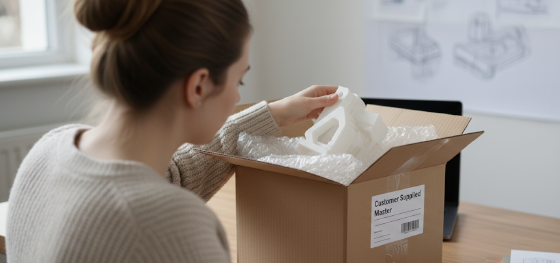
A significant portion of your NRE (Non-Recurring Engineering) fee goes toward creating the master pattern. If your facility already owns a high-resolution SLA 3D printer (like a Formlabs or 3D Systems machine), you are sitting on a cost-saving asset. Instead of paying Jucheng Precision to CNC machine or print the master, you can fabricate it yourself.
This requires strict discipline. The master you ship to us must be polished to the exact surface finish you desire on the final parts, as the silicone will copy every layer line you fail to sand. However, if you have the internal labor to prep the part, shipping us a "Ready-to-Pour" master can instantly shave $200 to $500 off your total project cost. This is the single most effective way to learn how to reduce vacuum casting cost without altering the design itself.
Strategy 2: The "20-Shot" Ordering Rule
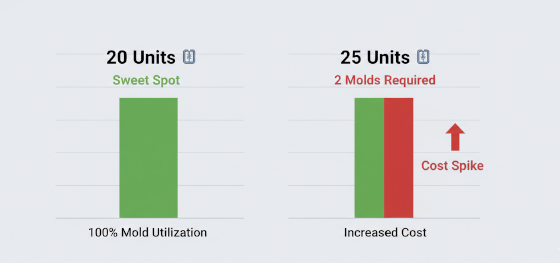
Silicone molds have a biological clock. A standard mold is viable for approximately 20 to 25 shots before the surface degrades. Understanding this lifespan allows you to game the system. If you order 25 parts, you are maximizing the utility of a single mold. Your amortization is perfect.
However, if you order 30 parts, you trigger a financial penalty. That extra 5 parts forces us to build a *second* silicone mold, which we will only use for 5 shots before discarding. You are paying full price for a tool that is 80% wasted. Smart procurement managers align their quantities with the mold life. If you need 30, consider ordering 25 now and waiting, or pushing the order to 50 to justify the second mold. Always ask your JUCHENG engineer: "What is the max shot count for this geometry?" and adjust your PO quantity to match that number exactly.
Strategy 3: Eliminating Expensive Undercuts
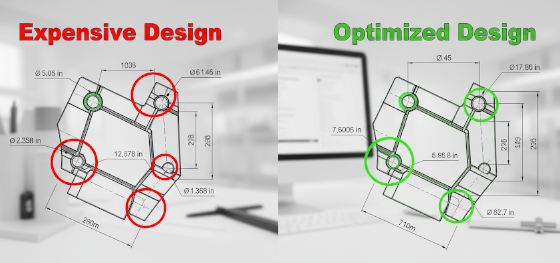
Complexity is billable hours. In silicone molding, deep undercuts and side-actions require the mold maker to hand-cut complex, zigzagging parting lines or create loose cores that must be manually inserted for every cycle. This increases the labor time for demolding from five minutes to twenty minutes, drastically raising the unit price.
Review your CAD file for "Lazy Geometry." Can that side-hole be moved to the top face? Can that deep snap-fit be redesigned as a simple rib? By modifying the design to allow for a simple "Open-and-Shut" mold pull, you eliminate hours of skilled manual labor. Simplification does not mean making the part look cheap; it means making the part smart. A simpler mold is a cheaper mold, and often a more durable one.
Strategy 4: Standardizing Cosmetic Requirements
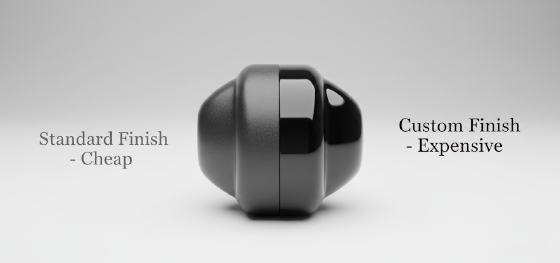
La sur-spécification est un tueur de budget. Les ingénieurs copient souvent-collent "Brillance SPI A2" ou "Texture VDI 34" sur chaque surface du dessin, y compris les nervures internes et les bossages de montage cachés. Obtenir une brillance élevée nécessite des heures de polissage manuel du modèle maître. Obtenir une texture spécifique nécessite un sablage ou l'application de peaux de moule technologiques coûteuses.
Soyez impitoyable avec vos annotations cosmétiques. Marquez toutes les surfaces internes non visibles comme "Brut de coulée" ou "Finition d'usinage standard." Ne payez pour une finition premium que sur les surfaces "Côté A" que le client touchera et verra réellement. De plus, à moins qu'une couleur Pantone spécifique ne soit critique pour l'identité de la marque, choisir une résine standard "Noire" ou "Naturelle" élimine le travail de correspondance des couleurs et de peinture, réduisant votre coût unitaire de 10 à 15 %.
JUCHENG Advisory: We Engineer the Savings
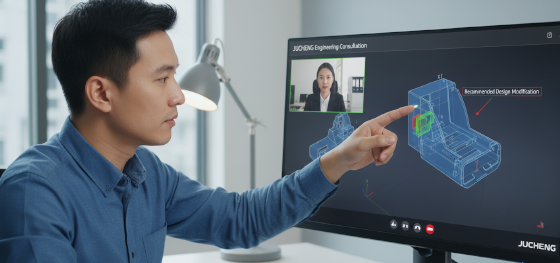
Nous ne nous contentons pas de deviser vos fichiers ; nous les interrogeons. Lorsque vous téléchargez un design chez Jucheng Precision, notre équipe d'ingénierie cherche activement des opportunités de vous faire économiser de l'argent. Nous signalerons la contre-dépouille qui vous coûte 1 200 $ de plus. Nous vous alerterons que votre quantité de 26 est inefficace. Nous agissons en tant que vos consultants en fabrication, vous aidant à éliminer le superflu de votre projet sans couper dans le muscle de votre intention de conception. Téléchargez vos fichiers dès aujourd'hui pour une revue DFM gratuite, et laissez-nous vous montrer à quel point le prototypage haute fidélité peut être abordable.

