


Un trou n'est jamais qu'un simple trou dans le monde de la fabrication de précision. C'est une interface fonctionnelle qui définit l'âme d'un assemblage mécanique. Si vous concevez une pièce où un arbre doit glisser sans frottement ou un roulement doit s'ajuster par pression avec une certitude au micron près, la simplicité trompeuse d'une ouverture circulaire devient votre plus grand défi technique. La plupart des concepteurs commencent par demander un trou, mais un machiniste expérimenté chez Jucheng Precision commence par poser des questions sur la tolérance. Cette question fondamentale nous mène directement au carrefour technique du perçage vs alésage vs alésage de finition.
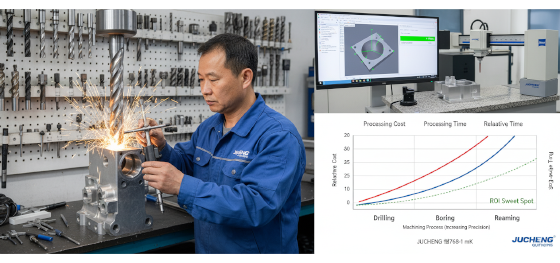
Dans le contexte plus large du processus d'usinage CNC, la création d'un diamètre intérieur est une évolution en plusieurs étapes. Vous ne pouvez pas passer directement à un alésage H7 poli miroir sans suivre un chemin discipliné d'enlèvement de matière. Chaque étape de cette trilogie — perçage, alésage et alésage de finition — sert un objectif structurel spécifique : le premier crée l'espace, le second définit la géométrie et le troisième verrouille la dimension. Ce guide explore les nuances mécaniques de ces trois piliers, vous aidant à comprendre quand accepter l'économie d'un foret et quand exiger la précision chirurgicale d'un alésoir.
L'efficacité de la production réside dans l'équilibre de ces opérations. Sur-ingénierie d'un trou entraîne un gaspillage budgétaire, tandis qu'une sous-ingénierie conduit à une défaillance catastrophique de l'assemblage. Examinons les fondements techniques de la création de trous et comment JUCHENG traduit ces processus en ajustements mécaniques parfaits.
contenu :
Percage : La naissance violente d'une ouverture
Alésage : Correction du chemin géométrique
Alésage de finition : La finition chirurgicale pour les ajustements serrés
Le paradoxe de la précision : Équilibrer précision et retour sur investissement
Métrologie de JUCHENG : Vérification par MMT
Percage : La naissance violente d'une ouverture
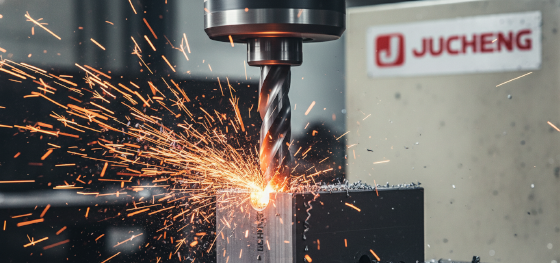
Dans la séquence du perçage vs alésage vs alésage de finition, le perçage est toujours la première étape. C'est une opération à haute énergie et haute force conçue pour une seule chose : l'enlèvement rapide de matière. Un foret hélicoïdal standard comporte deux arêtes de coupe qui convergent en un point. Lorsque la broche entraîne cet outil dans le métal, il crée un trou à partir d'une pièce pleine. Cependant, le perçage est intrinsèquement imprécis. Parce que le foret est long et relativement flexible, il est sujet au "déplacement" ou à la dérive lorsqu'il pénètre dans le matériau. Le trou résultant est rarement parfaitement droit et souvent légèrement surdimensionné en raison des vibrations des cannelures de coupe.
Furthermore, the surface finish of a drilled hole is rough, typically ranging from Ra 3.2 to 6.3 µm. This is acceptable for a clearance hole for a bolt, but it is a disaster for a bearing seat. The exit of a drilled hole often features a heavy burr because the tool "pops" through the final layer of metal. At Jucheng Precision, we use high-performance carbide drills with through-spindle coolant to minimize these issues, but we never rely on a drill for a precision fit. We view drilling as the "roughing" phase—it creates the vacancy that we will later refine. If your part only requires a simple hole with a +/- 0.2mm tolerance, drilling is the most cost-effective path. But if the physics of your assembly demand more, the drill is just the beginning of the journey.
Alésage : Correction du chemin géométrique
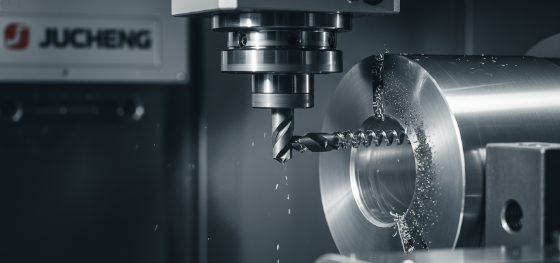
If drilling is the blunt instrument, boring is the corrective lens. In the perçage vs alésage vs alésage de finition hierarchy, boring is the process used to enlarge an existing hole while correcting its geometric center. Unlike a drill, which follows its own point, a boring bar is a single-point cutting tool that behaves like an internal lathe. Because the tool is offset from the spindle center, it carves a path that is perfectly concentric with the machine's axis of rotation. If a pre-drilled hole has wandered by 0.1mm, a boring operation will bring it back to the true position.
The primary value of boring is geometric truth. It ensures the hole is perfectly round and perfectly straight. This is vital for long internal bores in the processus d'usinage CNC, where any taper would cause a shaft to bind. At Jucheng Precision, we utilize digital boring heads that can be adjusted in increments of 0.002mm. This allow us to hit precise diameters that standard drills simply cannot achieve. Boring also improves the surface finish significantly over drilling, reaching an Ra 1.6 µm range. It is the mandatory step for any part that features a heavy press-fit or a complex internal step that must be perfectly aligned with an outer diameter. We treat boring as the bridge between raw creation and surgical refinement, ensuring that the "location" of your hole is as accurate as its size.
Alésage de finition : La finition chirurgicale pour les ajustements serrés
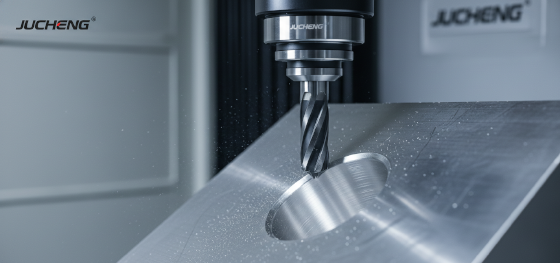
The final tier of the perçage vs alésage vs alésage de finition trilogy is reaming. If boring defines the position, reaming defines the perfection. A reamer is a multi-edged finishing tool designed to remove a very small amount of material—typically between 0.1mm and 0.3mm from the diameter. Because it has multiple straight or helical flutes, it provides a highly stable cutting action that produces an incredibly smooth surface finish, often Ra 0.8 µm or better. This is the process JUCHENG uses to achieve H7 or H8 tolerances, where the allowable margin of error is thinner than a human hair.
However, reaming has a critical limitation: it cannot correct the position of a hole. A reamer will follow the path of the existing bore. This is why the sequence is so important. If you ream a hole that was poorly drilled without boring it first, you will end up with a smooth, perfectly sized hole that is in the wrong place. At Jucheng Precision, we combine these technologies into a seamless workflow. We drill to create the void, bore to ensure the location and straightness, and finally ream to lock in the final, mirror-finished diameter. This three-stage protocol is how we deliver medical-grade components that require an exact sliding fit. Reaming is the surgical strike of the machining world—it is fast, predictable, and delivers the consistent sizing needed for high-volume precision assembly.
Le paradoxe de la précision : Équilibrer précision et retour sur investissement
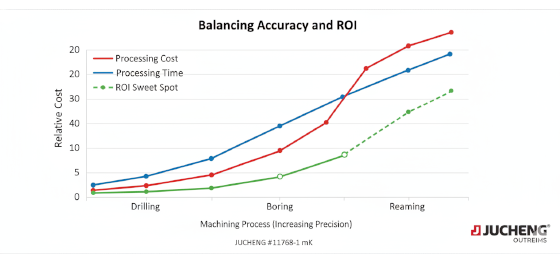
Choisir entre perçage vs alésage vs alésage de finition is ultimately an economic decision based on the physics of your design. Every additional step in the hole-making process adds cycle time and tooling cost. A drilled hole is the cheapest; a reamed hole is the most expensive. The "Accuracy Paradox" in manufacturing is that 90% of a part's cost can be driven by the final 10% of its tolerance requirements.
During our DFM (Design for Manufacturing) reviews, JUCHENG engineers look for opportunities to optimize this balance. If a part is a simple structural bracket, we suggest staying with drilling to save you money. But if the part is a high-speed rotating housing, we mandate the boring and reaming sequence to ensure safety and performance. We also utilize modern "Interpolation Milling" as a flexible alternative to boring for large diameters, using our high-speed 5-axis machines to spiral a mill into a hole with extreme precision. This technical flexibility allows us to offer the most cost-effective path to your desired quality. By understanding the diminishing returns of precision, we help you invest your budget where it actually impacts the function of your product.
Métrologie de JUCHENG : Vérification par MMT
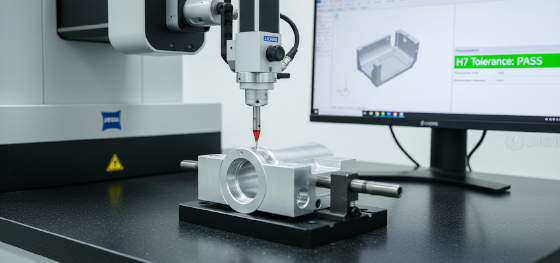
The final hallmark of a professional processus d'usinage CNC is the ability to prove that the hole meets the print. You cannot verify an H7 tolerance with a visual check. At Jucheng Precision, every precision bore we manufacture undergoes a rigorous inspection cycle. We utilize digitized inner-diameter micrometers for real-time shop floor checks, and for final validation, we use our Zeiss and Hexagon Coordinate Measuring Machines (CMM).
Our CMM probes take hundreds of points inside a hole to generate a 3D map of its circularity, cylindricity, and position. We provide our clients with detailed inspection reports that guarantee every perçage vs alésage vs alésage de finition operation was executed to perfection. This transparency is vital for medical devices and aerospace assemblies where a single out-of-spec hole could lead to system failure. When you partner with JUCHENG, you aren't just buying a part; you are buying the engineering certainty that your components will assemble flawlessly every time. Don't leave your critical fits to a shop that only knows how to drill. Trust the specialists who understand the entire precision hierarchy. Contact Jucheng Precision today for a technical review of your next precision project.

