


Designing custom enclosures, robotic chassis, or medical device carts is a process of balancing complex spatial constraints. Specifying custom fabricated sheet metal assemblies provides your hardware with the exact physical envelope, thermal ventilation arrays, and structural mounting coordinates required to house delicate electronic systems safely. This advanced mechanical integration represents a critical milestone in custom sheet metal fabrication, directly determining whether your product launch remains highly profitable or stalls under heavy development costs.
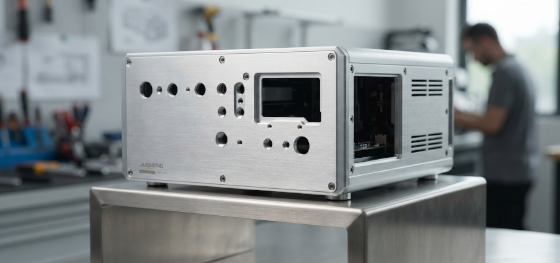
Suffer from standard, off-the-shelf plastic or metal boxes that fail to protect your internal components from liquid splashes, environmental dust, or electromagnetic noise? Forcing your high-value PCBs into rigid standard enclosures requires tedious, manual modifications that slow down assembly speeds and compromise aesthetic value. Moving to a tailored, cold-worked sheet metal strategy provides complete design freedom, ensuring that your external housing integrates seamlessly with your internal electrical components.
Let's explore why standard catalog enclosures fall short in modern applications, explore how rapid prototyping allows you to test geometries quickly, and review the structural advantages of combining exotic materials under one roof.
Why Standard Enclosures Don't Always Work
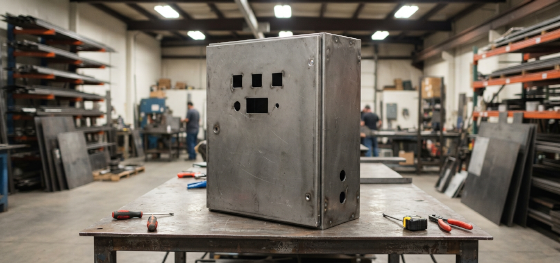
What are the primary functional limitations of standard, off-the-shelf electronic enclosures?
Standard enclosures lack material-specific electromagnetic shielding, custom thermal venting slots, and direct PCB mounting standoff holes, requiring expensive secondary machining.
While purchasing ready-made plastic or steel boxes is cheap for hobbyist builds, they present massive bottlenecks for commercial hardware projects. Standard enclosures rarely align with your specific port locations, forcing engineers to run secondary milling operations to create connector cutouts. This double-handling slows down your lead times and introduces high risk of cosmetic scratching.
Additionally, standard enclosures cannot provide integrated thermal management. High-power components inside the cabinet produce thermal energy that must be dissipated to prevent processor throttling. Custom assemblies allow you to design downward-oriented louver vents or high-density perforated patterns directly into the sheet panels, establishing active air-intake pathways that protect internal systems.
Prototyping Your Custom Assembly Design
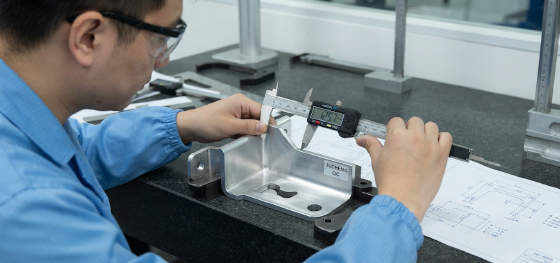
How do product developers validate custom multi-panel assemblies before mass production?
Nous exécutons un prototypage rapide piloté par logiciel pour découper des flans plats et plier des brides sans outillage sur mesure coûteux, ce qui permet des ajustements géométriques immédiats.
Before committing significant capital to mass production, validating your physical part geometry on physical test units is essential. Our prototypage rapide cellule utilise des lasers à fibre de haute puissance et des presses plieuses CNC pour découper et plier des pièces sur mesure directement à partir de vos profils CAO. Ce processus piloté par logiciel évite le besoin de matrices d'emboutissage sur mesure, ce qui maintient des coûts de test initiaux exceptionnellement bas.
This hands-on prototyping phase allows designers to verify actual material behavior, check for flange-to-edge clearances, and run physical fitment tests. If a mounting hole is misaligned by a fraction of a millimeter, we can correct the digital flat pattern instantly. This iterative loop ensures that your parts are fully optimized for fabrication en faible volume, transitioning seamlessly from prototypes to production-ready hardware.
Working with Exotic Materials and Complex Geometries

What metallurgical challenges arise when joining exotic materials like copper and titanium?
Exotic metals exhibit extreme optical reflectivity and high thermal conductivity, requiring advanced fiber lasers for cutting and certified inert-gas welding to prevent structural brittleness.
Integrating exotic materials into your product assemblies provides elite levels of performance. For high-voltage power distribution blocks, we process high-purity le cuivre busbars to maximize electrical conductivity; for aerospace frameworks, we fabricate lightweight titanium brackets to achieve an ultimate strength-to-weight ratio.
However, processing these metals requires advanced equipment. Reflected laser beams from copper can burn out standard CO2 lasers, so we utilize high-power fiber lasers to slice highly reflective metals safely. Furthermore, titanium absorbs atmospheric oxygen at high welding temperatures, causing extreme embrittlement. We execute TIG welding under pure argon gas trailing shields, ensuring that your joined panels remain structurally solid and ready for environmental service.
Bring Your Custom CAD Designs to Jucheng Precision

How does Jucheng Precision support custom projects from initial drawings to final assembly?
Nous exploitons des lasers à fibre de haute puissance, des presses plieuses CNC avancées et des postes d'assemblage automatisés sous un système qualité unifié, en vérifiant toutes les tolérances.
L'intégration de ces étapes de protection préparatoires, de pliages précis et de configurations de joint dans votre cycle conception de tôle cycle is the single most effective way to eliminate assembly bottlenecks. Jucheng Precision houses these advanced automated benders, laser cutters, and assembly lines inside our 8000-square-meter facility, ensuring that your custom fabricated sheet metal assemblies are cut, folded, painted, and completely integrated under one roof with extreme quality control.
Nous traitons une large gamme de matériaux, y compris l'aluminium léger, l'acier inoxydable à haute limite d'élasticité et l'acier au carbone facilement formable lors des cycles de fabrication de tôlerie de haute précision. Notre service technique fournit une analyse DFM gratuite sous 24 heures pour vérifier vos modèles CAO, en contrôlant les tolérances et les jeux de charnières avant la production. Soutenus par notre politique sans MOQ et notre garantie de livraison rapide, nous gérons votre projet depuis la découpe initiale du motif plat jusqu'au revêtement en poudre final de haute durabilité et à l'assemblage.
FAQ: Critical Questions About Custom Fabricated Sheet Metal Assemblies

Notre équipe d'ingénierie a compilé des solutions professionnelles aux défis de qualité et de coût les plus courants rencontrés par les développeurs de produits :
Can Jucheng Precision fabricate custom assemblies directly from our 3D CAD files?
Yes, absolutely. We accept direct 3D solid models in STEP, IGES, or DXF formats. Our automated DFM software parses your file to generate flat pattern unfolding profiles, calculating exact bend allowances and K-factors relative to our active press brakes to ensure flawless cutting and bending.How do you prevent galvanic corrosion when joining aluminum and stainless steel?
Galvanic corrosion occurs when two electrochemically different metals contact each other in a damp environment. To prevent this, we utilize zinc-plated fasteners, insert non-conductive nylon washers, or apply protective chemical conversion films to physically isolate the aluminum from the stainless steel.Why is a custom-designed assembly fixture critical for low-volume production?
Manual assembly is highly prone to positioning errors and cumulative tolerance stack-ups. Designing custom, high-precision assembly fixtures to physically clamp separate parts in place during riveting or welding ensures that every finished box-build matches your strict specifications with extreme repeatability.How does Jucheng Precision guarantee the structural integrity of custom fabricated sheet metal assemblies?
We operate an ISO 13485 and IATF 16949 certified facility, running advanced coordinate measuring machines (CMM) to inspect dimensional tolerances at multiple points. Our quality control team conducts full mechanical testing and visual audits, ensuring every custom enclosure assembly complies with your strict technical requirements.

