


Gérer les erreurs d'ajustement imprévues lors de l'assemblage final du matériel est un combat permanent pour les concepteurs de produits. Alors que votre modèle CAO 3D affiche une épaisseur de tôle nominale parfaitement uniforme de 2,0 mm, les tôles brutes réelles provenant de l'usine ne sont jamais complètement identiques. Comprendre les limites physiques de la tolérance d'épaisseur de tôle est une étape cruciale dans la fabrication de tôles sur mesure, déterminant directement si vos brides superposées se plient proprement ou se bloquent sous pression.

Se fier aux modèles CAO théoriques sans tenir compte des variations naturelles d'épaisseur de l'acier brut peut entraîner une dérive dimensionnelle catastrophique sur plusieurs pliages. Étant donné que les tôles brutes peuvent varier de cinq à dix pour cent selon le laminoir, les calculs de pliage standard échouent souvent. Concevoir vos pièces en tenant compte de ces variations physiques des matériaux est le meilleur moyen de garantir la qualité de votre produit.
Explorons les origines physiques des tolérances des laminoirs d'acier, analysons comment l'acier laminé à froid se compare aux variations de calibre de l'acier laminé à chaud, et examinons comment les écarts d'épaisseur amplifient directement les erreurs de pliage et d'assemblage.
Qu'est-ce que la tolérance de laminage dans la tôle ?
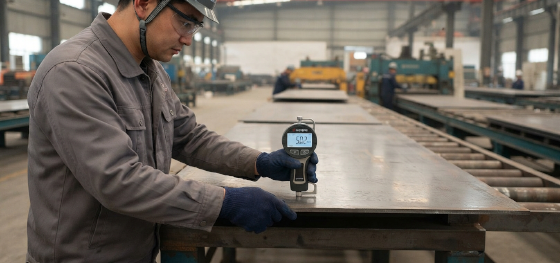
Pourquoi les tôles brutes varient-elles en épaisseur à la sortie du laminoir ?
Les laminoirs industriels traitent les plaques d'acier à travers des rouleaux de réduction lourds qui fléchissent inévitablement sous une pression immense, ce qui fait que le centre de la tôle reste légèrement plus épais que ses bords.
Lorsque les tôles brutes sont fabriquées, le laminoir doit gérer des forces extrêmes. Alors que les cylindres d'acier massifs compriment le métal chaud ou froid, le centre du rouleau subit une légère déflexion mécanique. Cette déflexion crée un effet de bombé, ce qui signifie qu'une plaque nominale de 2,0 mm présente en réalité une tolérance de laminage allant de 1,85 mm à 2,10 mm sur sa surface.
Ces variations physiques sont strictement réglementées par des normes internationales telles que l'ASTM A568. L'achat de matière première sans vérifier ces tolérances de laminage est un risque majeur pour l'ingénierie. Les concepteurs doivent tenir compte de ces variations dès la phase de conception initiale pour éviter des interférences d'assemblage inattendues.
Variations de calibre : acier laminé à froid vs acier laminé à chaud
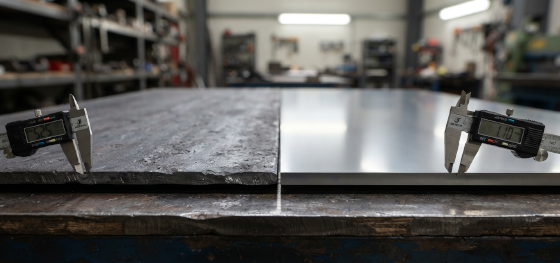
Comment les procédés de laminage à chaud et à froid affectent-ils la constance de l'épaisseur ?
Le laminage à froid est effectué à température ambiante pour offrir des tolérances d'épaisseur serrées et très constantes, tandis que le laminage à chaud est traité à des températures élevées, entraînant des fluctuations de calibre plus larges.
La méthode de fabrication spécifique utilisée pour laminer l'acier détermine fortement sa constance d'épaisseur. L'évaluation de la tolérance d'épaisseur de la tôle entre l'acier laminé à froid et l'acier laminé à chaud montre des caractéristiques de matériau distinctes. L'acier laminé à chaud standard est traité à des températures extrêmes, ce qui provoque un retrait inégal du métal lors du refroidissement et laisse une surface rugueuse couverte de calamine avec des variations de calibre plus larges. Cela rend l'acier laminé à chaud très rentable pour les supports lourds, mais peu pratique pour les boîtiers de précision.
À l'inverse, l'acier laminé à froid est traité à température ambiante par des cylindres de réduction à haute pression. Ce processus d'écrouissage offre une surface exceptionnellement lisse, des tolérances d'épaisseur précises (souvent à ±0,05 mm) et une limite d'élasticité supérieure. En sélectionnant des tôles SPCC laminées à froid plutôt que des tôles SPHC laminées à chaud, vous réduisez considérablement les fluctuations d'épaisseur brute, garantissant un comportement de formage constant.
Comment les tolérances d'épaisseur affectent le pliage et l'assemblage
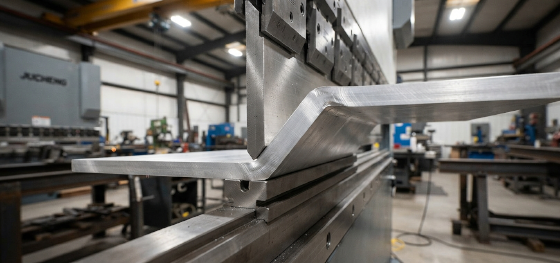
Comment une micro-variation de l'épaisseur de la tôle affecte-t-elle les angles de pliage et les mises à plat ?
Même un écart d'épaisseur de 0,1 mm modifie le facteur K et la tolérance de pliage, ce qui amène les plieuses automatiques à surplier ou sous-plier le métal.
Dans la fabrication de tôlerie sur mesure, un léger écart d'épaisseur peut causer un énorme casse-tête à l'opérateur de plieuse. Lorsque le flan est plié, le matériau s'étire élastiquement. Comme le logiciel calcule la déduction de pliage exacte en utilisant l'épaisseur nominale, toute variation physique du calibre modifiera le facteur K.
Cette modification amène la plieuse à rencontrer des forces de résistance différentes, entraînant des variations de retour élastique angulaire. Pour un châssis à plusieurs plis, ces légères dérives angulaires s'accumulent à chaque pli consécutif, provoquant une accumulation de tolérance cumulative sévère qui empêche les guides de cartes imbriqués ou les PCB de s'aligner parfaitement lors de l'assemblage final.
Approvisionnement en matériaux de qualité chez Jucheng Precision
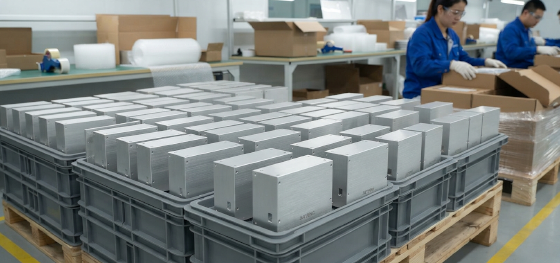
Comment Jucheng Precision élimine-t-elle les erreurs dimensionnelles induites par l'épaisseur pendant la production ?
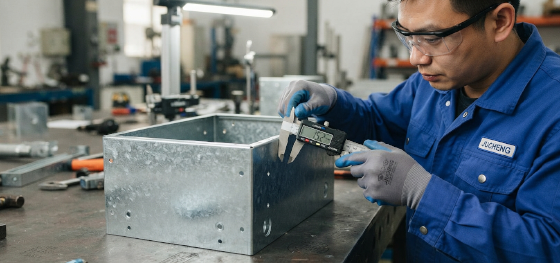
Nous nous approvisionnons uniquement en tôles d'acier certifiées de première qualité avec des tolérances d'épaisseur serrées, et nous mesurons chaque lot entrant avec des micromètres numériques avant traitement.
Pourquoi risquer les tolérances de votre projet sur de la matière première de qualité inférieure et inconstante ? Chez Jucheng Precision, nous appliquons un protocole de contrôle qualité strict, mesurant les tôles brutes sur plusieurs points pour vérifier leur épaisseur décimale réelle. Cette vérification approfondie du matériau maintient notre taux de rejet global tolérances de tôlerie remarquablement bas, garantissant que notre logiciel de pliage et nos imbrications laser sont calibrés sur l'épaisseur réelle du métal plutôt que sur des valeurs nominales génériques.
En sélectionnant cette tôle de première qualité à haute constance matériau de tôle est le fondement de la fabrication matérielle à haut rendement. Jucheng Precision opère dans un environnement certifié IATF 16949 et ISO 13485, utilisant des lasers à fibre avancés et des plieuses CNC avec une répétabilité extrême. Soutenus par notre politique sans MOQ et notre garantie de livraison rapide, nous gérons votre projet depuis la découpe initiale du motif plat jusqu'à l'emballage et l'assemblage finaux à haute durabilité.
FAQ : Questions critiques sur la tolérance d'épaisseur de tôle
Notre équipe d'ingénierie a compilé des solutions professionnelles aux défis de qualité les plus courants rencontrés lors des vérifications d'épaisseur de matériau :
L'épaisseur de la tôle varie-t-elle au sein d'une même feuille individuelle ?
Oui, des variations mineures peuvent se produire sur une seule feuille. En raison de la déflexion des rouleaux à l'aciérie, le centre de la feuille (le bombé) est souvent légèrement plus épais que les bords extérieurs. Nous minimisons cette variation d'épaisseur en nous approvisionnant uniquement en feuilles certifiées de qualité supérieure et en imbriquant les pièces critiques près du centre de la feuille lorsque cela est possible.Comment Jucheng Precision gère-t-elle une exigence de tolérance serrée sur l'épaisseur de la tôle ?
Si votre application exige une constance d'épaisseur extrême, nous recommandons d'utiliser de l'acier laminé à froid de qualité supérieure ou de l'aluminium de qualité aérospatiale. Notre équipe de contrôle qualité mesure en continu les feuilles brutes avec des micromètres numériques, calibre les butées arrière de nos plieuses pour compenser toute variation mineure d'épaisseur, et effectue des contrôles dimensionnels complets sur machine à mesurer tridimensionnelle (MMT) sur les assemblages finis avant l'emballage final.Une jauge de tôle plus épaisse réduit-elle les tolérances de pliage personnalisées ?
Oui, les tôles plus épaisses sont plus rigides et plus difficiles à déformer, nécessitant des forces de pliage significativement plus élevées sur les plieuses. Ce tonnage élevé augmente l'usure des outils et les variations de retour élastique, obligeant nos opérateurs à utiliser des ouvertures de matrice en V plus grandes et à ajuster soigneusement la course de presse pour maintenir des tolérances angulaires serrées.Pourquoi la direction du grain des bobines de métal brut est-elle importante pour la constance de la tolérance d'épaisseur de la tôle ?
Les bobines de métal brut développent une direction de grain continue pendant le traitement au laminoir. Si un pli majeur de votre pièce est exécuté parallèlement à ce grain, le matériau est très sujet aux micro-fissures et à une variation angulaire élevée du retour élastique. Lors de notre étape d'imbrication, nous alignons les pièces à des angles pour garantir que tous les plis majeurs sont exécutés perpendiculairement ou en diagonale à la direction du grain, maintenant ainsi vos tolérances constantes.

