


La sécurité dans la stratosphère n'est pas une variable ; c'est une exigence technique codée en dur. Lorsqu'un composant intérieur d'avion ou un support automobile sous le capot est conçu, la principale crainte n'est pas seulement la défaillance structurelle, mais le danger d'incendie. Dans le vaste catalogue de l'industrie du plastique d'impression 3D , la plupart des matériaux sont essentiellement des combustibles. Ils fondent, brûlent et émettent des fumées toxiques. Il existe cependant une exception d'élite qui comble le fossé entre la polyvalence du plastique et la survie aérospatiale. C'est le monde sophistiqué de l' impression 3d ultem. Le polyétherimide (PEI), connu sous la marque Ultem, est un thermoplastique amorphe haute performance qui offre un rapport résistance/poids incroyable combiné à un ignifugeage inhérent. C'est le seul matériau additif qui permet aux ingénieurs de passer d'une maquette numérique directement à un composant certifié pour le vol et en fin d'utilisation.

Chez JUCHENG, nous reconnaissons que l'impression avec des résines à haute température comme l'Ultem est un pas vers un niveau de fabrication à haute responsabilité. Vous ne pouvez pas obtenir la liaison moléculaire nécessaire du PEI sur une machine de bureau standard. Si la chambre de construction n'est pas activement chauffée à des niveaux extrêmes, la pièce souffrira d'un gauchissement catastrophique et d'une "délaminage interne" qui n'est pas visible jusqu'à ce que la pièce cède sous charge. Nous avons conçu notre installation additive pour satisfaire aux exigences rigoureuses des secteurs aérospatial et de la défense, en utilisant des systèmes FDM de qualité industrielle qui maintiennent la souveraineté thermique sur tout le volume de construction. Ce guide dépasse les définitions de base pour explorer la chimie de la conformité FST, la division mécanique entre l'Ultem 9085 et le 1010, et pourquoi l'approche intégrée de JUCHENG en matière d'extrusion à haute température est la dernière étape pour garantir que vos conceptions critiques survivent à la chaleur du monde réel.
La fiabilité dans les environnements extrêmes se trouve dans la gestion du choc thermique. Vous n'empilez pas seulement des couches de résine ; vous gérez un événement de changement de phase à 400°C qui doit aboutir à un solide monolithique stable. Que vous construisiez un conduit d'air léger pour un satellite ou un connecteur électrique haute tension, la logique de la fusion est votre plus grand atout d'ingénierie. Examinons les piliers techniques de l'extrusion industrielle d'Ultem et voyons comment JUCHENG verrouille l'intégrité de vos conceptions les plus ambitieuses dans la réalité.
Souveraineté thermique : l'exigence de chambre à 180°C
Sélection des matériaux : déchiffrer la logique 9085 vs 1010
Souveraineté FST : pourquoi l'aérospatiale s'appuie sur la chimie du PEI
Surplombs de précision : gérer le support soluble à haute température
Norme de certification de JUCHENG : au-delà de la broche
Données techniques : base de référence des propriétés mécaniques de l'Ultem
Souveraineté thermique : l'exigence de chambre à 180°C

Le principal ennemi de l'extrusion haute performance est le gradient de température. Lorsque vous faites fondre le filament d'Ultem à 360°C et que vous l'extrudez dans un environnement non contrôlé, le matériau subit un choc thermique immédiat. Les résines amorphes comme le PEI ont une température de transition vitreuse (Tg) élevée d'environ 186°C. Si l'air ambiant autour de la pièce est plus froid que ce seuil, les chaînes polymères gèlent instantanément, les empêchant de se lier à la couche suivante. Cela donne des pièces visuellement correctes mais structurellement "délaminées"—elles se sépareront le long des lignes de couche dès qu'elles seront soumises à un couple ou à des vibrations.
At JUCHENG, we eliminate this mechanical vulnerability through absolute thermal sovereignty. Our industrial FDM platforms utilize actively heated build chambers that maintain a constant 180°C environment. This keeps the entire part in a semi-relaxed state during the hours-long build cycle. By maintaining this elevated temperature, we ensure that the interface between layers remains chemically active, allowing for the maximum possible cross-linking across the Z-axis. This thermal discipline is the only way to achieve the +/- 0.15mm tolerances required for aerospace interior components. We don't just "print" Ultem; we manage a slow, controlled cooling event that locks in the dimensional accuracy and structural homogeneity your designs demand. This technical rigor is what separates industrial impression 3d ultem from hobbyist-level failures.
Sélection des matériaux : déchiffrer la logique 9085 vs 1010

Choosing the right grade of Ultem is an exercise in engineering trade-offs. While both materials are built on the PEI molecule, they are optimized for different "theaters of war." Ultem 9085 is the undisputed champion of the aerospace cabin. It is a blended resin that offers high ductility and impact strength. If an aerospace bracket needs to survive a violent vibration or a sudden impact without shattering into dangerous shards, 9085 is the material of choice. Its superpower is its toughness; it bends and deforms slightly before it ever breaks, providing a safety margin that brittle materials cannot offer.
Ultem 1010 is the athlete of pure heat and chemical resistance. It is an unblended, high-purity PEI resin that offers the highest tensile strength and heat deflection temperature in the FDM family. If your part is a food-processing manifold that must endure high-pressure steam cleaning, or an automotive engine housing that sees constant 200°C temperatures, 1010 is the only logical choice. However, 1010 is significantly more brittle than 9085; it behaves more like a glass-filled polymer. At JUCHENG, we help our clients audit their load cases. We don't just look at the melting point; we look at the fatigue cycle. By matching the specific grade of Ultem to the structural destiny of your part, we ensure your 3d printing materials strategy is as precise as your engineering drawings.
Souveraineté FST : pourquoi l'aérospatiale s'appuie sur la chimie du PEI
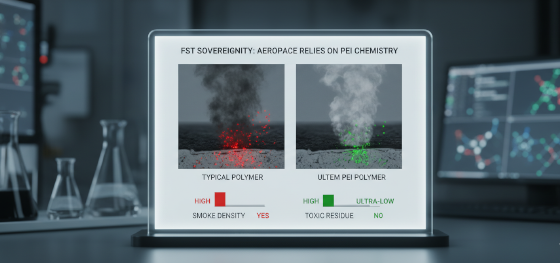
In the aerospace and defense world, "performance" is secondary to "compliance." The ultimate gatekeeper for aircraft interior parts is the FST protocol: Flame, Smoke, and Toxicity. If a component is placed inside a pressurized cabin, it must prove that it will not contribute to a fire and, more importantly, that it won't emit toxic gases that could incapacitate passengers. This is where impression 3d ultem earns its stay. Ultem resins are inherently flame-retardant. They do not require the addition of halogenated additives—which are themselves toxic—to reach a UL94 V-0 rating.
When exposed to direct flame, Ultem forms an insulating "char" layer that prevents the fire from spreading. Its smoke emission is exceptionally low, and its toxicity profile meets the most stringent FAA and EASA standards. At JUCHENG, we treat FST compliance as a manufacturing baseline. We provide full material traceability and certificates of conformance for every aerospace order, ensuring that the 9085 parts we ship are documented survivors. This chemical safety, combined with the lightweight nature of the polymer, allows us to replace heavy aluminum air ducts and junction boxes with topologically optimized Ultem parts, shaving kilograms off an aircraft’s weight while increasing the overall safety of the vehicle.
Surplombs de précision : gérer le support soluble à haute température

Complexity in 3D printing is often limited by the ability to remove the scaffolding that holds it up. In the 400°C nozzle environment of an Ultem print, standard breakaway supports are a nightmare. They bond too tightly to the part, leaving behind ugly surface scars that require hours of manual sanding. To solve the riddle of internal channels and complex undercuts, Jucheng Precision utilizes specialized **High-Temperature Soluble Support** materials. These are engineered polymers that can withstand the 180°C chamber temperature without melting, yet dissolve completely in a specialized chemical bath after the print is finished.
This "hands-off" support removal is vital for functional parts like lightweight air manifolds or medical instrument housings with internal electronics bays. It ensures that the internal surfaces are as smooth and precise as the exterior ones. By utilizing dual-extrusion technology, we can print geometries that are physically impossible to de-mold in traditional casting. This freedom allows our clients to design for "Laminar Flow" or "Structural Efficiency" without worrying about tool access. Our mastery of support chemistry ensures that your most intricate internal visions are realized without the manufacturing scars of manual intervention, delivering a level of geometric fidelity that defines world-class plastique d'impression 3D production.
Norme de certification de JUCHENG : au-delà de la broche

Choosing a partner for high-stakes polymers is a decision of technical liability. At Jucheng Precision, we operate a facility that is ISO 9001 and ISO 13485 certified, with IATF 16949-aligned process controls. We understand that for an automotive EV battery enclosure or a medical surgical robot component, "guessing" the material strength is not an option. Our impression 3d ultem protocol includes "Layer-by-Layer Verification." We utilize in-process monitoring to detect any extrusion variations that could indicate an internal void.
We also manage the "Hygroscopic Threat." Ultem resin is extremely sensitive to moisture. If the filament is not dried to a -40°C dew point before it enters the nozzle, the water molecules will turn to steam inside the part, creating microscopic "bubbles" that destroy the part's tensile strength. JUCHENG maintains a closed-loop dry-air system from the material dryer directly to the machine's sealed intake. This ensures that the material we print is as pure as the day it was synthesized. When you receive a shipment from JUCHENG, you aren't just getting 3D prints; you are getting verified engineered solutions. We provide the documentation, the precision, and the material science to ensure your next breakthrough survives the most hostile environments.
Données techniques : base de référence des propriétés mécaniques de l'Ultem
To finalize your design-for-manufacturing review, Jucheng Precision provides the following mechanical baseline for our industrial-grade Ultem components. These values reflect parts produced in our stabilized thermal environments.
| Propriété | Ultem 9085 (Aerospace) | Ultem 1010 (High Temp) |
|---|---|---|
| Tensile Strength (XY) | ~70-75 MPa | ~80-85 MPa |
| Température de fléchissement sous charge (HDT) | 153°C | 216°C |
| Allongement à la rupture | ~6.0% (Ductile) | ~3.0% (Brittle/Stiff) |
| FST Rating | Full Aerospace Compliance | High (UL94 V-0) |
| Ideal Use Case | Cabin Interiors, Brackets | Engine Zones, Molds |
Success in the modern market requires the ability to replace metal with high-performance plastics without sacrificing safety. JUCHENG’s expertise in matériaux d'impression 3D ensures that your designs are not just realized, but verified for flight. Contact our engineering team today for a comprehensive technical review and see how our Ultem protocols can armor your next industrial project.

