

Durability is a deceptive metric when you only look at the surface. In the evolving landscape of matériaux d'impression 3D, the most critical shift hasn't been in the machines themselves, but in the transition of polymers from visual mockups to functional hardware. This is the industrial era of plastique d'impression 3D powders. MJF and SLS are both options for functional polymer parts, but the appropriate choice depends on the exact material, geometry, loads and acceptance criteria. Do not select a process based on the material family alone.
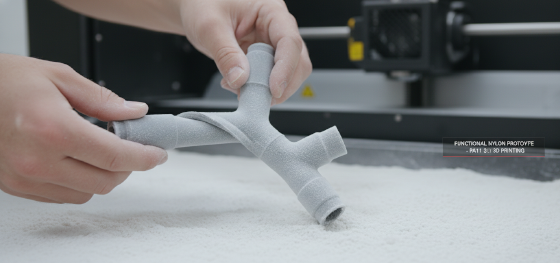
At JUCHENG, we have built our additive production strategy around the absolute reliability of engineering-grade nylons. We understand that a part is only as successful as its ability to withstand cyclic fatigue and chemical exposure. By moving away from standard prototyping and focusing on technologies like HP Multi Jet Fusion (MJF), we provide our clients with a bridge to mass production that bypasses the high cost of injection molding tooling. This guide explores the technical divide between PA11 and PA12, the logic of composite reinforcement, and why JUCHENG’s expertise in high-density sintering is the mandatory final step in turning a 3D model into a production-ready asset.
Reliability in plastic manufacturing is found in the management of the thermal boundary. You aren't just melting powder; you are orchestrating a fusion event that defines the part’s mechanical soul. Whether you are building an innovative drone chassis or a complex set of industrial jigs, the logic of the powder is your greatest asset. Let us examine the technical pillars of industrial plastics and see how they redefine the survival of your most ambitious designs.
Polyamide Power: Engineering the Performance of PA11 and PA12
Composite Fortification: Glass and Carbon Reinforcement Logic
MJF Dominance: Why Multi Jet Fusion Rules Batch Production
Elastomeric Expansion: The Role of TPU Powders
JUCHENG’s Integrated Standard: Sintering to Precision Finish
Polyamide Power: Engineering the Performance of PA11 and PA12
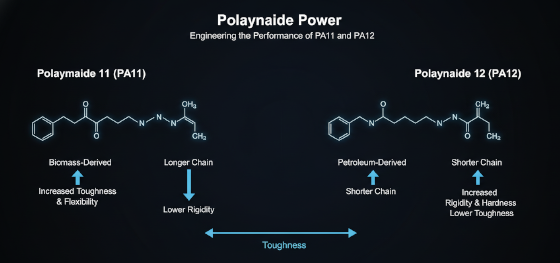
In the hierarchy of industrial 3D printing, Nylon (Polyamide) is the undisputed king. However, choosing the right "flavor" of nylon is where engineering projects are won or lost. Nylon 12 (PA12) is the global workhorse. Its molecular structure is characterized by a balanced crystalline matrix that offers high strength, excellent long-term stability, and chemical resistance to oils and fuels. At Jucheng Precision, we utilize PA12 for the majority of our functional prototypes because it is the most predictable material in the powder-bed world. It absorbs very little moisture compared to lower-grade nylons, ensuring that your dimensions stay "true" from our inspection lab to your assembly line.
For applications that demand the absolute limit of impact resistance, we pivot toward Nylon 11 (PA11). While PA12 is stiff and reliable, PA11 is ductile and resilient. Derived from vegetable-based castor oil, PA11 possesses a higher elongation-at-break value, meaning it can bend and absorb energy where PA12 might snap. This is the material for living hinges, athletic gear, and aerospace components that must endure high-vibration environments without developing stress cracks. By understanding the mechanical "breath" of these two polymers, JUCHENG helps you navigate the trade-off between stiffness and ductility. We don't just supply plastic; we supply the metallurgical-level engineering needed to ensure your polymer components perform as a structural system, not just a visual model.
Composite Fortification: Glass and Carbon Reinforcement Logic
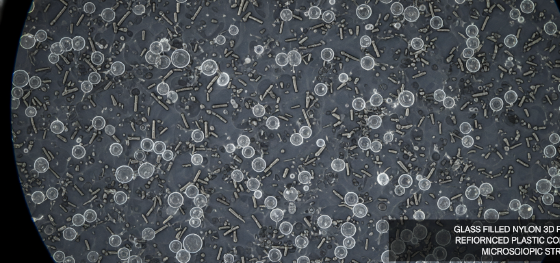
Sometimes, raw nylon isn't enough. When a design requires the stiffness of a cast metal but the weight of a plastic, we move into the realm of "Composite Powders." JUCHENG utilizes Glass-Filled Nylon (PA12-GF) to provide a massive boost in structural rigidity. By infusing the nylon matrix with 30% to 40% microscopic glass beads, we create a material that refuses to bow under pressure. This is essential for large-format enclosures or high-temp industrial housings where dimensional creep must be avoided at all costs. The glass beads act as an internal stabilizer, significantly increasing the material's heat deflection temperature (HDT).
For the ultimate in performance, we offer Carbon-Fiber Reinforced Nylon. In this composite, short carbon fibers provide a skeletal reinforcement that increases the tensile modulus to levels that challenge lightweight aluminum alloys. This is the choice for Formula 1 air ducts and high-end cycling components. However, machining or finishing these composites is a technical high-wire act. The fibers are abrasive and can lead to surface "fuzz" if the fusion isn't perfect. JUCHENG’s mastery of the matériaux d'impression 3D landscape ensures that these fibers are perfectly encapsulated within the resin matrix. We manage the thermal gradients of the build chamber to prevent delamination between the fibers and the binder, delivering a part that is structurally homogeneous and visually consistent. We turn a difficult composite into a reliable engineering solution.
MJF Dominance: Why Multi Jet Fusion Rules Batch Production
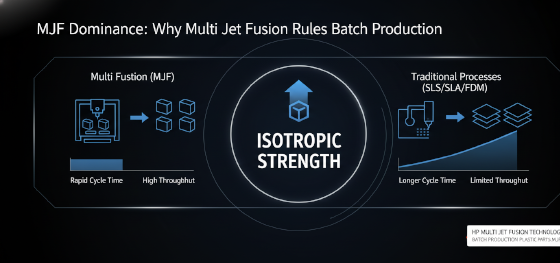
For a production quote, assess the actual build and finishing plan before choosing Multi Jet Fusion (MJF). The process applies fusing and detailing agents across the powder bed before an energy pass, a different route for plastique d'impression 3D. Selective laser sintering (SLS) uses a laser to scan each layer. An area-wide pass does not make every job take the same time: build height, print mode, number of builds, cooling, cleanup and finishing affect the schedule. Compare quotes for the actual geometry and quantity rather than using a fixed batch range.
Compare the mechanical properties that matter instead of assuming Isotropic properties in all directions. For example, HP reports a mean tensile strength of 54 MPa in both XY and Z for HP 3D High Reusability PA 12 specimens printed on a Jet Fusion 5600 using its Balanced profile, but mean elongation at break was 18% in XY and 10% in Z. Those specimen values are not a pressure rating. For a fluid manifold, specify the service medium, pressure, temperature and allowable leakage. Verify leak performance on representative finished parts and qualify structural loads separately. Do not assume either MJF or SLS is leak-tight without validation of the actual construction and finish.
Elastomeric Expansion: The Role of TPU Powders
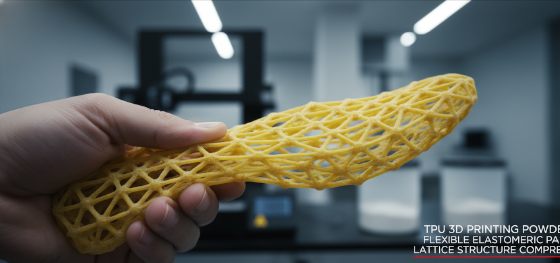
Engineering isn't always about rigidity. Sometimes, success is found in the ability to yield. This is the domain of Thermoplastic Polyurethane (TPU). As a powder-bed material, TPU is a miracle of elastomeric engineering. It combines the toughness of plastic with the flexibility of rubber. We utilize TPU to produce seals, gaskets, ergonomic grips, and complex vibration dampers that would traditionally require expensive overmolding. Because it is printed in a powder bed, we can create complex lattice structures that allow for "Variable Density"—making one part of a cushion soft and another part firm.
At Jucheng Precision, we specialize in high-resolution Flexible 3D Printing. We understand that the porous nature of 3D printed TPU can be an issue for hygiene or fluid containment. To solve this, we offer integrated chemical sealing and vapor smoothing to create a "skin" on the TPU parts, making them liquid-resistant and easy to clean. Whether you are building a custom-fit prosthetic liner or a series of shock-absorbers for a high-speed assembly line, JUCHENG’s TPU protocols provide the tactile and functional performance of production-grade rubber without the molding cost. We help you select the exact Shore hardness needed to satisfy your ergonomic or mechanical requirements, ensuring your flexible designs are both durable and responsive.
JUCHENG’s Integrated Standard: Sintering to Precision Finish
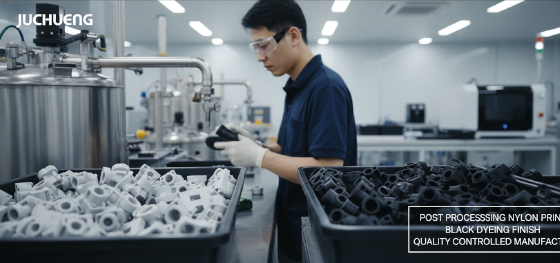
A raw part straight out of the powder is only half-finished. In the industrial world, aesthetics are a functional requirement. A part that looks "rough" is often perceived as "low quality" by the end user. At Jucheng Precision, we have invested in a comprehensive post-processing hub to transform raw plastique d'impression 3D into consumer-ready products. Our workflow includes automated bead-blasting to homogenize the surface and high-temp chemical dyeing to achieve a deep, permanent black finish that won't chip or fade.
Our quality protocol includes full CMM verification of critical dimensions and material lot tracking to ensure every batch meets the ISO 9001 standard. We don't just "hit go" on a printer; we manage a technical lifecycle that includes DFM reviews, thermal stabilization, and final aesthetic refinement. Whether you are building an aerospace sensor housing or a production run of a thousand custom consumer cases, JUCHENG has the technical rigor and the manufacturing capacity to deliver. We don't just make parts; we engineer reliability through the science of industrial polymers. Contact our engineering team today for a comprehensive technical review and see how our plastic additive protocols can armor and elevate your next manufacturing breakthrough.