


L'ingénierie est une quête de perfection matérielle, mais souvent nous sommes contraints de choisir entre le poids des polymères et les performances superficielles des métaux. Dans l'arène à enjeux élevés du post-traitement d'impression 3D, il existe un pont technique qui efface cette frontière. C'est l'art sophistiqué du nickelage de pièces imprimées en 3D. Ce n'est pas un simple revêtement décoratif ; c'est la création d'un exosquelette métallique qui transforme un noyau fragile en résine ou en nylon en un hybride structurel. En déposant une couche uniforme d'alliage nickel-phosphore sur un substrat non conducteur, nous conférons aux composants imprimés en 3D les superpouvoirs de la métallurgie—blindage électromagnétique, dureté de surface extrême et augmentation exponentielle de la rigidité—sans la masse d'un bloc métallique solide.
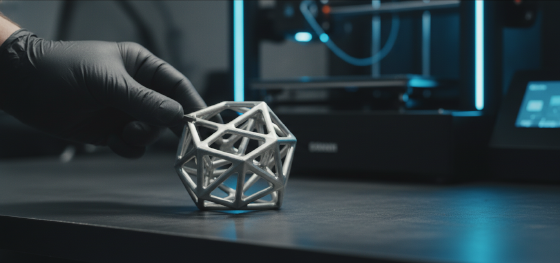
Jucheng Precision opère à l'intersection de l'alchimie chimique et de la précision micronique. Nous reconnaissons que pour un boîtier de drone ou un capteur médical, la "sensation" du métal est secondaire par rapport à son blindage fonctionnel. Si la liaison de placage est faible ou l'épaisseur incohérente, la pièce est un handicap. Notre flux de travail intégré traite le nickelage de pièces imprimées en 3D comme un cycle d'ingénierie principal, utilisant des bains autocatalytiques automatisés pour garantir que chaque alésage interne et chaque treillis complexe reçoive une couche de protection identique. Ce guide dépasse les maquettes visuelles pour explorer la mécanique moléculaire du pont conducteur, la logique structurelle de l'exosquelette, et pourquoi les protocoles DFM intégrés de JUCHENG sont l'étape finale obligatoire pour transformer une conception 3D en un actif industriel haute performance.
La rentabilité dans le matériel moderne est gagnée en fusionnant la vitesse des polymères photopolymérisables avec l'armure des alliages industriels. Lorsque vous pouvez imprimer un collecteur complexe puis le blinder avec une peau métallique structurelle, vous éliminez le besoin d'assemblages secondaires coûteux. Décomposons les lois physiques du dépôt chimique et voyons comment la prévoyance technique peut verrouiller l'intégrité de vos conceptions hybrides les plus ambitieuses dans la réalité physique.
Pont autocatalytique : Résoudre la barrière de non-conductivité
Blindage EMI : Transformer les polymères en boîtiers électroniques
Renforcement structurel : Gérer l'exosquelette métallique
DFM de placage : Ingénierie de surface pour un dépôt uniforme
Protocole intégré de JUCHENG : Validation de la liaison hybride
Pont autocatalytique : Résoudre la barrière de non-conductivité
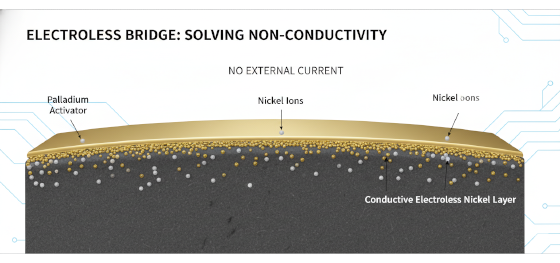
The primary technical hurdle in nickelage de pièces imprimées en 3D is the materials’ inherent insulation. Unlike steel or aluminum, standard 3D printed resins and filaments will not accept an electrical current. Traditional electroplating, which relies on a cathode-anode circuit, would fail instantly. The solution is a "Chemical Bridge"—specifically, Electroless Nickel (EN). This process begins with surface activation, where the part is dipped into a palladium-tin catalyst. These microscopic metallic seeds anchor themselves into the pores of the 3D printed skin, creating the nucleation sites required for the next phase of the reaction.
Once activated, the part enters an autocatalytic nickel bath. Here, a reducing agent (usually sodium hypophosphite) reacts with nickel ions in the liquid, causing them to deposit onto the part’s surface without the need for an external power source. This is the ultimate "Uniformity Hack." Because the reaction happens wherever the liquid touches the part, the nickel layer grows at an identical rate on the sharpest corner and at the bottom of the deepest internal hole. At Jucheng Precision, we calibrate these immersion times to achieve specific thickness layers, usually ranging from 10 to 50 microns. This primary nickel-phosphorus layer provides the electrical conductivity needed for subsequent decorative plating and, more importantly, creates a pristine, non-porous seal over the 3D printed substrate. We don't just "cover" the part; we engineer a chemical interface that turns an organic polymer into a metallurgically active component.
Blindage EMI : Transformer les polymères en boîtiers électroniques
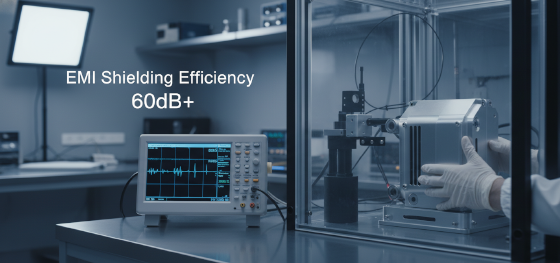
In the world of 5G telecommunications and medical diagnostics, electromagnetic interference (EMI) is a silent saboteur. Lightweight plastic enclosures are preferred for portability, but they offer zero protection against the invisible "noise" of radio frequencies. Nickel plating 3d printed parts provides a technical sanctuary for sensitive circuitry. A thin layer of electroless nickel acts as a conductive shield, reflecting and absorbing electromagnetic waves before they can compromise the data integrity of your device.
JUCHENG’s plating protocols are designed to meet strict decibel-reduction standards. We analyze your enclosure's geometry to ensure the nickel layer is continuous across mating faces and hinges. By achieving a surface resistivity of less than 0.1 ohms per square, we transform a simple 3D print into a high-performance EMI/RFI shield. This is particularly vital for prototypes destined for FCC or CE certification testing. Instead of waiting weeks for a vacuum-metallized production part, you can test a nickel-plated prototype that behaves exactly like the final commercial product. We bridge the gap between lightweight design and electronic security, providing the "Faraday Cage" performance your high-frequency electronics demand without the weight of solid metal.
Renforcement structurel : Gérer l'exosquelette métallique
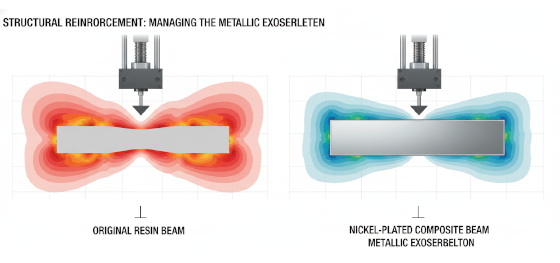
Beyond the electrical benefits, nickelage de pièces imprimées en 3D offers a massive boost to mechanical performance. When you wrap a polymer core in a high-hardness nickel shell, you are effectively creating a composite structure. The nickel-phosphorus alloy we use has an as-plated hardness of roughly 45 to 50 HRC (Rockwell C). This metallic "exoskeleton" significantly increases the flexural modulus of the part, making it up to five times stiffer than the raw print.
This reinforcement is a strategic asset for parts that must survive heavy handling or abrasive environments. For instance, a 3D printed SLA jig used on a high-speed production line will eventually wear down due to friction. By applying a 25-micron nickel layer, JUCHENG grants that jig the wear resistance of tool steel. We also account for the thermal expansion mismatch between the plastic and the metal. If the part is intended for high-heat use, we utilize specific "Low-Stress" nickel formulations to prevent the plating from cracking as the core expands. This structural foresight ensures that your "metallic" plastic part doesn't just look tough—it withstands the impact, torque, and friction of the real world. We turn the post-traitement d'impression 3D cycle into a structural evolution, allowing your designs to survive load cases that would crush a standard 3D print.
DFM de placage : Ingénierie de surface pour un dépôt uniforme
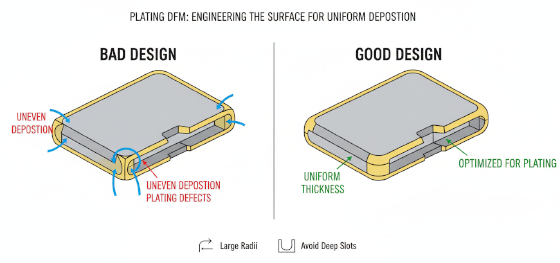
Successful plating is decided at the drawing board. One of the most common errors in conception d'impression 3D for plating is the use of sharp internal corners and deep, narrow blind holes. In the chemical bath, bubbles can become trapped in these features, preventing the activating catalyst from reaching the plastic. This leads to "bald spots" where the metal won't bond. Furthermore, sharp corners act as "current hogs" if secondary electroplating is applied, leading to uneven buildup and dimensional distortion.
At Jucheng Precision, we advocate for "Plating-Ready" geometry. We suggest generous fillets—ideally 1mm or more—on all internal and external edges to promote a uniform flow of ions. We also mandate the inclusion of "Vent and Drain" holes in hollow geometries. This ensures the plating chemicals can enter and, more importantly, exit the part without becoming trapped and causing internal corrosion. By engineering the surface for the tank, we ensure a 100% yield rate and a finish that is visually flawless. We treat the plating process as a geometric constraint, providing our clients with the DFM feedback needed to ensure their metallic-plastic hybrids are as precise as they are brilliant.
Protocole intégré de JUCHENG : Validation de la liaison hybride
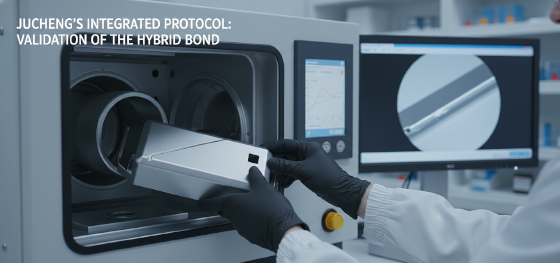
The final hallmark of a professional manufacturing partner is the refusal to accept visual beauty as a proxy for technical quality. A part can look like solid chrome but fail an adhesion test on day two. Jucheng Precision eliminates this risk by owning the entire value chain. We don't just "outsource" our plating; we integrate it into our internal quality ecosystem. Our post-traitement d'impression 3D includes rigorous validation of the hybrid bond.
Every batch of nickelage de pièces imprimées en 3D undergoes a standardized thermal cycling audit. We alternate the parts between freezing and high-heat environments to verify that the coefficient of expansion mismatch doesn't lead to delamination. We also perform "Cross-Hatch" tape tests on sacrificial coupons to guarantee that the molecular bond is absolute. When you receive a component from JUCHENG, you aren't just getting a 3D print; you are getting a verified engineering solution that combines the best of polymer flexibility and metallic armor. Whether you are building an innovative heart valve or a mission-critical aerospace sensor, our expertise in metallic-plastic hybrids clarifies and elevates your vision. Contact Jucheng Precision today for a technical DFM review and see how our plating protocols can armor your next breakthrough.

