


Tool chatter destroys micron-level tolerances when cutting sticky copper alloys. Machinists battle severe built-up edge and rapid tool wear on pure copper blanks daily. Zinc integration fundamentally transforms this harsh thermal dynamic.
Understanding the raw brass mechanical properties dictates the profitability of high-volume CNC runs. Engineers must balance tensile strength requirements against the aggressive machine cycle times demanded by modern production schedules. Selecting the wrong alloy grade triggers massive operational bottlenecks.
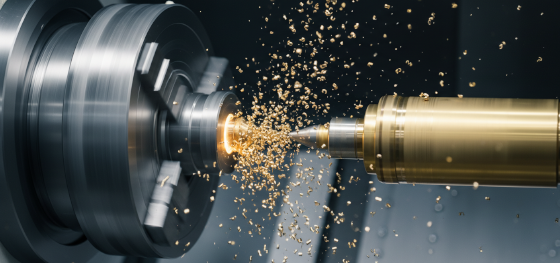
Microscopic structural variations within the copper-zinc matrix directly control how the metal shears under a carbide cutting tool. Navigating these precise metallurgical boundaries separates elite fabrication facilities from mediocre job shops. Precision engineering relies entirely on predictable material behavior under extreme kinetic stress.
Why C36000 Free-Machining Brass Sets the Industry Baseline?
How Zinc Content Alters the Tensile Strength of Brass Alloys?
What Causes Tool Chatter When Milling Low-Lead Brass?
How Does Thermal Conductivity Impact High-Speed CNC Turning?
Which Surface Treatments Prevent Brass Oxidation Post-Machining?
Why Choose Jucheng for Complex Brass Component Fabrication?
What Are the Most Common Brass Machining FAQs?
Why C36000 Free-Machining Brass Sets the Industry Baseline?
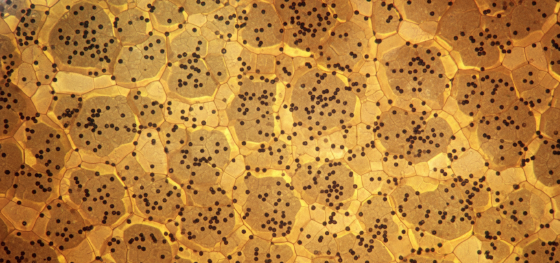
C36000 brass establishes the universal 100% machinability index standard due to its 3% lead dispersion, acting as an internal microscopic lubricant during violent chip formation.
Les atomes de plomb ne se dissolvent pas dans la solution solide cuivre-zinc lors de la coulée. Ils restent dispersés sous forme de particules globulaires distinctes et minuscules dans toute la matrice cristalline interne. Ces inclusions microscopiques agissent comme des points de fracture intentionnels lorsque l'outil de coupe impacte la surface métallique.
Les copeaux se cassent immédiatement en formes "C" étroitement enroulées au lieu de former de longs rubans continus. Ce mécanisme de fracture hautement conçu empêche complètement l'accumulation de nids d'oiseau autour de la broche en rotation. Les machinistes peuvent pousser les vitesses d'avance jusqu'aux limites absolues de l'équipement sans risquer un enchevêtrement catastrophique de l'outil.
Le frottement diminue significativement au niveau du plan de cisaillement primaire car le plomb étalé fournit une lubrification intrinsèque à l'état solide. La charge de la broche reste incroyablement stable même lors de passes d'ébauche lourdes. Une résistance cinétique plus faible se traduit directement par une durée de vie considérablement prolongée des plaquettes en carbure.
How Zinc Content Alters the Tensile Strength of Brass Alloys?
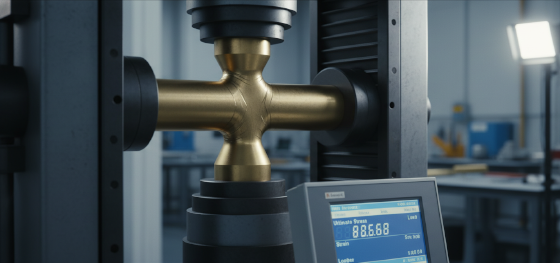
L'augmentation de la concentration en zinc jusqu'à 39 % élève directement la résistance ultime à la traction de la matrice de laiton tout en diminuant proportionnellement sa ductilité de formage à froid.
La métallurgie dicte que le cuivre pur manque de la structure atomique rigide nécessaire pour les applications industrielles à haute charge. L'introduction d'atomes de zinc dans le réseau de cuivre crée une solution solide qui déforme physiquement la structure cristalline. Cette tension atomique interne bloque efficacement les mouvements de dislocation sous contrainte mécanique.
Les alliages contenant moins de 35 % de zinc forment une structure de phase alpha pure. Cette phase métallurgique spécifique offre d'excellentes propriétés de formage à froid, ce qui la rend idéale pour l'emboutissage profond de douilles de cartouches ou le poinçonnage de contacts électriques complexes. Les ingénieurs spécifient le laiton alpha lorsqu'une déformation plastique extrême est obligatoire avant la rupture.
Pousser la teneur en zinc à près de 40 % force le matériau à adopter une structure biphasée alpha-bêta. Les molécules de phase bêta augmentent considérablement la dureté brute et la résistance à la traction, mais se brisent sous un formage à froid intense. Ces formulations à haute teneur en zinc excellent exclusivement dans les processus de forgeage à chaud et les applications de quincaillerie architecturale rigide.
| Qualité d'alliage de laiton | Limite d'élasticité (MPa) | Résistance à la traction (MPa) | Indice d'usinabilité |
|---|---|---|---|
| C36000 (Usinabilité libre) | ~310 | ~400 | 100 % (Référence) |
| C26000 (Laiton pour cartouches) | ~110 | ~325 | 30% |
| C46400 (Laiton naval) | ~170 | ~380 | 30% |
| C68800 (Cobalt Brass) | ~380 | ~565 | 20% |
What Causes Tool Chatter When Milling Low-Lead Brass?
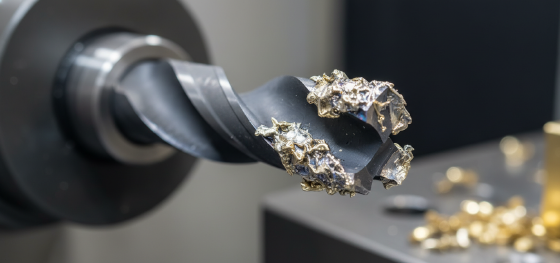
Removing lead from modern RoHS-compliant brass formulations fundamentally shifts the shear plane angle, causing continuous stringy chips that induce violent high-frequency tool chatter.
Navigating [2026] global environmental mandates forces manufacturers to adopt eco-brass variants heavily alloyed with silicon or bismuth. These lead-free substitutes entirely lack the microscopic internal fracture points that normally facilitate crisp chip snapping. The cutting edge must brutally tear through the sticky matrix.
Stringy chips wrap aggressively around end mills, blocking coolant nozzles and instantly generating massive thermal shock. The localized heat melts the copper-rich alloy directly onto the cutting flutes. This phenomenon, known as galling or smearing, destroys the tool's balanced geometry.
Unbalanced cutting forces generate severe resonant vibrations that echo through the machine spindle. Operators must combat this chatter by deploying specialized variable-helix end mills and applying high-pressure oil-based cutting fluids to artificially lubricate the shear zone.
How Does Thermal Conductivity Impact High-Speed CNC Turning?

Brass dissipates heat at 115 W/m·K, aggressively pulling thermal energy away from the cutting zone and allowing spindle speeds exceeding 10,000 RPM without coolant shock.
Machining titanium or stainless steel traps kinetic heat directly inside the cutting edge, destroying carbide coatings within minutes. Brass behaves entirely differently under heavy rotational stress. The metallic lattice rapidly absorbs the generated heat and channels it deep into the workpiece body.
This superior thermal conductivity creates a massive economic advantage during high-volume production cycles. Programmers can double or triple conventional cutting velocities without risking thermal tool failure. Rapid heat evacuation prevents the part from expanding unpredictably during finish passes.
Coolant primarily serves to flush chips away rather than strictly controlling temperature. Many Swiss-turning experts prefer cutting free-machining brass completely dry, utilizing only compressed air blasts. Dry machining eliminates expensive coolant disposal costs and prevents unwanted chemical staining on cosmetic surfaces.
Which Surface Treatments Prevent Brass Oxidation Post-Machining?
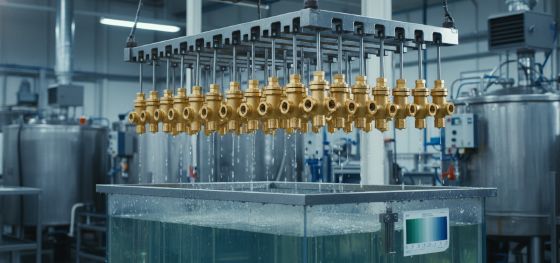
Electroplating brass with nickel or clear chromate conversion coatings completely seals the reactive zinc boundaries, preventing catastrophic dezincification in aggressive marine environments.
Freshly machined brass exhibits a brilliant golden luster that degrades rapidly upon exposure to atmospheric oxygen and ambient humidity. The surface reacts chemically to form a dull brown or green patina. While aesthetically pleasing for antique replicas, oxidation ruins tight geometric tolerances on precision mating surfaces.
Dezincification represents a far more dangerous failure mode in fluid handling applications. Aggressive chlorides in municipal water systems selectively dissolve the zinc atoms out of the alloy matrix, leaving behind a porous, structurally compromised copper sponge. This hidden corrosion causes unexpected pressurized valve blowouts.
Engineers deploy electroless nickel plating to provide an impenetrable, hard-wearing barrier over the raw brass substrate. For electrical connector applications, gold flash plating over a nickel underplate guarantees exceptional conductivity while entirely eliminating surface tarnishing risks. Proper post-processing ensures long-term operational survival.
Why Choose Jucheng for Complex Brass Component Fabrication?
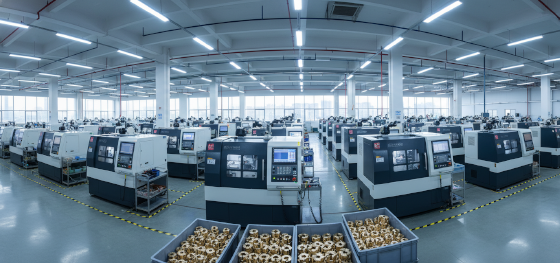
Operating within the Shenzhen precision manufacturing hub, Jucheng Precision leverages customized tool geometries to execute sub-micron tolerances on challenging lead-free brass components.
Fragmented supply chains destroy prototyping budgets through hidden NRE markups and disjointed communication. Jucheng consolidates the entire manufacturing ecosystem under one massive 8000-square-meter facility. We deploy 25 high-rigidity Mazak 5-axis centers specifically calibrated for aggressive copper alloy removal rates.
Incoming raw material verification remains strictly non-negotiable. Our quality control engineers utilize imported spectrometers to instantly detect illicit lead spikes in batches claiming to be RoHS-compliant. We guarantee metallurgical integrity long before the first billet enters the chuck.
Strictly audited under ISO9001:2015 and IATF16949 certifications, our production floor operates with relentless consistency. We offer comprehensive Free DFM reviews to analyze your brass geometries, identifying high-risk chatter zones before machining begins. Our "No MOQ" policy directly empowers your most ambitious iterative design cycles.
What Are the Most Common Brass Machining FAQs?
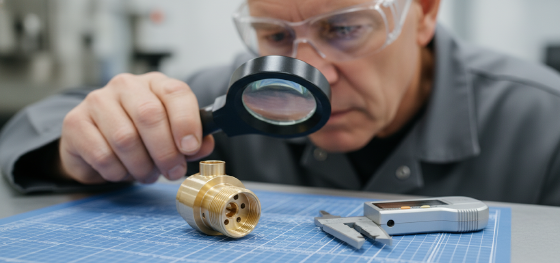
Does cold working significantly increase brass yield strength?
Yes. Heavy cold rolling or drawing compresses the crystalline grain structure, drastically elevating the yield point through work hardening. However, this process sacrifices raw ductility and introduces internal residual stresses that may warp during subsequent milling operations.
What is the optimal chip load for turning C36000?
Operators typically target aggressive chip loads between 0.15mm and 0.35mm per revolution. The inherent lubricating properties of lead allow these heavy cuts without fracturing the carbide insert, maximizing raw volumetric material removal rates.
How does spindle runout affect brass threading?
Even microscopic spindle runout causes the rigid tapping tool to drag against the soft brass thread flanks. This dragging action smears the metal rather than cutting it cleanly, resulting in oversized, non-compliant threads that fail strict gauge inspections.

