


Les mensonges visuels sont la monnaie ultime du design industriel. Dans les premières étapes du développement de produits, la capacité de tenir un prototype qui ressemble et se sent exactement comme un produit de consommation fini vaut plus que mille rendus CAO. Dans le spectre high-tech du processus d'impression 3D, la plupart des technologies peinent à combler l'écart entre la couleur, la texture et la transparence. Elles produisent des pièces en couleurs uniques ou avec des grains de couche visibles qui nécessitent une peinture manuelle extensive. Cependant, une méthode se distingue comme l"" imprimante à jet d'encre du monde 3D ». C'est l' impression 3D par jet de matière. C'est un processus qui abandonne le laser et le filament au profit de gouttelettes microscopiques de photopolymère, permettant la création de chefs-d'œuvre multi-matériaux et en couleur qui peuvent imiter tout, du tissu humain aux tableaux de bord automobiles à haute brillance en une seule construction.

Chez JUCHENG, nous analysons chaque technologie additive non seulement pour sa nouveauté, mais pour son placement stratégique dans le cycle de vie de la fabrication. Le jet de matière est un miracle technique de réplication sensorielle, mais il comporte un compromis structurel. C'est le choix premier pour les maquettes marketing et les modèles de planification chirurgicale où la fidélité visuelle est la directive principale. Mais pour les composants qui doivent résister au stress mécanique ou aux températures élevées, la chimie des résines jetées atteint souvent sa limite. Ce guide va au-delà des définitions superficielles pour explorer la dynamique des fluides de l'orchestration des gouttelettes, la logique de la simulation de surmoulage, et pourquoi l'engagement de JUCHENG envers le MJF haute durabilité et l'usinage CNC sert de pivot essentiel pour les pièces qui doivent passer du studio de design à la réalité dure du terrain.
Le réalisme dans la fabrication est une question de coordination microscopique. Vous n'imprimez pas seulement une forme ; vous mélangez une palette numérique de propriétés physiques au niveau du voxel. Que vous construisiez un modèle cardiaque médical réaliste pour la planification préopératoire ou une maquette électronique grand public haute fidélité, la logique de la gouttelette est un allié d'ingénierie puissant. Examinons les piliers techniques du jet de matière et voyons comment il redéfinit la vitesse de validation visuelle haute définition.
Orchestration des gouttelettes : mécanique du dépôt par jet d'encre
Précision chromatique : ingénierie du réalisme couleur
Fondations solubles : obtention d'alésages internes parfaits
Illusions sensorielles : la fragilité des résines esthétiques
Pivot technique : quand choisir les solutions fonctionnelles JUCHENG
Orchestration des gouttelettes : mécanique du dépôt par jet d'encre
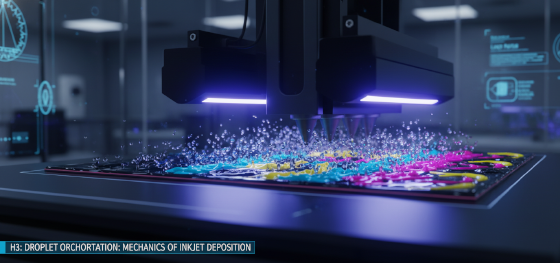
La logique opérationnelle du impression 3D par jet de matière est une évolution sophistiquée de l'imprimante de bureau traditionnelle. Au lieu d'encre sur papier, la machine utilise plusieurs têtes d'impression équipées de centaines de buses microscopiques pour déposer de minuscules gouttelettes de résines photopolymères sur un plateau de construction. Lorsque les têtes balayent la zone de travail, une lampe ultraviolette (UV) à haute intensité suit immédiatement derrière, durcissant les gouttelettes liquides en un état solide en une fraction de seconde. Ce jet et durcissement simultanés permet des couches incroyablement minces—souvent aussi fines que 16 à 30 microns—résultant en des pièces avec une douceur de surface qui rivalise avec celle des impression 3D SLA standard.
Because the droplets are dispensed in a discrete grid, the machine can vary the material type from one micron to the next. This is "Digital Material" engineering. We can mix rigid resins with flexible elastomers during the build to create a part with a graded Shore hardness. Imagine a medical tool handle that is rock-solid in the center but transitions into a soft-touch rubber grip at the surface—all printed in a single continuous cycle without any manual assembly. This level of microscopic coordination is the hallmark of Material Jetting, providing a level of geometric and material complexity that is technically impossible to achieve through traditional overmolding or adhesive bonding. It is a process of additive alchemy, turning digital data into complex sensory experiences.
Précision chromatique : ingénierie du réalisme couleur

For a designer, color is information. Standard 3D prints are often limited to the color of the filament or powder, requiring secondary painting that can obscure fine details. Material Jetting shatters this barrier by utilizing a CMYK (Cyan, Magenta, Yellow, Key/Black) color system. By jetting droplets of different colors in specific concentrations, the machine can generate over 500,000 distinct hues with incredible accuracy. This is not just a surface tint; the color is integrated into the entire volume of the part. If you cut a full-color Material Jetting part in half, the color remains consistent all the way through.
This chromatic precision is why JUCHENG identifies Material Jetting as the gold standard for high-fidelity consumer mockups. We produce prototypes for smartphones, wearable technology, and premium appliance controls that include vibrant brand colors, subtle gradients, and even transparent windows—all in one piece. The technology can even replicate the "wood grain" or "carbon fiber" appearance on a surface by projecting a high-resolution texture map into the resin matrix. When you present a Material Jetting prototype to a stakeholder, you aren't asking them to imagine the final product; you are showing it to them. This ability to eliminate visual ambiguity accelerates the design approval process and reduces the risk of aesthetic errors discovered late in the production cycle.
Fondations solubles : obtention d'alésages internes parfaits

Internal geometry is the graveyard of many additive methods. Removing rigid supports from a 2mm internal fluid channel is a physical impossibility. Material Jetting solves this through a secondary jetting system dedicated to "Support Material." Alongside the modeling resin, the machine jets a specialized wax or gel-like substance that fills all the voids and supports overhanging features. Once the print is complete, the part is either placed in a pressurized water bath or a chemical solution that melts or dissolves the support material away.
This "Soluble Foundation" allows for the creation of internal labyrinths, tiny cross-holes, and intricate lattice structures that remain perfectly clean. It ensures that the "skin" of the part is never touched by a mechanical scraper or a file, preserving the pristine surface finish that is essential for optical and aesthetic components. At JUCHENG, we leverage this non-contact support strategy to deliver micro-scale assemblies with moving internal parts—like captured ball valves or interlocking gears—that are ready for inspection directly from the cleaning tank. By removing the physical struggle of support removal, Material Jetting ensures that your most delicate internal visions are realized without the scars of manual labor.
Illusions sensorielles : la fragilité des résines esthétiques

We must balance the visual awe of impression 3D par jet de matière with a technical reality check. These parts are sensory illusions. While they look and feel like production-grade plastic, the photopolymer resins used in the jetting process are inherently sensitive. They are susceptible to UV light (which can cause them to yellow or become brittle over time) and have relatively low heat-deflection temperatures compared to sintered nylons. If you leave a Material Jetting part on a car dashboard on a hot day, it may warp. If you drop it onto a concrete floor, it may shatter.
This fragility defines the material’s niche. It is a material for the eyes and the hands, not for the hammer. Designers often fall into the trap of using these realistic models for functional stress tests, leading to false failure data. At JUCHENG, we help our clients navigate this "Realism Trap." We advise that if your prototype is meant for a boardroom presentation or an ergonomic tactile study, Material Jetting is unbeatable. But if that same design must undergo high-pressure fluid testing or survive a 1,000-cycle mechanical endurance run, the beautiful resin facade will fail. Understanding the mechanical limits of the "Digital Material" is vital for engineering success. We don't just provide the pretty part; we provide the technical warning that ensures your testing data is accurate and your project avoids post-validation disasters.
Pivot technique : quand choisir les solutions fonctionnelles JUCHENG
Choosing a manufacturer for high-end prototypes is a move of technical trust. While Material Jetting creates the most beautiful visual models in the processus d'impression 3D, JUCHENG’s core manufacturing philosophy is built on functional durability. We are honest with our clients: when the design moves past the "look-and-feel" phase and into the "work-and-survive" phase, you must pivot your technology choice.
For prototypes that need to survive the brutal reality of functional testing, we will direct you toward our MJF 3D Printing line or our precision CNC Machining Services. These technologies deliver parts made from industrial-grade thermoplastics like Nylon 12, PEEK, and Ultem—materials that can handle the heat, the chemicals, and the stress of real-world use. When you partner with JUCHENG, you are accessing a diversified manufacturing hub that understands when to use the sensory magic of the jet and when to use the raw power of the mill. We don't just ship 3D prints; we ship validated engineered solutions. Contact our engineering team today for a free technical consultation and let us help you choose the technology that will armor your next breakthrough.

