


The acrid, sickening smell of melting polylactic acid (PLA) dripping onto a hot V8 engine block is a mistake a junior automotive engineer only makes once. Last year, a racing client handed me a shattered polymer suspension mount that snapped perfectly cleanly along its layer lines the moment the car hit a pothole. Holding the ruined plastic in my hands, I ran my thumb over the brittle, delaminated ridges. It was a textbook example of confusing desktop hobbyist materials with industrial-grade mechanical reality. Designing a functional 3d print car part requires brutally discarding marketing hype and respecting the unforgiving physics of the open road.

Prototyping complex intake manifolds or custom dashboard bezels forces procurement managers to choose between additive manufacturing and subtractive CNC machining. One technology builds geometries from nothing using powdered polymers and high-power lasers, while the other violently carves solid aluminum billets with spinning carbide. Mixing up these two structural paradigms guarantees catastrophic field failures.
Surviving the automotive environment demands absolute mastery of thermal deflection temperatures and anisotropic material limits. Fabricators must mathematically calculate when a glass-filled nylon print can safely replace a costly machined metal bracket. Precision economics relies entirely on matching the specific polymer chemistry to the brutal kinetic stresses hidden beneath the hood.
contenu :
3D Print Car Part vs CNC Machining: How Do They Compare?
When Should You Specify Additive Automotive Components?
When MUST You Avoid FDM Printing for Structural Loads?
How Does Heat Deflection Destroy Engine Bay Prototypes?
What Are the True NRE Cost Breakdowns for Rapid Scaling?
How Does Jucheng Optimize Auto Prototyping in Shenzhen?
What Are the Most Critical Automotive 3D Printing FAQs?
3D Print Car Part vs CNC Machining: How Do They Compare?

Does 3D printed nylon possess the exact same tensile strength as CNC machined nylon? Absolutely not. CNC machined parts boast completely isotropic strength from a solid, compressed billet, whereas extrusion-based 3D prints suffer from anisotropic weakness, specifically tearing apart easily along the Z-axis layer boundaries.
Industrial CNC machining removes material from heavily compressed, stress-relieved plastic rods. If you mill an engine transmission mount from solid Delrin, that part will absorb kinetic shock flawlessly regardless of which direction the impact comes from. The raw crystalline structure remains undisturbed, delivering pure, uncompromised catalog-rated mechanical data that automotive engineers can trust blindly.
Basic Dépôt de fil fondu (FDM) builds parts by stacking melted strings of plastic. The thermal bond between layer 10 and layer 11 is mathematically much weaker than the continuous filament strand itself. However, high-end Selective Laser Sintering (SLS) completely eliminates this layer weakness. By using high-power lasers to fuse nylon powder, SLS creates a nearly 100% dense, isotropic solid capable of surviving aggressive road testing without shattering.
| Métrique de fabrication | Industrial 3D Printing (SLS/MJF) | Usinage CNC 5 axes | Automotive Design Impact |
|---|---|---|---|
| Complexité Géométrique | Infinite (Internal channels free) | Limited (Line of sight required) | Printing builds impossible cooling manifolds |
| Structural Rigidity | Moderate to High | Absolute Maximum | CNC dominates load-bearing chassis components |
| Surface Finish Tolerance | Rougher (Powder texture) | Flawless Mirror Finish | CNC requis pour ajustements serrés de roulements |
| Déchets de matériau | Quasi nul (poudre recyclée) | Élevé (jusqu'à 80% de copeaux) | L'impression réduit les coûts de matériau sur les pièces creuses |
When Should You Specify Additive Automotive Components?

Les composants imprimés sont-ils viables pour des tests fonctionnels en conditions réelles sur un circuit ? Oui, à condition de spécifier du nylon de qualité technique ou du TPU. Ils sont idéaux pour les conduits HVAC complexes, les boîtiers de jauges de tableau de bord personnalisés et les collecteurs de fluides complexes qui nécessiteraient des assemblages CNC multi-pièces coûteux.
Les ingénieurs matériel exploitent la fabrication additive spécifiquement pour le refroidissement conforme et l'optimisation topologique. Une équipe de course peut concevoir un conduit de refroidissement d'étrier de frein avec des chemins internes en spirale bizarres qui épousent parfaitement les dimensions serrées du châssis. Une fraiseuse CNC ne peut tout simplement pas se plier dans les coins pour usiner ces cavités internes. L'impression 3D exécute cette géométrie impossible sans faille en une seule construction de nuit.
La production de pont prospère grâce aux technologies de lit de poudre comme Multi Jet Fusion (MJF). Lorsqu'une startup de véhicules électriques a besoin de 300 clips de faisceau de câbles personnalisés instantanément, la découpe d'un moule d'injection en acier de quatre-vingt mille dollars paralyse leur trésorerie. Déposer ces 300 clips dans une seule chambre de construction MJF livre des pièces en nylon hautement flexibles de qualité production dès le lendemain, sans dépenser un seul dollar en outillage NRE.
When MUST You Avoid FDM Printing for Structural Loads?
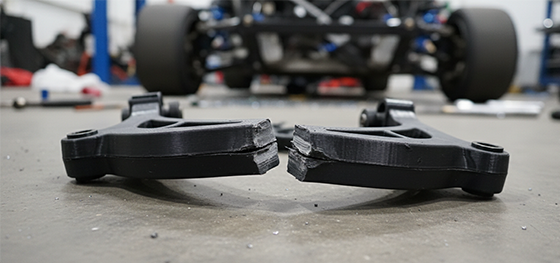
Un support imprimé FDM peut-il supporter en toute sécurité un alternateur sous de fortes vibrations ? Jamais. Les pièces d'extrusion de base subissent une défaillance catastrophique par fatigue sous des vibrations harmoniques continues du moteur, finissant par se déchirer le long des faibles limites de couche.
Placer une pièce FDM anisotrope sous une contrainte cinétique de cisaillement est un suicide d'ingénierie. J'ai vu des supports de suspension imprimés se fissurer instantanément au moment où un mécanicien a appliqué quatre-vingt-dix pieds-livres de couple au boulon de montage. Le plastique manque tout simplement de la réticulation moléculaire dense nécessaire pour empêcher les couches de se cisailer violemment les unes des autres pendant l'accélération.
Vous devez immédiatement passer à de l'aluminium usiné CNC ou de l'acier forgé chaque fois que le plan exige une intégrité structurelle rigide. Si une défaillance de pièce entraîne une perte de contrôle du véhicule, une dégradation de la direction ou une fuite de liquide de frein sous pression, les polymères additifs doivent être complètement retirés de l'équation de prototypage. Les facteurs de sécurité humaine exigent du métal solide inflexible.
How Does Heat Deflection Destroy Engine Bay Prototypes?

Will standard ABS prints survive bolted directly near an exhaust manifold? No. Engine bays routinely exceed 120°C (250°F). Standard plastics hit their glass transition temperature long before this, softening like warm butter and collapsing entirely under their own gravitational weight.
Evaluating the Heat Deflection Temperature (HDT) separates amateur cosmetic designs from aerospace-grade survival. If you mount a beautiful resin SLA intake manifold onto a turbocharged engine, the ambient exhaust heat will slowly deform the plastic. The vacuum seal breaks, the engine runs dangerously lean, and catastrophic internal detonation occurs within minutes of the initial track test.
Surviving the under-hood inferno mandates exotic, ultra-high-performance polymers. Industrial systems printing Ultem 9085 or PEEK easily withstand continuous operating temperatures pushing 200°C without shedding a single micron of dimensional tolerance. These advanced aerospace filaments aggressively rival the thermal stability of raw aluminum while shaving pounds of weight off the front axle.
What Are the True NRE Cost Breakdowns for Rapid Scaling?

Is 3D printing inherently cheaper than CNC machining for car parts? Only for complex, hollow geometries in extreme low volumes. If you need a simple, solid block of material, CNC machining a raw billet often costs significantly less than buying expensive specialized polymer filaments.
Additive manufacturing eliminates CAM programming and fixturing setups, dragging initial NRE costs down to practically zero. However, producing 500 massive car bumpers via 3D printing is financial insanity. The printer takes excruciatingly long hours to build massive objects, driving the variable unit cost sky-high. The laser beam can only move so fast across the powder bed.
Subtractive machining dominates large, simple geometric forms. Slapping a thick aluminum plate onto a high-speed router allows massive cutting heads to clear pounds of metal in seconds. Procurement executives must aggressively plot the volumetric intersection curve where the slowness of the printer begins incinerating the budget compared to the raw muscle of a CNC spindle.
How Does Jucheng Optimize Auto Prototyping in Shenzhen?

Can a single facility seamlessly combine 3D printed plastics with tight CNC metal tolerances? Yes. Operating within the [2026] Shenzhen precision manufacturing hub, Jucheng merges high-end HP MJF additive technologies directly alongside our 150-machine CNC fleet.
Navigating global hardware procurement requires an absolute rejection of unverified plastic tolerances. If you print a complex nylon intake but need a perfectly flat, leak-proof mating surface, we mount the 3D printed part directly onto a 5-axis CNC. We physically mill the printed plastic face flat to guarantee an absolute micron-level vacuum seal for your gaskets.
Our engineering teams intervene heavily during the CAD review phase. Backed by uncompromising ISO9001:2015 and IATF16949 automotive protocols, our Free DFM reviews identify thermal failure risks before the laser fires. We execute intelligent hardware scaling without MOQ restrictions, ensuring your exact digital design survives the harsh realities of the racetrack.
What Are the Most Critical Automotive 3D Printing FAQs?

Resolving hardcore kinetic and thermal variables prevents devastating assembly line bottlenecks when scaling complex digital automotive models into physical prototypes.
Can you thread a bolt directly into a 3D printed plastic hole?
It is highly discouraged for automotive applications. Cutting threads directly into layered plastic creates massive stress concentrators that strip out instantly under torque. You must design the CAD file to accept ultrasonic brass heat-set inserts. Melting these metal anchors into the plastic provides permanent, indestructible machine threads.
Does SLA resin printing work for exterior car body panels?
No. Standard stereolithography (SLA) resins are notoriously brittle and hypersensitive to prolonged ultraviolet (UV) radiation. If you bolt a raw SLA resin spoiler to a car, the sunlight will slowly degrade the polymer chains over weeks, turning it yellow and causing it to shatter catastrophically upon the first gravel impact.
Can a 3D printed automotive part be electroplated with chrome?
Yes, but the preparation is excruciating. Because plastics are non-conductive, the part must be sanded completely flat, coated in a specialized conductive copper or nickel spray, and then submerged in the chemical bath. Any microscopic layer lines left un-sanded will be violently magnified and highlighted by the shiny chrome finish.

