


Roughness is the primary signature of an amateur build. In the professional landscape of post-traitement d'impression 3D, the "grainy" feel of a raw MJF part or the visible layer ridges of an FDM extrusion are more than just aesthetic nuisances—they are technical liabilities. These surface irregularities act as microscopic traps for bacteria, conduits for fluid leakage, and starting points for structural failure. To transform these raw precursors into components that meet the rigorous standards of the medical and automotive industries, we must look beyond manual sanding. This is the domain of Vapor Smoothing for 3D Prints. It is a non-contact, chemical process that re-engineers the skin of a part at the molecular level, effectively "melting" away the evidence of additive manufacturing to reveal a surface that rivals the clarity and smoothness of a high-pressure injection mold.
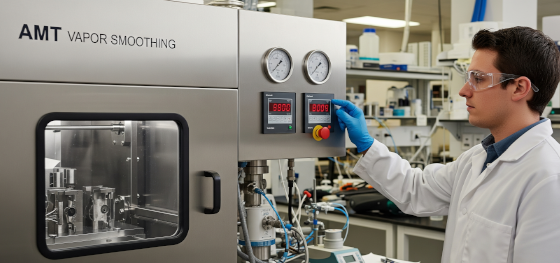
At JUCHENG, we recognize that the final ten microns of a part's surface dictate its market survival. We have integrated automated vapor-phase finishing into our core workflow to provide our clients with a "Net-Shape" aesthetic that requires zero manual labor. By utilizing precisely controlled chemical vapors within an industrial-tier chamber, we trigger a controlled physical transition where the polymer surface relaxes, flows, and solidifies into a mirror-like finish. This 2000-word guide explores the thermodynamic logic of solvent condensation, the critical sealing advantages of vapor-treated materials, and why JUCHENG’s automated approach is the definitive solution for hardware teams looking to bridge the gap between "prototype" and "product."
Efficiency in additive finishing is found in the management of surface energy. You aren't just cleaning a part; you are manipulating its molecular boundary to enhance its performance. Whether you are building an airtight medical manifold or a premium consumer wearable, the logic of the vapor is your greatest tactical asset. Let us examine the technical pillars of vapor-phase refinement and see how JUCHENG turns raw 3D output into engineered perfection.
Gritty Reality: The Surface Roughness Problem
Vapor Phase Alchemy: Understanding the Condensation Mechanism
Material Synergy: Mastering MJF Nylon and FDM Thermoplastics
Functional Sovereignty: Sealing the Voids for Liquid Tightness
Structural Integrity: Managing the Post-Smoothing Stress
JUCHENG’s Automated Standard: Precision Gloss Control
Gritty Reality: The Surface Roughness Problem
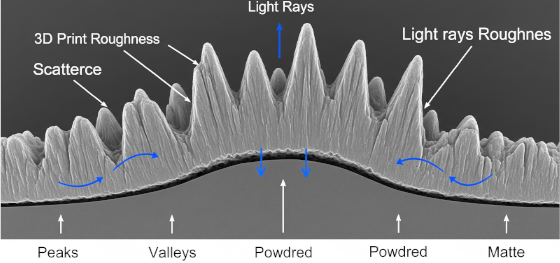
Traditional additive builds leave a distinctive mechanical footprint. If you examine a part from the MJF or SLS matériaux d'impression 3D family, you will find a surface composed of thousands of semi-fused powder particles. This creates a porous, "gritty" texture that scatters light and absorbs skin oils. In high-speed conception d'impression 3D, these micro-peaks and valleys are more than just ugly; they are structural weaknesses. Each tiny pit acts as a "stress riser," providing a site for a fracture to begin under load. Furthermore, for parts used in medical or food-processing environments, this porosity is a sanitation disaster, as microscopic valleys provide the perfect sanctuary for biofilm and bacteria that standard cleaning cannot reach.
Manual sanding is the conventional fix, but it is a crude instrument. A technician can smooth the large, flat surfaces of a part, but they can never reach into a 2mm internal hole or a complex lattice structure. This is the geometric bottleneck of manual labor. If you sand too aggressively, you ruin the tolerances; if you sand too little, the haze remains. Vapor Smoothing for 3D Prints offers a non-linear escape from this struggle. Vapor smoothing can change accessible surfaces, but internal channels may not respond like exposed faces. Identify the critical internal and external surfaces and verify the finish and dimensions at those locations.
Vapor Phase Alchemy: Understanding the Condensation Mechanism
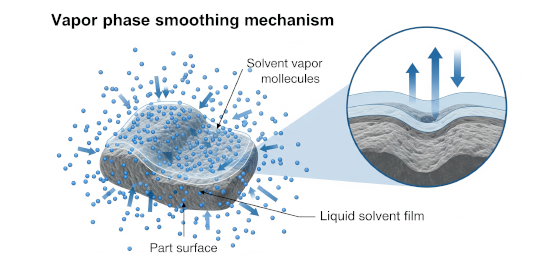
The mechanics of vapor polishing are an exercise in controlled condensation. Inside JUCHENG’s automated finishing chambers, a specialized solvent is heated until it reaches a gaseous state. When this warm vapor encounters the cooler surface of the 3D printed part, it can condense where it reaches the printed surface; the response depends on geometry and exposure. This is not a solvent dip; a dip would aggressively melt the part into a distorted glob. The vapor phase allows for a much more subtle, self-limiting interaction. The condensed liquid solvent begins to dissolve the outer shell of the plastic, turning the surface into a momentary, semi-liquid state.
In this liquid state, the laws of surface tension become the primary manufacturing tool. Much like a drop of water pulls itself into a perfect sphere, the semi-liquid plastic surface naturally pulls itself flat. The peaks of the layer lines flow into the valleys, erasing the evidence of the print. Once the exposure time is complete—a duration JUCHENG engineers calibrate down to the second—the chamber is evacuated. As solvent is removed, the surface re-solidifies. Narrow passages and recesses may not finish like exposed faces, and fine details or fits can change. Verify dimensions and finish after treatment on specified features such as threads, sealing lands, press fits and small bores.
Material Synergy: Mastering MJF Nylon and FDM Thermoplastics
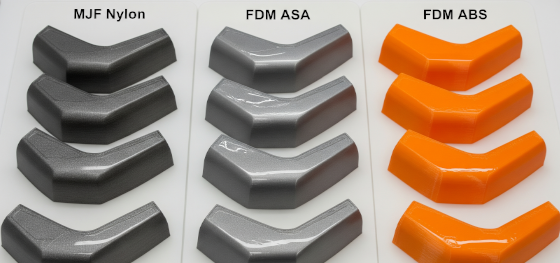
Compatibility is the filter of success in post-traitement d'impression 3D. Not every plastic responds to vapor smoothing with the same brilliance. At Jucheng Precision, we specialize in the materials that yield the highest ROI for this process. Nylon 12 (PA12) processed via MJF or SLS is the primary candidate. The raw grey or white nylon transforms into a deep, professional ebony finish that feels like a polished stone. This is essential for components like automotive gear knobs or high-end robotics enclosures where the user’s tactile experience is a direct reflection of the brand’s quality.
The synergy also extends to the FDM world, particularly with **ASA** and **ABS**. These amorphous polymers are highly reactive to solvent vapors, allowing us to achieve a "Piano Black" high-gloss finish that looks identical to an injection-molded part. For engineers building outdoor equipment, vapor-smoothed ASA is the ultimate defense; by closing the surface pores, we further enhance the material's already superior UV resistance and prevent dirt from becoming embedded in the part. We help our clients navigate this material selection, ensuring you don't waste budget on vapor-smoothing materials like PETG or Polycarbonate, which are notoriously difficult to smooth without clouding. By matching the chemical agent to the specific polymer matrix, JUCHENG ensures that the "visual upgrade" of your part is backed by a stable, non-degraded material structure.
Functional Sovereignty: Sealing the Voids for Liquid Tightness
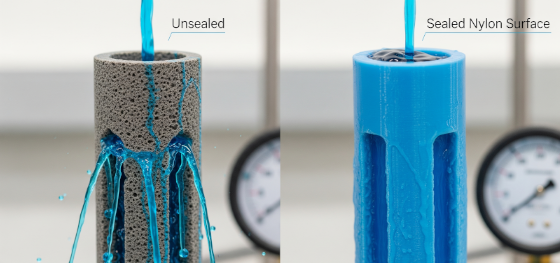
Appearance is only the surface of the benefit. The true engineering value of Vapor Smoothing for 3D Prints is to modify the surface, not to qualify a pressure-containing component. Leakage depends on the print process, wall geometry and assembly. Compare finishing or sealing options against the required fit and leak test.
For a compatible printed polymer, vapor smoothing can reduce surface roughness and porosity, but it does not establish gas or liquid tightness or a pressure rating. Specify the medium, pressure differential, temperature, test duration and allowable leakage. Test the finished part or assembly, including its joints and fittings where applicable. We have delivered vapor-smoothed manifolds for medical diagnostic equipment that must hold vacuum or handle aggressive chemicals without a single leak. A smoother surface may aid cleaning, but it does not demonstrate cleanability, sterility, food-contact suitability or readiness for fluid service. Verify the applicable performance and hygiene requirements on the finished part.
Structural Integrity: Managing the Post-Smoothing Stress
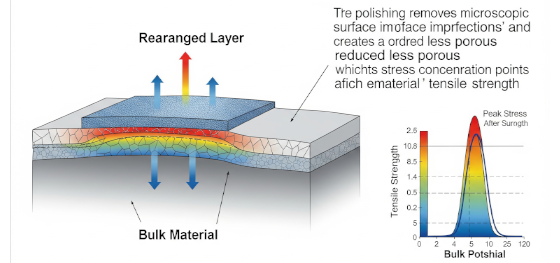
There is a technical nuance that many finishing bureaus ignore: the impact of chemical smoothing on mechanical properties. The process of melting the outer skin of a part can introduce localized internal stresses. If the solvent isn't fully evacuated from the part's core, it can lead to "delayed cracking" or a loss of tensile modulus. Mastering Vapor Smoothing for 3D Prints requires a rigorous understanding of the material's relaxation cycle. At Jucheng Precision, we follow every smoothing cycle with a controlled "Degassing" phase.
This step is intended to reduce residual solvent. Verify any applicable residue limit rather than assuming complete removal. Smoothing can change mechanical properties, but it does not establish fatigue life. Where cyclic loading matters, test representative finished parts under the intended loading and environment. We treat the surface integrity of your parts with the same technical reverence as our 5-axis usinage CNC du PEEK, with finish acceptance based on the part’s specified requirements. This commitment to the long-term lifecycle of the material is what separates a world-class manufacturing facility from a basic prototype shop.
JUCHENG’s Automated Standard: Precision Gloss Control
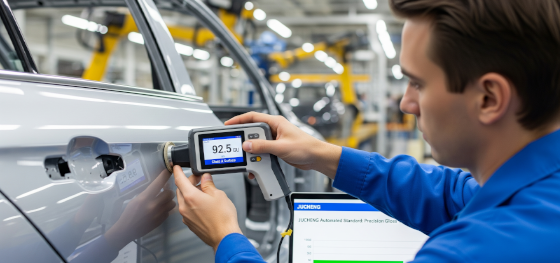
The final hallmark of a professional manufacturing partner is the move away from manual "eyeballing." Most shops tell their operators to "leave it in the vapor until it looks good." Jucheng Precision has discarded this subjective approach in favor of automated, recipe-driven gloss control. We have codified the relationship between vapor concentration, temperature, and material density into a digital library. This ensure that the "matte" finish you approved in the prototype phase is the exact same finish you receive in your 500-unit production run.
Our quality assurance framework includes the use of digital gloss meters and surface profilometers to verify that the $Ra$ value and the light-reflection index meet your specific requirements. We understand that in high-volume industrial orders, consistency is the only metric that matters. Whether you are building an iconic consumer electronic housing or a high-purity medical instrument, JUCHENG’s vapor smoothing expertise ensures your parts arrive with a professional finish that requires no apologies. We don't just print nylon; we refine its soul. Contact our engineering team today for a technical DFM review and see how our automated finishing protocols can clarify and armor your next manufacturing breakthrough.