


Choisir la bonne nuance d'acier inoxydable détermine le mode de défaillance et la marge de sécurité des composants industriels. Le SUS 304, équivalent à l'AISI 304, est l'acier inoxydable austénitique le plus utilisé dans la fabrication mondiale. Cependant, les ingénieurs interprètent souvent mal la distinction critique entre Limite d'élasticité et Résistance à la traction. Cette confusion entraîne des défaillances de conception catastrophiques où les pièces se déforment de manière permanente sous charge ou se fracturent structurellement en fonctionnement. La limite d'élasticité définit la limite exacte de récupération élastique, représentant le point où le métal commence à s'étirer de manière permanente. La résistance à la traction, en revanche, mesure la contrainte maximale absolue que le matériau peut supporter avant de se rompre. Maîtriser l'écart entre ces deux valeurs mécaniques révèle la " zone de déformation plastique ", un paramètre critique pour prédire le comportement du SUS 304 lors d'un usinage CNC agressif, du pliage de tôles et des opérations de formage à haute pression.
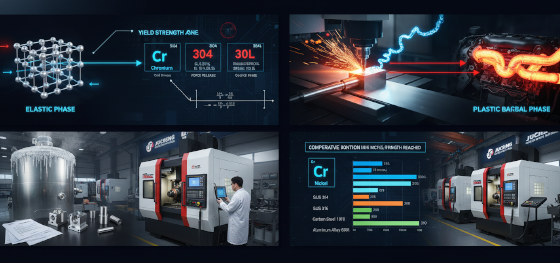
La fabrication du SUS 304 nécessite des connaissances métallurgiques approfondies, précisément en raison de ses caractéristiques de résistance uniques. Contrairement à l'aluminium ou à l'acier doux, l'acier inoxydable 304 présente une propension significative à l'écrouissage. Lorsqu'un outil de coupe déforme le matériau pour générer un copeau, la limite d'élasticité locale du métal non coupé augmente immédiatement, devenant effectivement plus dure que le matériau de base. Les machinistes CNC doivent maintenir agressivement les charges de copeaux pour couper sous cette couche durcie. De même, les opérateurs de tôlerie doivent calculer des angles de pliage précis pour contrer la mémoire de retour élastique du matériau. Jucheng Precision intègre ces principes de science des matériaux directement dans notre programmation CAM et nos stratégies d'outillage, garantissant que les propriétés mécaniques théoriques de la fiche technique correspondent à la réalité physique de vos pièces fabriquées sur mesure.
contenu :
Définition de la limite élastique et de la mécanique du point de fluage
Phénomènes d'écrouissage dans l'usinage CNC
Retour élastique de la tôle et implications pour le formage
La zone de déformation plastique et la résistance ultime à la traction
Impacts de la température sur les performances mécaniques
Facteurs de composition chimique influençant la variation de résistance
Tableau d'analyse comparative des alliages courants
Fabrication et assurance qualité chez Jucheng Precision
Définition de la limite élastique et de la mécanique du point de fluage

Les ingénieurs privilégient la limite d'élasticité comme principale contrainte de conception pour les applications non destructives. Pour l'acier inoxydable SUS 304, la limite d'élasticité se situe généralement autour de 215 mégapascals (MPa). Cette valeur représente la contrainte maximale que le matériau peut supporter tout en agissant comme un ressort. Si une charge reste en dessous de ce seuil, le réseau atomique s'étire temporairement et revient à sa forme d'origine une fois la force retirée. Concevoir un support structurel ou une cuve sous pression nécessite de maintenir les contraintes de fonctionnement bien en dessous de cette limite de 215 MPa pour éviter toute distorsion géométrique permanente. Toute force dépassant cette valeur spécifique provoque le glissement des plans atomiques les uns sur les autres, entraînant une déformation plastique irréversible.
Distinguer le point de fluage exact dans les aciers inoxydables austénitiques présente un défi technique. Contrairement aux aciers au carbone qui montrent une chute brutale du point de fluage, le SUS 304 présente une transition progressive du comportement élastique au comportement plastique. Les métallurgistes utilisent la " méthode de décalage de 0,2% " pour normaliser cette mesure. Ils tracent une ligne parallèle à la courbe du module élastique initial mais décalée de 0,2% de déformation sur l'axe des X. L'intersection de cette ligne théorique avec la courbe contrainte-déformation définit la limite d'élasticité officielle. Comprendre cette transition progressive est crucial pour l'estampage de précision, car le matériau commence à s'écouler microscopiquement avant que la déformation macroscopique ne devienne visible à l'œil nu.
Phénomènes d'écrouissage dans l'usinage CNC
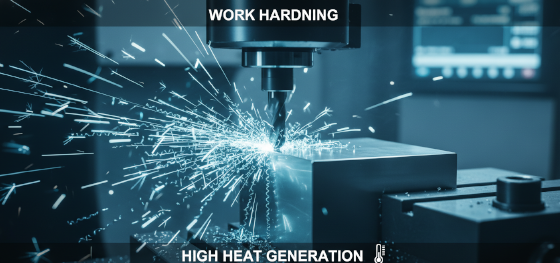
L'usinage de l'acier inoxydable SUS 304 exige un départ complet des stratégies standard de traitement de l'aluminium en raison du phénomène d'écrouissage. Ce matériau possède une ductilité élevée et une structure cristalline unique qui durcit rapidement lorsqu'il est soumis à des forces de travail à froid. Lors d'une opération de fraisage ou de tournage, si l'outil de coupe frotte contre la surface plutôt que de la cisailler, la chaleur et la pression augmentent instantanément la limite d'élasticité locale de la pièce. Le matériau directement devant l'outil devient nettement plus dur que le matériau en vrac, provoquant une usure rapide de l'outil, une rupture catastrophique de la fraise et de mauvais états de surface.
Overcoming this "gummy" yet hard characteristic requires aggressive CNC parameters. Machinists must maintain a constant, heavy chip load to ensure the cutting edge penetrates beneath the work-hardened zone created by the previous pass. Dwelling in the cut or allowing the tool to idle against the part is strictly prohibited. High-pressure coolant delivery becomes essential not just for temperature control, but to provide lubricity that prevents the material from seizing or welding onto the tool bit (Built-Up Edge). Jucheng Precision employs specialized coated carbide tooling with sharp positive rake angles specifically designed to shear austenitic stainless steel cleanly, preventing the heat buildup that triggers hardening.
Retour élastique de la tôle et implications pour le formage
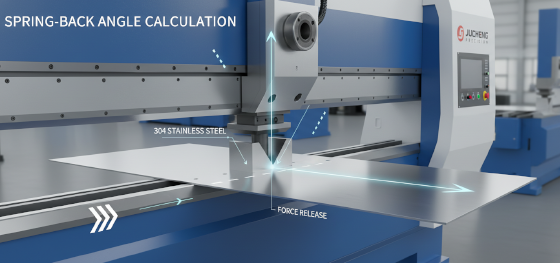
Fabricating sheet metal components from SUS 304 introduces the complex variable of elastic recovery, commonly known as spring-back. Because the yield strength determines the limit of elasticity, it directly dictates how much the metal will try to return to its original flat shape after bending. Since SUS 304 has a relatively high yield strength compared to mild steel, it stores more elastic energy during the forming process. When the press brake punch retracts, the bent flange relaxes, opening the angle by several degrees. A ninety-degree bend programmed into the machine might result in a ninety-three-degree angle on the physical part.
Predicting and compensating for this deviation requires sophisticated bending calculations. Operators must over-bend the material effectively to account for the relaxation. For a target angle of ninety degrees, the tooling might need to drive to eighty-seven degrees. The exact amount of spring-back varies depending on the sheet thickness, the bend radius, and the specific rolling grain direction of the raw material. Bending perpendicular to the grain offers different resistance than bending parallel to it. Jucheng Precision utilizes adaptive laser bending systems that measure the angle in real-time during the stroke, automatically adjusting the punch depth to guarantee precise geometric tolerances despite the material's inherent elastic memory.
La zone de déformation plastique et la résistance ultime à la traction

Ultimate Tensile Strength (UTS) defines the absolute breaking point of the material. For SUS 304, this value typically ranges between 505 and 700 MPa, significantly higher than its yield strength. The vast gap between the 215 MPa yield point and the 505 MPa tensile limit represents the "plastic deformation zone." This wide range indicates high ductility, meaning the material can stretch significantly—often up to 40% elongation—before finally fracturing. This property makes 304 excellent for deep drawing processes, such as manufacturing kitchen sinks or industrial chemical tanks, where the metal must flow extensively without tearing.
Designers must understand that reaching the tensile strength means the component has already failed structurally. While the part has not physically separated into two pieces, it has undergone massive, permanent distortion and "necking," where the cross-sectional area thins dramatically at the stress concentration point. In safety-critical applications like lifting rigging or pressurized piping, engineers apply a safety factor based on the yield strength, not the tensile strength. The tensile strength serves primarily as a buffer against catastrophic separation, providing a margin of safety where the material deforms visibly, giving warning before total collapse occurs.
Impacts de la température sur les performances mécaniques
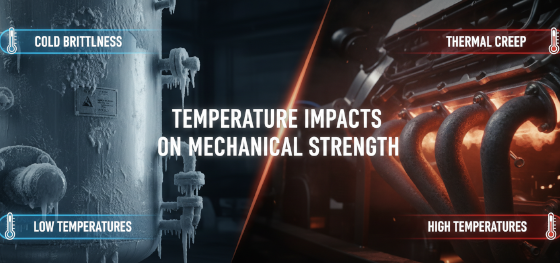
Thermal environments drastically alter the mechanical relationship between yield and tensile strength. SUS 304 maintains excellent toughness at cryogenic temperatures, avoiding the brittle fracture transition that plagues carbon steels. At temperatures as low as minus 196 degrees Celsius, 304 actually gains tensile strength while retaining usable ductility, making it the standard choice for liquid nitrogen storage tanks. The face-centered cubic crystal structure remains stable, preventing sudden shattering under impact in freezing environments.
Conversely, elevated temperatures degrade these mechanical properties. As the operational environment exceeds 500 degrees Celsius, both yield and tensile strength begin to drop precipitously. Furthermore, the material becomes susceptible to "creep," a phenomenon where the metal slowly deforms over time under constant stress, even if that stress is below the yield point. For high-temperature exhaust manifolds or industrial furnace components, engineers might switch to stabilized grades like 321 or 347, or move to high-nickel alloys like Inconel. Understanding the thermal service curve is mandatory for preventing long-term structural failures.
Facteurs de composition chimique influençant la variation de résistance
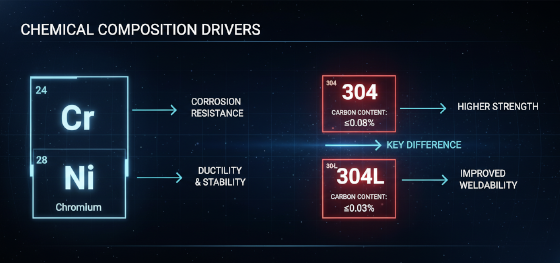
The mechanical muscle of SUS 304 derives directly from its specific alloy recipe. It contains nominally 18% chromium and 8% nickel, often referred to as "18/8 stainless." The carbon content plays a pivotal role in determining strength. Standard 304 allows for up to 0.08% carbon, which acts as an interstitial strengthening agent within the iron lattice. This carbon helps lock the crystal planes, boosting tensile strength. However, this same carbon can lead to carbide precipitation during welding, causing corrosion issues.
The low-carbon variant, SUS 304L (with carbon below 0.03%), solves the welding corrosion problem but sacrifices some mechanical strength. The reduction in carbon atoms allows the crystal lattice to slip more easily, slightly lowering both the yield and tensile values compared to standard 304. To compensate for this, steel mills often add nitrogen to 304L, creating "dual-certified" 304/304L. The nitrogen atoms replace the strengthening role of carbon, restoring the yield strength to standard levels while maintaining the superior weldability. Procurement managers must verify the specific mill test reports to ensure the material batch meets the structural calculations of the design.
Tableau d'analyse comparative des alliages courants
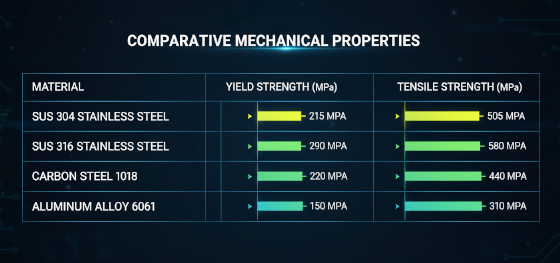
Benchmarking SUS 304 against other manufacturing materials clarifies its position in the engineering hierarchy. While it offers excellent corrosion resistance, its yield strength is relatively modest compared to heat-treated alloy steels. However, its massive gap between yield and tensile strength (ductility) far exceeds that of aluminum or hardened tool steels. The following data highlights why 304 is chosen for forming and corrosion resistance rather than pure structural rigidity.
| Grade du matériau | Limite d'élasticité (MPa) | Résistance à la traction (MPa) | Primary Fabrication Characteristic |
|---|---|---|---|
| SUS 304 (Annealed) | ~215 | ~505 | High ductility, work hardens rapidly |
| SUS 316 (Marine) | ~205 | ~515 | Superior corrosion resistance, slightly harder to machine |
| Aluminium 6061-T6 | ~276 | ~310 | Excellent machinability, low ductility (snaps easily) |
| 1045 Carbon Steel | ~310 | ~565 | Higher strength, poor corrosion resistance |
Fabrication et assurance qualité chez Jucheng Precision
Sourcing reliable stainless steel components requires a manufacturing partner who understands the nuance of material science. Jucheng Precision eliminates the risks associated with SUS 304 fabrication by implementing strict material verification and process controls. Before any CNC machining or sheet metal forming begins, our quality team analyzes the incoming raw material using advanced spectrometers to confirm the Nickel and Chromium content matches international standards. This prevents the accidental use of sub-standard materials that may fail prematurely in the field.
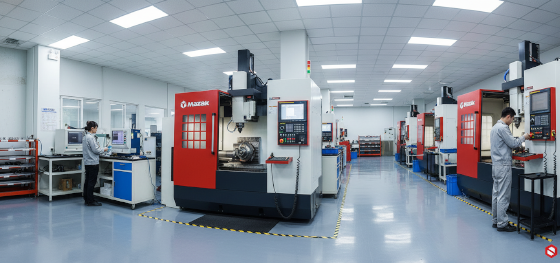
Our manufacturing facility, spanning 8000 square meters, houses over 150 CNC machines, including 25 high-rigidity 5-axis Mazak centers capable of powering through work-hardened stainless steel without vibration. We offer comprehensive services from rapid prototyping to low-volume production with absolutely no minimum order quantity (No MOQ). Whether you require complex machined manifolds with tight tolerances or precision bent sheet metal enclosures, Jucheng provides free DFM reviews to optimize your design for the specific mechanical behaviors of SUS 304. Backed by ISO9001:2015, ISO 14001, and IATF16949 certifications, we deliver components that perform exactly as engineered, balancing cost, quality, and speed.

