


La force d'écrasement hydrostatique représente le juge ultime de l'intégrité du matériel en eaux profondes. Lorsqu'un robot sous-marin moves into deeper water, external pressure rises. Whether an aluminum, stainless steel or titanium housing is suitable depends on its geometry, material condition, loading and validation; alloy or depth alone does not establish collapse resistance. Strength-to-weight and corrosion resistance are reasons to consider Usinage CNC du titane pour équipements sous-marins. Jucheng Precision opère comme un sanctuaire métallurgique haute-fidélité dans le pôle de fabrication de précision de Shenzhen, fournissant la profondeur CNC 5 axes nécessaire pour conquérir les alliages de titane les plus difficiles. Dans le cadre plus large de l' Pièces AGV et AMR and maritime robotics, pressure hulls and thruster mounts should be assessed and validated for their own loads and intended service.
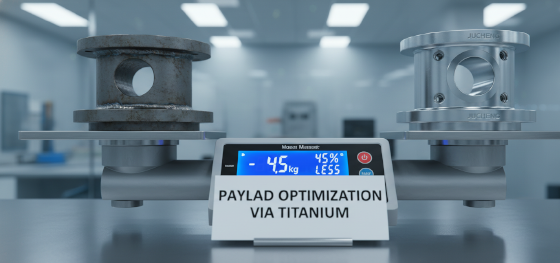
Establishing a resilient deep-sea supply chain in 2026 demands the rejection of "standard-speed" machining logic. Titanium’s low thermal conductivity makes it harder to move heat away from the cutting zone. Tool wear and surface condition depend on the alloy, cutter, engagement, speed and coolant delivery. Jucheng Precision eliminates these "Metallurgical Disasters" by enforcing a strict "Cold-Cut" protocol across our 150+ CNC machine campus. Whether you are developing an ultra-deep sea ROV camera housing or a titanium battery pod, our facility provides the material science and metrological rigor required for global market entry. This guide compares titanium grades, explains heat management during cutting and outlines what to verify for Usinage CNC du titane pour équipements sous-marins projets pour l'abysse.
Grade 5 vs. Grade 2 : Sélection des alliages pour la pression structurelle
Guerre Thermique : Gérer la chaleur dans les alliages non conducteurs
Glands Hermétiques : Usinage des faces d'étanchéité à +/- 0,005 mm
Souveraineté sans Revêtement : Pourquoi le titane ignore l'attaque de l'eau salée
Protocole JUCHENG : Tiodize et Métrologie Haute Pression
Grade 5 vs. Grade 2 : Sélection des alliages pour la pression structurelle
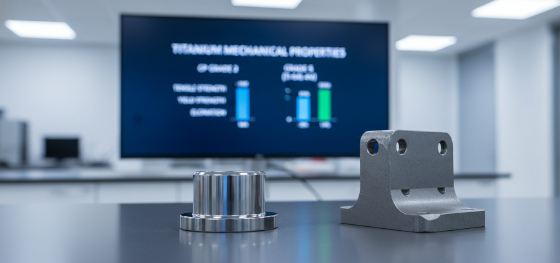
Pour Usinage CNC du titane pour équipements sous-marins, commercially pure Grade 2 and Grade 5 (Ti-6Al-4V) are different material options. Grade 5 typically offers higher strength than Grade 2, but use the specified product form, section size and material condition for design properties. Titanium has lower density than stainless steel, but finished weight and pressure capability depend on the design. Verify the completed housing for its specified service rather than using a grade name as a pressure rating.
Guerre Thermique : Gérer la chaleur dans les alliages non conducteurs
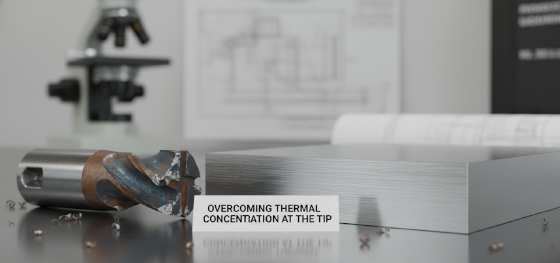
Titanium alloys have relatively low thermal conductivity, so heat can concentrate near the cutting edge. Depending on the operation, mechanical loading, thermal cycling and adhesion or chemical interaction can contribute to edge wear or chipping. There is no fixed fraction of heat entering the tool or universal cutting temperature. Assess tool wear and the machined surface for the actual alloy, cutter, engagement, speed and cooling conditions. Usinage CNC du titane pour équipements sous-marins at Jucheng Precision is managed with "Thermodynamic Rigor." We utilize specialized positive-rake cutters and program high-feed toolpaths that physically "Peel" the metal away before the heat can accumulate. Verify bearing-seat and flange dimensions and surface condition against the drawing; a toolpath does not guarantee zero thermal distortion.
Glands Hermétiques : Usinage des faces d'étanchéité à +/- 0,005 mm
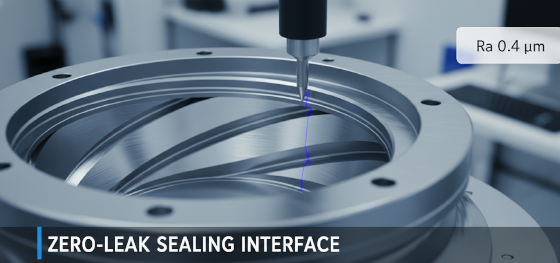
An O-ring gland is one part of the sealing system. Usinage CNC du titane pour équipements sous-marins should follow the gland dimensions and finish on the approved drawing. Evaluate the seal compound, squeeze, clearance under load, surface condition and service environment together. No universal finish value proves leak tightness. Jucheng Precision utilizes specialized burnishing passes to achieve an SPI B-1 or mirror finish (Ra < 0.4 µm) on all sealing faces. A specified concentricity tolerance can be checked by inspection, but it does not establish a pressure rating or rule out seal failure. Validate pressure and leak performance on the assembled hardware for the specified service conditions.
Souveraineté sans Revêtement : Pourquoi le titane ignore l'attaque de l'eau salée
A passive oxide layer gives titanium useful resistance in many seawater environments. This is not corrosion immunity: assess the exact grade, temperature, crevices and contact with other metals. For Usinage CNC du titane pour équipements sous-marins, decide whether protective finishes are needed from the actual service and assembly requirements. Include inspection and maintenance for fouling, seals and dissimilar-metal interfaces as applicable.
Protocole JUCHENG : Tiodize et Métrologie Haute Pression
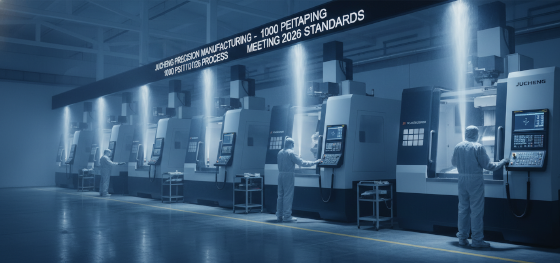
L'excellence de fabrication chez Jucheng Precision repose sur une base d'équipements industriels spécialisés. Nous hébergeons des centres CNC 5 axes haut de gamme équipés de systèmes de liquide de refroidissement à haute pression de 1 000 PSI à travers la broche (TSC) spécifiquement pour Usinage CNC du titane pour équipements sous-marins. Through-tool coolant can help manage heat and clear chips; results depend on delivery to the cutting edge and the actual operation. We provide full material lot traceability and CMM inspection reports for every batch, providing the "Paper Trail of Quality" required for naval and high-stakes research contracts. Stop gambling your abyssal mission on vendors who treat titanium like standard steel. Leverage our decade of high-performance metallurgical mastery to validate rapidly and launch profitably. Contact our technical team today for a free DFM review.
FAQ
Q : Pourquoi le titane Grade 5 est-il utilisé pour les coques de robots sous-marins ?
A: Grade 5 is a candidate where strength relative to density matters. Use the applicable specification for the actual material form and condition. Weight, buoyancy and pressure capability depend on the finished assembly, not the grade alone.
Q : Comment JUCHENG empêche-t-il le "Grippage" dans les filetages en titane ?
A: We offer specialized Tiodize (Type II Anodize) surface treatments and dry-film lubricants that increase surface lubricity, which can help reduce galling risk. Verify the chosen finish and lubricant with the actual mating materials and assembly conditions.
Q : Quel est le délai de livraison pour un caisson sous pression en titane ?
R : Grâce à notre flux de travail CNC 5 axes accéléré, Jucheng Precision peut livrer des boîtiers de ROV en titane entièrement usinés et testés en aussi peu que 12 à 15 jours ouvrables.

