


Observer un axe asservi dans une salle blanche de semi-conducteurs en [2026] révèle un défi mécanique critique pour pièces de robot industriel: la fixation du moteur. Si le support du moteur fléchit ou permet un désalignement même microscopique, l'arbre du moteur et l'entrée du réducteur s'affronteront, générant une chaleur destructrice et des vibrations audibles. Ce " tueur silencieux " de la longévité du robot impacte directement la précision de positionnement du robot et la durée de vie des actionneurs coûteux. Maîtriser la fabrication de supports de moteur robotisés nécessite un alignement coaxial absolu, une dissipation thermique efficace et une résistance aux vibrations sans compromis.
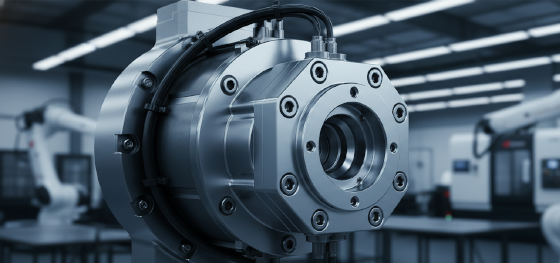
La précision ne concerne pas simplement l'usinage ; il s'agit d'empêcher les forces qui dégradent la précision sur des millions de cycles. Un support de moteur est l'interface critique entre le moteur principal du robot et son système de réduction de mouvement. Tout écart de concentricité ou de parallélisme provoque une usure prématurée des roulements dans le moteur et le réducteur, entraînant une consommation d'énergie accrue et une défaillance catastrophique éventuelle. Jucheng Precision relève ces défis d'interface critiques en utilisant des centres de tournage-fraisage CNC à haute rigidité et des techniques avancées de relaxation des contraintes.
Opérant au sein du pôle de fabrication de précision de Shenzhen, JUCHENG fournit un " Pont vers la Production " pour les fabricants de robots visant des applications à haute précision et à cycle de service élevé. Nous transformons des billettes d'aluminium à haute résistance en supports de moteur personnalisés qui servent d'ancrage inébranlable pour le système servo du robot. Ce guide explore les normes d'alignement essentielles, les stratégies de gestion thermique et les techniques d'antivibration requises pour fabriquer des supports de moteur robotisés garantissant des performances inébranlables et une durée de vie opérationnelle prolongée.
Réaliser l'alignement coaxial : prévenir la défaillance du réducteur
Données comparatives : matériaux de support pour la stabilité thermique
Optimiser la dissipation thermique pour les moteurs à cycle de service élevé
Résister aux vibrations : sécuriser les supports contre le desserrage
JUCHENG : le pôle de Shenzhen pour les supports de moteur de haute précision
FAQ : longévité des supports de moteur pour systèmes autonomes
Réaliser l'alignement coaxial : prévenir la défaillance du réducteur
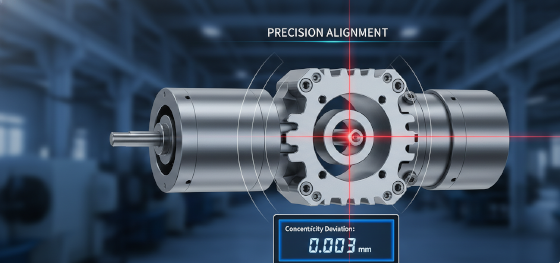
La concentricité entre l'arbre du moteur et l'entrée du réducteur est la mesure la plus critique dans fabrication de supports de moteur robotisés. Même un désalignement radial de 0,01 mm crée une charge excentrique sur les roulements du moteur et du réducteur. Cela entraîne une usure prématurée, une friction accrue et une génération de chaleur. JUCHENG utilise le tournage et le fraisage CNC de précision pour usiner les faces de montage et les diamètres de centrage en une seule opération, garantissant que tous les axes de rotation sont parfaitement coaxiaux à moins de 5 microns. Cela élimine le " faux-rond " qui peut détruire des systèmes servo coûteux.
Le parallélisme des faces de montage détermine également la répartition des contraintes. Si le support moteur a une légère forme de " coin ", le serrage des boulons induira des moments de flexion dans l'arbre du moteur, le faisant chauffer et pouvant endommager le codeur interne du moteur. JUCHENG utilise la rectification de surface avancée et le surfaçage de précision sur nos fraiseuses CNC pour atteindre des tolérances de planéité de 0,005 mm par 100 mm. Cela garantit que le support moteur offre une surface vraiment plane pour la bride du moteur, répartissant uniformément les forces de serrage et éliminant les concentrations de contraintes localisées.
Les trous de goupilles de positionnement de précision fournissent la précision angulaire requise pour une installation répétable du moteur. JUCHENG usine ces trous de positionnement avec une tolérance H7, garantissant un ajustement glissant parfait qui élimine le jeu rotationnel. Cela signifie que si un moteur doit être remplacé sur le terrain, le nouveau moteur s'alignera automatiquement exactement à la même position que l'ancien, éliminant ainsi le besoin de recalibrage complexe du pièces de robot industriel et réduisant considérablement les temps d'arrêt du robot.
L'état de surface des faces d'accouplement est contrôlé à Ra 0,8 ou mieux. Une surface rugueuse peut entraîner une " corrosion de frottement " — une usure microscopique qui crée de fines particules métalliques pouvant contaminer les roulements voisins. L'usinage de précision de JUCHENG garantit une interface lisse et non abrasive qui maintient son intégrité sur des millions de cycles vibratoires, protégeant à la fois le support moteur et les composants servo coûteux qu'il connecte.
Données comparatives : matériaux de support pour la stabilité thermique
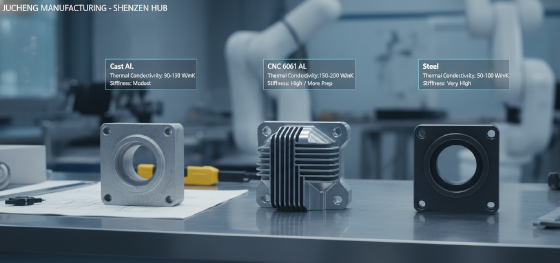
Le choix du bon matériau pour un support moteur implique un équilibre entre rigidité, conductivité thermique et coût. Les servomoteurs à cycle de service élevé génèrent une chaleur importante, et le support fait souvent office de dissipateur thermique. Jucheng Precision fournit des consultations techniques pour vous aider à naviguer dans ces compromis métallurgiques. Le tableau suivant compare les matériaux courants utilisés dans les hautes performances fabrication de supports de moteur robotisés pour le marché [2026].
| Grade du matériau | Conductivité thermique (W/m·K) | Limite d'élasticité (MPa) | Avantage principal |
|---|---|---|---|
| Aluminium 6061-T6 | 167 | 270 | Haute conductivité / Léger |
| Aluminium 7075-T6 | 130 | 500 - 540 | Rigidité max / Léger |
| Acier AISI 1045 | 49.8 | 450 - 600 | Haute rigidité / Économique. |
| Magnésium AZ91D | 72 | 160 | Ultra-Lightweight |
6061-T6 Aluminum is the preferred choice for motor mounts because it offers an excellent balance of strength, lightweight properties, and superior thermal conductivity. Its high thermal transfer rate allows the motor mount to act as an extended heat sink, drawing heat away from the motor body and dissipating it into the surrounding air. JUCHENG integrates complex cooling fin geometries directly into the CNC toolpath, maximizing the surface area for passive cooling and reducing the need for active fans, which can introduce dust and noise.
7075-T6 Aluminum is utilized when maximum stiffness-to-weight is paramount, such as in the J5 or J6 axes of a high-speed robot where inertia must be minimized. While its thermal conductivity is slightly lower than 6061, its significantly higher yield strength allows for thinner wall sections, resulting in a lighter and more rigid mount. JUCHENG’s "cold-cut" CNC machining strategies prevent thermal distortion during the milling of 7075, ensuring that the critical pilot diameters remain perfectly round for the motor.
Optimiser la dissipation thermique pour les moteurs à cycle de service élevé
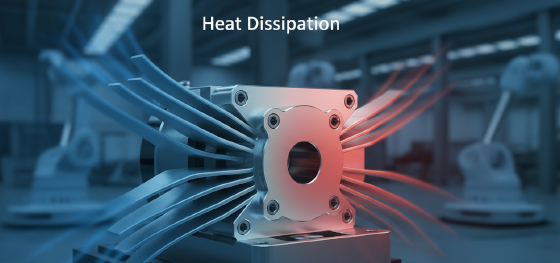
Heat generated by servo motors is a direct enemy of performance and longevity. Overheated motors suffer from "thermal throttling," where their output power is reduced to prevent damage. In fabrication de supports de moteur robotisés, the mount itself can be engineered to actively draw heat away from the motor. JUCHENG designs motor mounts with integrated cooling fins that increase the surface area for convective heat transfer. These fins are precisely machined using 5-axis CNC to optimize airflow and minimize thermal resistance.
Thermal interface material (TIM) placement is crucial for efficient heat transfer. JUCHENG often machines recessed pockets on the motor-facing side of the mount to accommodate high-performance TIMs (like thermal pastes or gap pads). These materials fill microscopic air gaps between the motor and the mount, ensuring a continuous thermal path and maximizing heat flow away from the motor windings. This attention to detail is critical for pièces de robot industriel that run 24/7 in non-climate-controlled factory environments.
Internal cooling channels can be integrated into the motor mount for liquid-cooled servo systems. For ultra-high-power robotic applications, passive air cooling is insufficient. JUCHENG utilizes deep-hole drilling and precision CNC milling to create complex internal fluid paths within the aluminum mount. This allows the OEM to circulate a liquid coolant around the motor's housing, maintaining a constant optimal operating temperature regardless of the load or ambient conditions. This level of advanced thermal engineering is what allows JUCHENG to support the most demanding automation projects in the laser processing and heavy-duty machining sectors.
Anodizing (Type III Hardcoat) provides more than just corrosion protection for aluminum motor mounts; it also enhances the surface emissivity for radiative cooling. The hard, porous oxide layer increases the surface area at a microscopic level, allowing the mount to shed heat more effectively. JUCHENG precisely controls the thickness of the anodized layer, ensuring that it does not interfere with the critical mounting tolerances while still providing superior thermal performance and a durable, aesthetically pleasing finish.
Résister aux vibrations : sécuriser les supports contre le desserrage
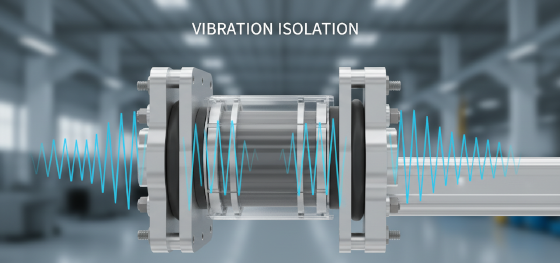
Vibrational fatigue is a primary cause of motor mount failure and positional drift. During millions of rapid acceleration/deceleration cycles, mounting bolts can slowly work loose, leading to catastrophic misalignment and encoder errors. JUCHENG’s fabrication de supports de moteur robotisés philosophy includes integrated vibration resistance. We machine mating surfaces to Ra 0.8 or better to maximize surface contact, which increases friction between the mount and the robot frame, preventing micro-slip.
Thread integrity is paramount. JUCHENG utilizes precision CNC tapping to produce Class 3B threads in all mounting holes. For critical applications, we often integrate hardened steel thread inserts (Helicoils) into aluminum mounts, providing superior pull-out strength that resists vibrational loosening. This ensures that the motor remains rigidly fixed to the robot frame, maintaining the precise geometric relationship required for repeatable motion.
Stress relief is applied between machining steps for complex motor mounts to prevent residual stresses from causing warpage. Large-volume material removal can release internal tensions in the alloy, leading to subtle dimensional changes. JUCHENG utilizes thermal stress relief (TSR) or vibrational stress relief (VSR) to "pre-condition" the material, ensuring that the mount remains perfectly flat and dimensionally stable throughout its service life, even under constant vibrational load.
Dampening elements can also be integrated into the motor mount design. For applications where the motor itself is a significant source of high-frequency vibration, JUCHENG can machine recesses for elastomeric pads or isolation washers. These elements decouple the motor from the main robot frame, preventing the transmission of unwanted harmonics that could affect sensitive sensors or cause premature wear in adjacent components. This holistic approach ensures the longevity of the entire robotic system.
JUCHENG : le pôle de Shenzhen pour les supports de moteur de haute précision
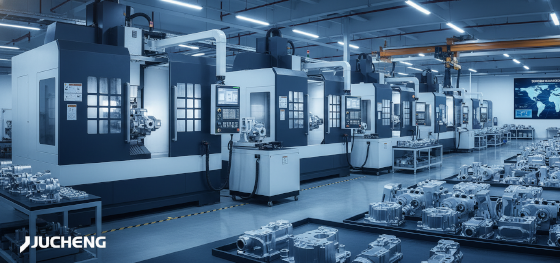
Dominating the [2026] industrial automation market requires a manufacturing partner that can scale from prototype to massive fleet production without losing precision. Jucheng Precision operates with a 24/7 manufacturing mindset in our Shenzhen precision manufacturing hub, delivering high-tolerance motor mounts and structural pièces de robot industriel with lead times as fast as 12 business days. We provide a "Bridge to Production" that allows you to move from a single hand-fitted prototype to a commercial deployment of 1,000 units with consistent coaxial alignment and thermal performance.
Integrating your motor mount design with JUCHENG’s expertise ensures that your robot survives the "First-Million Cycle" test and moves into long-term adoption. We offer comprehensive DFM reviews within 24 hours, identifying potential alignment risks or "thermal bottlenecks" in your mount design before they become field failures. Whether you are building a collaborative robot for delicate assembly or a heavy-duty robot for casting removal, Jucheng Precision provides the rigid, precise anchors that keep your innovation moving through the high-speed cycles and the years of hard labor.
Our facility is equipped with 150+ CNC machines, including the latest turn-mill centers and CMM inspection labs, allowing us to manage the entire motor mount lifecycle from raw billet to finished, verified assembly. We manage the complexity of micron-level machining so your engineering team can focus on the motion control algorithms and the AI. By combining Shenzhen's speed with industrial-grade material verification, JUCHENG remains the preferred partner for the world's most aggressive pièces de robot industriel les plus agressifs au monde. Contactez-nous dès aujourd'hui pour démarrer votre prochain projet.
FAQ : longévité des supports de moteur pour systèmes autonomes
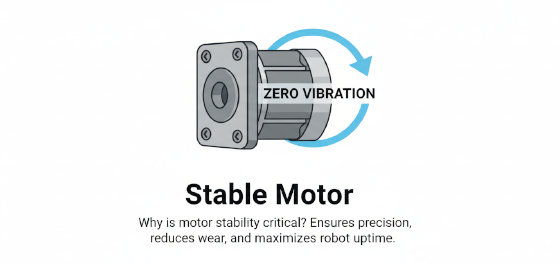
What is the ideal material for a thermally efficient motor mount?
6061-T6 Aluminum. Its high thermal conductivity allows the mount to act as a large heat sink.
How do you ensure motor mounts prevent vibration loosening?
We machine high-friction mating surfaces and use hardened steel thread inserts for superior bolt security.
Can JUCHENG machine liquid-cooling channels into mounts?
Yes. We use deep-hole drilling and precision CNC milling to integrate internal fluid paths for optimal thermal control.
What tolerance is required for motor pilot diameters?
Pilot diameters must be machined to a +/- 0.005mm tolerance to ensure perfect coaxial alignment with the gearbox.
What are typical lead times for custom motor mounts?
Precision-machined motor mounts are typically delivered in 10 to 15 business days.
Servo motor misalignment in industrial robotics is an absolute hardware killer. Partnering with Jucheng Precision ensures that your motor mounts are built with the micron-level coaxiality and specialized heat-dissipation techniques the industry demands. Reach out to our Shenzhen manufacturing hub today for a complete DFM review and build the rigid foundation your autonomous fleet requires.

