


Observing a high-precision welding robot in a Tesla or BMW facility reveals the critical role of pièces de robot industriel: the housing is the invisible guardian of motion. While the motor provides power, the joint housing dictates whether that power translates into micron-level accuracy or destructive vibration. If the housing for a Harmonic or RV drive is misaligned by even ten microns, the internal gears will experience uneven loading, leading to rapid wear and premature gearbox failure. Mastering Robotic joint housing machining is the only way to ensure the J1 through J6 axes maintain their zero-backlash performance over millions of cycles in [2026].
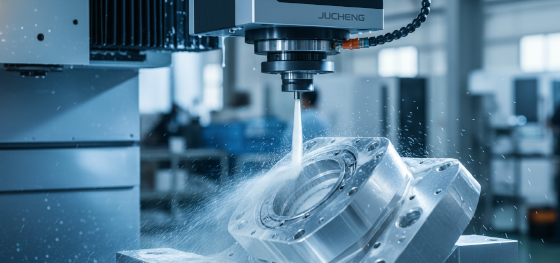
Concentricity dictates the lifespan of robotic drivetrains. In 6-axis kinematics, the housing must provide perfectly aligned bearing seats for the input and output shafts. Any tilt or offset in these seats creates "parasitic torque," which forces the motor to draw more current and generates localized heat. Jucheng Precision addresses these alignment challenges by utilizing 5-axis Mazak and Haas centers, ensuring that all critical rotational features are machined in a single setup to eliminate stacking errors.
Operating within the Shenzhen precision manufacturing hub, JUCHENG provides the "Bridge to Production" for collaborative and industrial robot OEMs. We transform raw aluminum billets or ductile iron castings into stabilized enclosures that act as the rigid "house" for the robot's heart. This guide explores the essential concentricity standards, the advantages of 5-axis integration, and the thermal stability strategies required for manufacturing robotic joint housings that never quit.
Concentricity Standards: Protecting the Gearbox Heart
Technical Data: Comparative Materials for Joint Enclosures
5-Axis CNC Precision: Eliminating Stacking Errors
Thermal Stability: Managing Dimensions in 24/7 Operations
JUCHENG: The Shenzhen Hub for Micron-Level Alignment
FAQ: Precision Machining for Robotic Motion Joints
Concentricity Standards: Protecting the Gearbox Heart
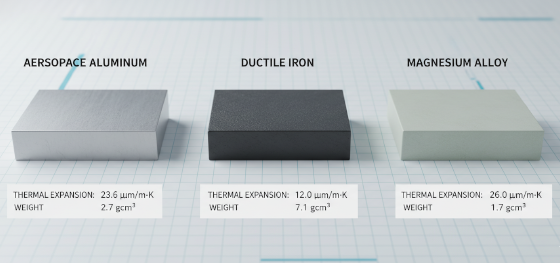
Concentricity between the bearing seats and the gear interface is the most significant metric in Robotic joint housing machining. In a typical J2 or J4 axis, the housing must accommodate a high-precision reducer, often a Harmonic drive. If the bearing seat is eccentric by even 0.01mm relative to the output flange, the gear teeth will not mesh uniformly. This creates "hot spots" where the lubricant is squeezed out, leading to microscopic metal-to-metal contact and the eventual unzipping of the gear teeth during high-torque move-sets.
Le parallélisme entre les faces de montage est tout aussi critique. Les articulations robotiques sont empilées dans une chaîne cinématique ; tout écart de parallélisme d'un boîtier est multiplié lorsque le bras s'étend. JUCHENG utilise des comparateurs à cadran submicroniques spécialisés et des trackers laser pour vérifier que les surfaces de montage supérieure et inférieure sont parallèles à moins de 0,005 mm. Cela garantit que le point " d'origine " du robot reste stable, évitant les problèmes de dérive logicielle qui affectent les assemblages robotiques de faible qualité.
La perpendicularité de l'axe de rotation par rapport à la base de montage garantit que le robot se déplace dans un plan réel. Si l'alésage du boîtier est " incliné " de quelques microns, le bras présentera un léger " balancement " lors des mouvements à pleine extension. Le processus CNC 5 axes de JUCHENG nous permet d'usiner l'alésage et la face de montage dans la même opération, garantissant que l'axe de rotation est parfaitement orthogonal au plan de montage. Cette perfection mécanique réduit la charge de calcul sur le contrôleur du robot, car il n'a pas à compenser le " jeu " géométrique."
L'état de surface dans l'alésage du roulement détermine l"" ajustement " et la stabilité à long terme de l'articulation. Nous usinons ces alésages avec une finition Ra 0,4 ou meilleure pour garantir que la piste de roulement a une surface de contact maximale avec le boîtier. Une finition plus rugueuse permettrait au roulement de " se tasser » ou de bouger légèrement sous les vibrations, desserrant éventuellement l'ajustement serré et entraînant des à-coups de l'axe. L'engagement de JUCHENG envers la précision au micron pièces de robot industriel garantit que vos articulations restent serrées et silencieuses pendant toute leur durée de vie opérationnelle.
Technical Data: Comparative Materials for Joint Enclosures
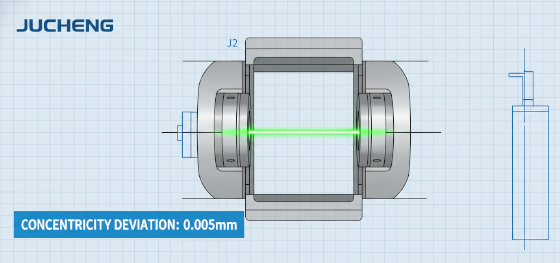
Le choix du bon matériau de boîtier nécessite d'équilibrer la masse, la rigidité et la dilatation thermique. Pour les robots collaboratifs (cobots), le magnésium ou l'aluminium est préféré pour la légèreté ; pour les robots à charge utile lourde de 500 kg, la fonte ductile est la norme. Jucheng Precision fournit des consultations techniques pour vous aider à naviguer dans ces compromis métallurgiques. Le tableau suivant compare les matériaux les plus fréquemment utilisés dans les applications haute performance Robotic joint housing machining pour le marché [2026].
| Type de matériau | Densité (g/cm³) | Dilatation thermique (μm/m·K) | Amortissement des vibrations |
|---|---|---|---|
| Aluminium 7075-T6 | 2.81 | 23.2 | Modérée |
| Fonte ductile (QT500) | 7.10 | 11.0 | Exceptionnel |
| Magnésium AZ91D | 1.81 | 25.0 | Élevé |
| Fibre de carbone (hybride) | 1.60 | < 2,0 | Très élevée |
La fonte ductile (QT500) est la maîtresse des articulations à usage intensif car son coefficient de dilatation thermique correspond étroitement à celui des roulements et engrenages en acier à l'intérieur. Cela garantit que l'ajustement serré reste constant, que le robot démarre à froid dans une usine en hiver ou fonctionne à 80 °C dans une fonderie en été. JUCHENG utilise des outils spécialisés pour usiner ce matériau abrasif, offrant la rigidité requise pour les axes à couple élevé comme J1 et J2 tout en maintenant les caractéristiques d'amortissement nécessaires pour absorber le bruit du réducteur.
L'aluminium 7075-T6 est le choix dominant pour les articulations de cobots où la sécurité et la vitesse sont primordiales. Son rapport résistance/poids élevé permet des conceptions de boîtier ultra-compactes sans sacrifier la rigidité. L'installation de JUCHENG pièces de robot industriel utilise des broches à haute vitesse pour traiter les boîtiers en aluminium avec zéro contrainte résiduelle, garantissant que les sections à parois minces de l'enceinte de l'articulation ne se déforment pas lors de l'assemblage final, un facteur critique pour maintenir l'intégrité d'étanchéité IP67.
5-Axis CNC Precision: Eliminating Stacking Errors
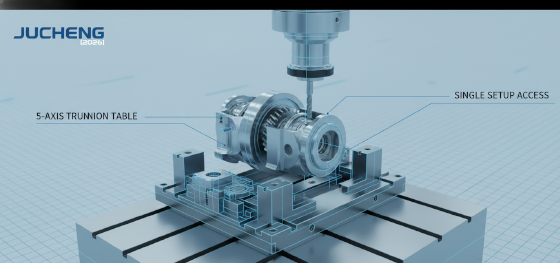
La géométrie d'une articulation robotique J3 ou J5 est souvent organique et complexe, nécessitant que l'outil atteigne les caractéristiques internes sous plusieurs angles. L'usinage traditionnel à 3 axes nécessite plusieurs configurations (retournement de la pièce), ce qui introduit des " erreurs de configuration " à chaque fois que la pièce est re-serrage. Dans Robotic joint housing machining, une erreur de configuration de même 0,02 mm peut entraîner un siège de roulement désaligné. JUCHENG utilise des centres CNC 5 axes continus pour usiner l'ensemble du boîtier en une seule configuration, garantissant que chaque trou, alésage et bride est géométriquement verrouillé sur le même système de coordonnées.
Le perçage profond et le fraisage interne pour le passage des câbles sont également optimisés grâce au mouvement 5 axes. Les robots modernes nécessitent des canaux internes pour que les câbles de données et d'alimentation à haute vitesse passent à travers le centre de l'articulation. JUCHENG usine ces cavités internes avec des transitions lisses et ébavurées, garantissant que les câbles ne subissent aucune abrasion pendant des millions de cycles de flexion. En regroupant ces caractéristiques dans une seule opération CNC, nous réduisons le délai total et garantissons que la " plomberie " du bras robotique est aussi précise que sa structure squelettique.
Les ailettes de refroidissement intégrées deviennent une caractéristique standard dans les articulations de robots à cycle de service élevé. Pour empêcher les servomoteurs de surchauffer, JUCHENG usine des réseaux d'ailettes complexes directement dans le boîtier de l'articulation. Cela augmente la surface pour la dissipation passive de la chaleur, permettant au robot de fonctionner à des vitesses plus élevées pendant des périodes plus longues sans limitation thermique. Notre capacité 5 axes nous permet d'usiner ces ailettes à des angles optimisés pour correspondre au flux d'air dans l'environnement d'installation spécifique du robot, améliorant encore l"" utilité » du pièces de robot industriel we provide.
Zero-point clamping systems ensure that if a part must be moved between machines, it returns to the exact same position within microns. JUCHENG utilizes these advanced work-holding technologies to maintain absolute consistency across a production run of 1,000 units. This "repeatability in manufacturing" is what allows our clients to swap out robotic joints in the field without any manual shimming or re-calibration, drastically reducing the total cost of maintenance for the end-user.
Thermal Stability: Managing Dimensions in 24/7 Operations
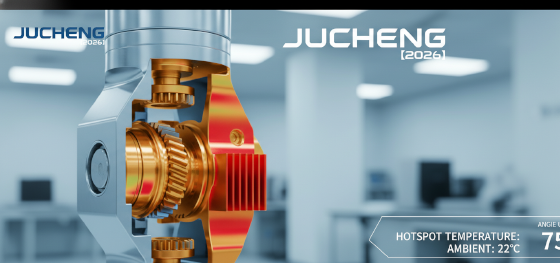
Robotic joints generate heat—it is an unavoidable byproduct of high-speed gear reduction. As the housing heats up, it expands. In Robotic joint housing machining, if this expansion is not managed, it can change the bearing preload and gear backlash, leading to a "tightening" of the joint that stalls the motor or a "loosening" that destroys accuracy. JUCHENG utilizes thermal stabilization cycles during the machining process, "pre-aging" the material so it remains stable throughout the thousands of temperature cycles it will face in the field.
Material selection for thermal compensation is a core JUCHENG expertise. For robots operating in extreme temperature fluctuations (like cold-storage warehouses or foundries), we recommend housing materials with low coefficients of thermal expansion (CTE) or design the housing with "expansion-friendly" geometries. This ensures that the micron-level concentricity we achieve in our Shenzhen hub is maintained whether the robot is at 0°C or 70°C, providing the environmental resilience required for [2026] industrial applications.
Secondary treatments like Hard Anodizing (Type III) for aluminum housings provide more than just corrosion protection; they offer a hard, wear-resistant surface for the bearing races to sit against. JUCHENG manages the "plating allowance" with extreme precision, machining the bores slightly oversized to account for the exact thickness of the anodized layer. This ensures that after the coating is applied, the bearing press-fit is exactly 0.005mm to 0.010mm, the "goldilocks zone" for smooth motion and long life.
Thermal-sink pads and integrated liquid-cooling channels are the next frontier in joint design. For ultra-high-speed SCARA or Delta robots, JUCHENG machines internal fluid paths directly into the joint housing. This allows the OEM to circulate coolant around the motor and gearbox, keeping the joint at a constant temperature regardless of the work cycle. This level of advanced pièces de robot industriel manufacturing is what allows JUCHENG to support the most demanding automation projects in the semiconductor and medical device sectors.
JUCHENG: The Shenzhen Hub for Micron-Level Alignment
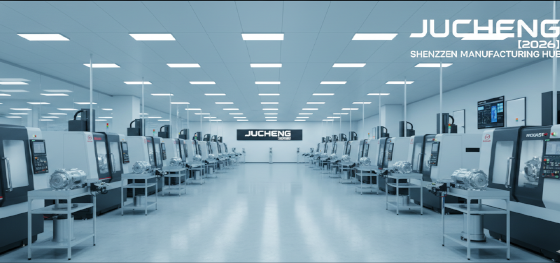
Dominating the [2026] industrial automation market requires a manufacturing partner that understands the high stakes of joint failure. Jucheng Precision operates with a 24/7 manufacturing mindset in our Shenzhen precision manufacturing hub, delivering high-tolerance joint housings and structural components with lead times as fast as 15 business days. We provide a "Bridge to Production" that allows you to move from a single hand-fitted prototype to a commercial fleet of 1,000 joints with consistent concentricity and thermal quality.
Integrating your joint design with JUCHENG’s expertise ensures that your robot survives the "First-Million Cycle" test and moves into mass adoption. We offer comprehensive DFM reviews within 24 hours, identifying potential concentricity risks or "heat-traps" in your housing design before they become field failures. Whether you are building a collaborative arm for electronics assembly or a 6-axis giant for aerospace milling, Jucheng Precision provides the rigid, precise "houses" that keep your innovation moving through the high-speed cycles and the years of hard labor.
Our facility is equipped with 150+ CNC machines, including the latest 5-axis Mazak centers and CMM inspection labs, allowing us to manage the entire housing lifecycle from raw material to finished, measured assembly. We manage the complexity of micron-level machining so your engineering team can focus on the motion control and the AI. By combining Shenzhen's speed with industrial-grade material verification, JUCHENG remains the preferred partner for the world's most aggressive pièces de robot industriel les plus agressifs au monde. Contactez-nous dès aujourd'hui pour démarrer votre prochain projet.
FAQ: Precision Machining for Robotic Motion Joints
What is the typical concentricity tolerance for a robotic joint housing?
High-performance joints require bearing seat concentricity within 0.005mm to 0.010mm to protect the gearbox.
Why is 5-axis machining necessary for joint housings?
It allows all critical bores and mounting faces to be machined in a single setup, eliminating the stacking errors of traditional 3-axis flips.
How do you handle thermal expansion in aluminum joints?
We utilize specialized heat treatment for stabilization and design the bearing fits with precise allowances for 24/7 heat cycles.
What is the maximum size housing JUCHENG can machine?
We can machine robotic joint housings and structural components up to 1,500mm in diameter with micron-level precision.
Joint misalignment in industrial robotics is an absolute hardware killer. Partnering with Jucheng Precision ensures that your enclosures are built with the micron-level concentricity and specialized 5-axis machining techniques the industry demands. Reach out to our Shenzhen manufacturing hub today for a complete DFM review and build the rigid foundation your autonomous fleet requires.

