


Regarder une immense feuille de matière première commercialement pur se déformer et s'enrouler lentement comme une feuille mourante sous un stress thermique intense est le pire cauchemar d'un ingénieur. Tronçonner d'épaisses plaques d'alliage exige une maîtrise absolue de l'énergie cinétique brutale et de la thermodynamique locale. Exécuter des coupes de précision impeccables impose aux opérateurs d'usine de calculer mathématiquement exactement comment le métal brut réagira avant que le faisceau ne soit déclenché.

Se fier uniquement à la haute vitesse lasers à fibre sans comprendre les conséquences physiques garantit une défaillance catastrophique sur la chaîne de montage. La vaporisation de l'acier solide crée une zone affectée thermiquement violente qui altère de façon permanente la structure granulaire métallurgique sous-jacente. Ignorer ces dommages moléculaires cachés fait directement céder des supports de charge critiques de manière imprévisible sous une vibration harmonique constante de l'autoroute.
L'approvisionnement en composants complexes de tôlerie exige un audit financier impitoyable de toute votre chaîne d'approvisionnement. Le retrait des scories dures et tranchantes des bords mal profilés consomme une quantité terrifiante de travail manuel et détruit silencieusement votre budget opérationnel. Les startups de matériel doivent s'associer avec des installations qui éliminent les goulets d'étranglement en aval en livrant des profils absolument impeccables et prêts à l'installation directement depuis le lit de la machine.
Opérant au cœur du hub de fabrication de précision de Shenzhen, nos équipes d'ingénierie bénéficient d'un avantage agressif. Jucheng Precision déploie stratégiquement un arsenal de technologies de profilage avancées spécifiquement adaptées à la densité moléculaire unique de votre matériau choisi. Nous refusons de compromettre vos tolérances d'assemblage premium avec des conditions de bord rugueuses et bon marché.
contenu :
Vaincre la distorsion thermique dans les alliages aérospatiaux
Éradiquer les pièges de profit du débavurage secondaire
Maîtriser la compensation avancée de la largeur de saignée
Tronçonnage à froid : l'avantage de la découpe au jet d'eau abrasif
Questions fréquemment posées : la physique de la tôlerie
Vaincre la distorsion thermique dans les alliages aérospatiaux

Les lasers à fibre intenses modifient-ils de façon permanente la structure granulaire interne des alliages aérospatiaux sensibles ?
Yes. The extreme localized heat violently melts the metal, creating a highly brittle Heat-Affected Zone (HAZ) along the edge that drastically lowers the overall fatigue life of the component.
Controlling aggressive thermal distortion separates amateur metal shops from true industrial heavyweights. Blasting high-carbon steel with a high-wattage beam causes the immediate edge to quench rapidly in the ambient air. This sudden temperature drop chemically hardens the outer skin, making it virtually impossible to machine or tap threads into the affected area later.
Thin-gauge aluminum sheets react violently to uncalibrated thermal profiling. The concentrated heat expands the localized metal instantly, but the surrounding cold plate restricts this expansion, causing the entire geometry to physically bow and twist. Operators must deploy intelligent nesting strategies and rapid piercing algorithms to safely dissipate this trapped kinetic energy.
Aviation engineers absolutely despise micro-cracking hidden along the profiled edges of their turbine components. These microscopic fractures act as massive stress concentrators during high-altitude flight. Eliminating this risk requires utilizing alternative cold-cutting methods or drastically dialing back the laser wattage while simultaneously flooding the zone with specialized assist gases like high-pressure nitrogen.
Éradiquer les pièges de profit du débavurage secondaire

Why do sharp slag deposits completely paralyze downstream assembly line stations?
Hardened dross physically prevents sheet metal parts from sitting completely flat inside robotic welding fixtures, ruining the weld penetration and destroying the dimensional accuracy of the entire sub-assembly.
Falling into the secondary deburring trap destroys hardware profit margins overnight. Factory managers despise watching exhausted technicians waste hours manually grinding rough edges with handheld power tools. This highly unpredictable human labor completely neutralizes the incredible speed advantages initially gained by using high-tech automated machinery.
Sending parts to a heavy automated tumbling machine removes the burrs but simultaneously ruins critical surface finishes on premium cosmetic enclosures. Procurement executives must aggressively demand zero-defect edge quality directly from the primary profiling operation. You cannot build a scalable hardware empire if you constantly pay for manual error correction.
Optimizing assist gas pressure prevents molten slag from fusing back onto the bottom of the raw plate. Firing high-purity nitrogen physically blows the liquid metal completely out of the trench before it has time to solidify. This precise chemical control delivers a flawless, oxidation-free edge that is immediately ready for premium powder coating.
Maîtriser la compensation avancée de la largeur de saignée
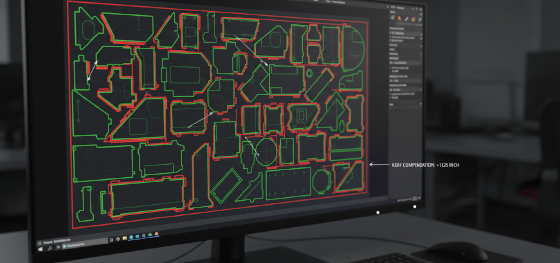
Can engineers safely ignore the physical width of the profiling beam when drawing CAD files?
Absolutely not. Every cutting technology physically consumes raw material during the severing process, and failing to offset the toolpath mathematically guarantees your final component will be significantly undersized.
Executing flawless kerf width compensation requires hardcore CAM programming expertise. A standard abrasive waterjet nozzle carves a physical trench roughly one millimeter wide. If the software fails to dynamically shift the cutting head outwards by exactly half that distance, the precision bearing press-fit designed into your CAD file will violently fail on the factory floor.
Dealing with thick metal plates introduces terrifying dimensional taper. The beam naturally loses kinetic focus as it travels deeper into the raw billet, resulting in a distinct V-shaped edge profile. Correcting this angular deviation requires advanced 5-axis tilting heads that physically angle the nozzle to counteract the natural kinetic decay of the beam.
Tronçonnage à froid : l'avantage de la découpe au jet d'eau abrasif

Is there a profiling technology that guarantees absolutely zero thermal damage to sensitive alloys?
Yes. Pushing water and crushed garnet through a sapphire orifice at sixty thousand PSI creates a supersonic abrasive stream that erodes the metal physically, entirely eliminating the dangerous heat-affected zone.
Deploying aggressive waterjet technologies solves impossible engineering dilemmas instantly. When an EV client demands complex profiles carved out of highly sensitive copper busbars, utilizing lasers causes massive beam reflection and severe melting. The cold abrasive stream slices through reflective copper and highly flammable carbon fiber identically, maintaining absolute molecular integrity.
Cutting multiple layers of different materials simultaneously is completely impossible with thermal machinery. The cold stream easily slices through pre-laminated composite sandwich panels without melting the sensitive internal adhesive layers. This immense versatility allows hardware startups to prototype exotic material combinations rapidly without fearing catastrophic delamination.
| Profiling Technology | Thermal Risk Factor | Edge Quality / Deburring Need | Ideal Manufacturing Application |
|---|---|---|---|
| High-Wattage Fiber Laser | High (Severe edge hardening) | Excellent (If N2 gas is used) | High-volume thin gauge steel |
| Jet d'eau abrasif | Zero (Cold cutting process) | Flawless (No slag produced) | Thick aerospace titanium |
| Industrial Plasma Arc | Extreme (Massive warping) | Poor (Heavy grinding required) | Heavy construction base plates |
Questions fréquemment posées : la physique de la tôlerie

Why does the piercing process leave a massive ugly crater on my metal plate?
Punching the initial entry hole through solid steel requires the beam to dwell in one spot, violently melting and blowing out material in all directions. Programmers must start the pierce entirely outside the final part geometry and slowly lead-in to the actual profile.
Can thermal profiling cut perfectly clean holes that are smaller than the plate thickness?
No, this violates basic thermodynamic physics. The intense concentrated heat cannot escape a tiny hole fast enough, causing the entire feature to melt into a deformed blob. Tiny precision holes in thick plate must be drilled mechanically on a CNC mill.
Does using oxygen as an assist gas reduce the final manufacturing cost?
Oxygen triggers an exothermic chemical reaction that burns the steel violently, drastically increasing cutting speeds and lowering machine time. However, it leaves a heavy oxidized scale on the edge that must be aggressively ground off before any premium paint will adhere, often destroying the initial cost savings entirely.

