


Imaginez essayer de couper un bloc de glace rempli de milliers de petites aiguilles dentelées. C'est essentiellement ce qui se produit lorsque vous introduisez des fibres de verre dans une matrice de nylon. Sur le terrain, le nylon renforcé de verre est un titan structurel. Il remplace les métaux moulés sous pression dans les collecteurs d'admission, les boîtiers structurels et les supports industriels lourds. Mais sur le lit de la machine CNC, c'est un matériau qui se comporte avec une violence unique. Il n'use pas seulement les outils ; il les broie jusqu'à les rendre inutilisables.
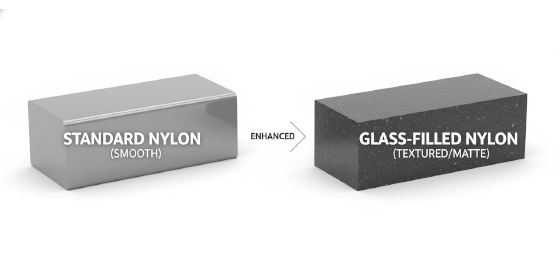
Le succès dans usinage CNC du nylon change complètement lorsque vous passez des polymères non chargés aux composites renforcés. Le nylon standard est collant et mou. Le nylon chargé de verre—en particulier le GF30 standard de l'industrie—est rigide, abrasif et impitoyable. Si vous utilisez des vitesses et avances standard, vous ne ruinerez pas seulement la pièce ; vous pourriez détruire les roulements de votre broche avec la fine poussière abrasive générée par le processus. Chez Jucheng Precision, nous maîtrisons l'art de l' Usinage du Nylon Chargé de Verre en le traitant comme un composite de haute précision, en utilisant des outils spécialisés de qualité diamant et des contrôles environnementaux stricts pour livrer des pièces aussi belles que solides.
Pour l'ingénieur, spécifier du nylon chargé de verre est un pas vers une performance maximale. Pour le fabricant, c'est un pas vers une discipline technique extrême. Ce guide explore les réalités mécaniques du travail avec le GF30, les secrets d'outillage que JUCHENG utilise pour combattre l'abrasion, et les stratégies que nous employons pour éliminer le " fiber bloom " pour une finition de qualité aérospatiale.
contenu :
Décoder le GF30 : Le Géant Renforcé
Le Défi Abrasif : Poncer Vos Outils
Maîtrise de l'Outillage : L'Avantage du Diamant
Gérer le Fiber Bloom : Obtenir des Surfaces Lisses
Sécurité Avant Tout : Gérer la Poussière Abrasive
L'Avantage de Précision de JUCHENG dans les Matériaux GF
Décoder le GF30 : Le Géant Renforcé
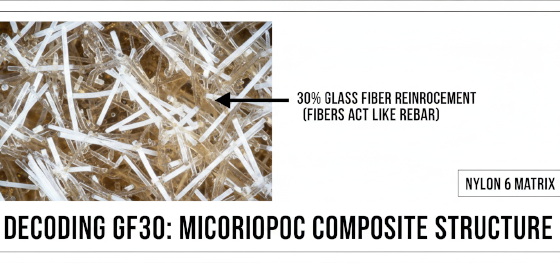
Pour comprendre la difficulté de ce matériau, vous devez examiner sa microstructure. Le nylon chargé de verre n'est pas un matériau unique mais un composite. Dans un grade GF30 typique, la résine de nylon agit comme un liant pour 30% en poids de fibres de verre à brins courts. Ces fibres sont essentiellement des tiges microscopiques de silice. Elles sont incroyablement dures, cassantes et solides. Lorsque le polymère est moulé ou extrudé, ces fibres s'alignent le long des lignes d'écoulement, créant une structure de grain qui confère au plastique une rigidité semblable à celle du métal et des températures de déflexion thermique élevées.
Ce renforcement résout la plus grande faiblesse du nylon : sa flexibilité. Le nylon non chargé fluera et se déformera sous une charge constante. Le nylon chargé de verre tient bon. Cependant, cette même force rend le matériau " sensible aux entailles ". Si un outil CNC laisse une déchirure microscopique ou un bord rugueux lors de Usinage du Nylon Chargé de Verre, that flaw can become a starting point for a crack. The fibers provide strength, but they also create thousands of potential failure points if the machining isn't surgically clean. At Jucheng Precision, we analyze the fiber orientation of the raw stock before we begin, ensuring our tool paths work with the material's grain, not against it, to maximize the structural integrity of the final component.
Le Défi Abrasif : Poncer Vos Outils
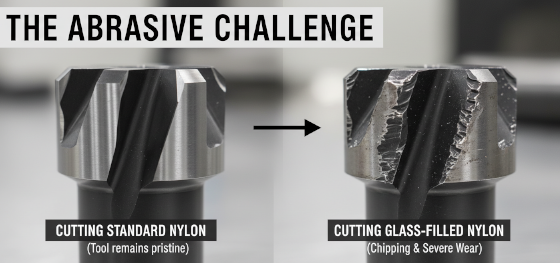
If you use a standard carbide end mill to cut GF30, you will notice something alarming within minutes. The tool stops cutting and starts rubbing. If you inspect the edge under a microscope, you will see that the razor-sharp corner has been rounded off. This is abrasive wear. Because the glass fibers are harder than the binder in many tool coatings, they effectively act like sandpaper, grinding away the cutting edge with every rotation.
This abrasion doesn't just dull the tool; it generates immense heat. In standard usinage CNC du nylon, heat is your enemy because it melts the plastic. In glass-filled machining, heat is your enemy because it accelerates tool degradation. Once the tool becomes dull, it no longer slices through the glass fibers. Instead, it begins to "yank" them out of the nylon matrix. This leaves the surface feeling like a rough wool sweater rather than a smooth engineered part. Managing this abrasive encounter requires a radical shift in tooling strategy that most general machine shops simply aren't equipped to handle. JUCHENG solves this through a heavy investment in exotic tool materials that can survive the "sandstorm" inside the machine enclosure.
Maîtrise de l'Outillage : L'Avantage du Diamant

When we quote a project for Usinage du Nylon Chargé de Verre, our clients sometimes ask why the tooling cost is higher than for standard nylon. The answer is Polycrystalline Diamond (PCD). For long production runs of GF30, standard carbide is a waste of time. We utilize PCD-tipped tools or specialized CVD diamond coatings. Diamond is the only material on Earth that is significantly harder than glass fibers. It allows us to maintain a razor-sharp edge for thousands of parts, where a carbide tool would fail after fifty.
The geometry of these tools is equally critical. We use high-positive rake angles and polished flutes. The goal is to slice the fibers instantly upon contact. If the tool "pushes" the fiber, the fiber will eventually snap or tear, leaving a pitted surface. By using diamond-hard edges and high-speed spindles, Jucheng Precision ensures that the fibers are sheared flush with the polymer surface. This leads to a finish that is structurally sound and aesthetically pleasing. While the initial investment in PCD tooling is higher, the ROI is found in the drastic reduction in scrap rates and the incredible surface consistency we provide for our automotive and aerospace clients.
Gérer le Fiber Bloom : Obtenir des Surfaces Lisses
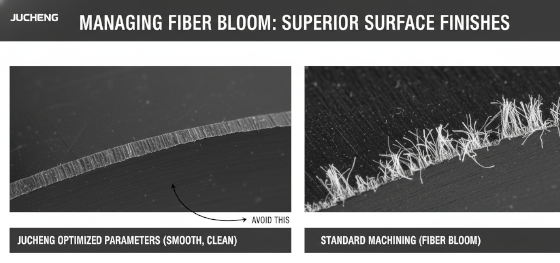
One of the most common aesthetic complaints with reinforced plastics is "fiber bloom." This occurs when the nylon resin is worn away or melted during machining, leaving the glass fibers exposed on the surface. It looks like a fine, white fuzz and feels like rough sandpaper. In medical or high-end consumer applications, this is a major defect. It can also cause issues with secondary processes like painting or ultrasonic welding, as the exposed glass interferes with the bond.
At Jucheng Precision, we eliminate fiber bloom through precise thermal management. We utilize high-pressure cold air guns and specialized mist coolants to keep the material well below its glass transition temperature. If the nylon stays cool, it remains rigid enough to hold the glass fibers in place while the tool shears them. We also employ a "dual-pass" strategy: a heavy roughing pass to remove bulk material, followed by a very light, high-speed finishing pass with a brand-new tool. This ensures that any fibers disturbed during the roughing stage are cleanly trimmed away during the final pass. The result is a smooth, matte finish that hides the reinforcement and highlights the precision of the design.
Sécurité Avant Tout : Gérer la Poussière Abrasive
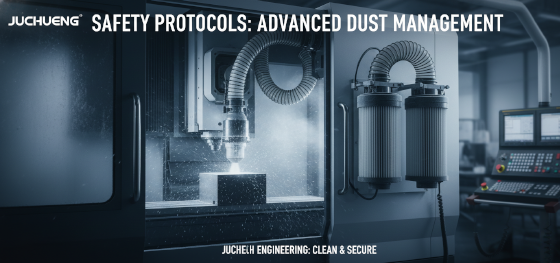
Machining reinforced plastics isn't just hard on tools; it's hard on the environment. The chips generated during Usinage du Nylon Chargé de Verre are essentially glass-reinforced dust. This dust is a serious health hazard if inhaled and a mechanical hazard for the CNC machine itself. Glass fines are abrasive enough to grind through the seals of machine ways and can even lead to electrical shorts if they settle on circuit boards.
Jucheng Precision operates a facility designed for composite handling. Our CNC centers for glass-filled nylon are equipped with high-volume industrial dust extraction systems that pull the fines directly from the cutting zone. We also utilize a "wet-capture" method in many cases, using coolant to trap the glass dust in a filtration system. Our operators follow strict EHS protocols, including the use of specialized PPE, ensuring a safe working environment. This attention to detail protects our machines and our team, ensuring that our facility remains at 100% operational capacity to meet your production deadlines. We don't just care about the part; we care about the process that creates it.
L'Avantage de Précision de JUCHENG dans les Matériaux GF
The biggest hurdle in usinage CNC du nylon with glass reinforcement is dimensional instability caused by moisture. As we've mentioned in our other guides, nylon is hygroscopic. It drinks water. In GF30, the glass fibers don't absorb water, but the nylon binder does. This can lead to internal stresses where the expanding nylon pulls against the rigid glass fibers. Without expert control, this leads to warping that can't be fixed.
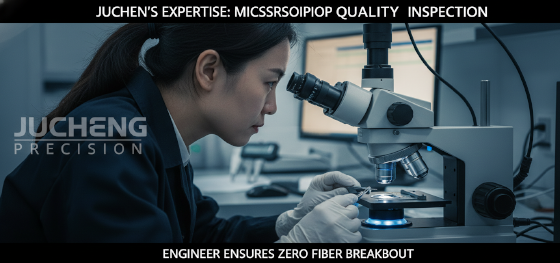
Jucheng Precision employs a unique "thermal stabilization" cycle for all our glass-filled nylon projects. We anneal the raw stock before machining to release extrusion stresses, and we perform a secondary stabilization after roughing. This ensures that the glass and the nylon have found their equilibrium before we perform the final precision cuts. Our QC team uses 40x magnification to inspect every edge, ensuring that your parts are free of delamination and fiber bloom. When you partner with JUCHENG, you are leveraging decades of experience in the world's most difficult engineered plastics. We provide the strength of glass with the precision of diamond. Contact our team today to receive a quote and a DFM review for your next reinforced nylon project.

