


You have probably heard its nickname: "18-8". It is the single most common and versatile stainless steel on the planet. It is the material of your kitchen sink, the tanks in a brewery, and the hardware on a sailboat.

This is 304 stainless steel. It is the industry's default choice for a huge range of applications. But its friendly, jack-of-all-trades personality hides a challenging secret for the machinist.
The process of machining 304 stainless steel is a battle against a phenomenon called work hardening. This guide, from a manufacturer's perspective, will show you how to win that battle.
contenu :
Properties: The Trustworthy '18-8'
Machining Challenges: Controlling 'Work Hardening'
Applications: A World of Versatility
JUCHENG's Advantage: Inventory and Expertise
Properties: The Trustworthy '18-8'
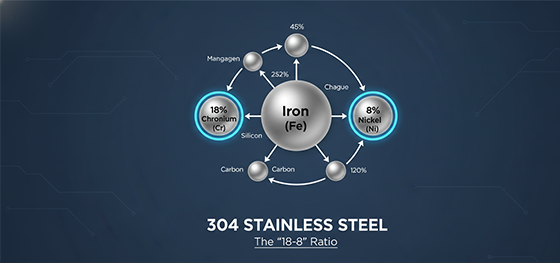
The nickname "18-8" comes directly from 304's chemical recipe. It is composed of approximately 18% chromium and 8% nickel. This specific composition gives it its famous and desirable properties.
The chromium is the key to its "stainless" nature. It forms a thin, invisible, and self-healing passive layer of chromium oxide on the surface, which protects the iron in the steel from rusting. This gives 304 excellent corrosion resistance in most normal environments.
The nickel is important for its mechanical properties. It makes the steel "austenitic," which means it is non-magnetic and has excellent toughness. It can be bent, formed, and welded with ease. This combination of good corrosion resistance, excellent formability, and reasonable cost makes it the most versatile of all stainless steels.
Machining Challenges: Controlling 'Work Hardening'
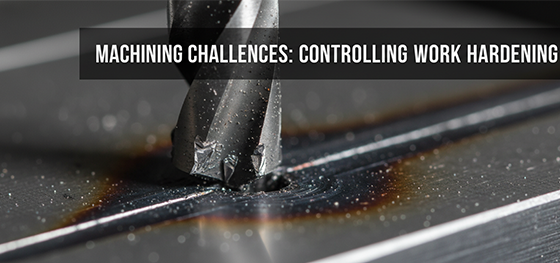
However, this toughness comes at a price on the factory floor. Like all austenitic stainless steels, 304 is prone to "work hardening." This is the primary challenge of any usinage CNC de l'acier inoxydable operation.
Work hardening means the material gets harder as you cut it. The pressure and heat from the cutting tool change the crystal structure of the surface, making it much harder than the material underneath.
This is a machinist's nightmare. It causes rapid tool wear and can lead to tool breakage. To combat this, a machinist must be aggressive. They must use sharp, tough, coated carbide tools. They must use a slow cutting speed but a constant, heavy feed rate. This strategy ensures the tool is always cutting "under" the hardened layer from the previous pass.
C'est un processus exigeant qui nécessite des machines rigides et une compréhension approfondie de la physique de la coupe. C'est pourquoi l'usinage de l'acier inoxydable 304 est nettement plus lent et plus coûteux que l'usinage de l'acier doux ou de l'aluminium.
Applications: A World of Versatility
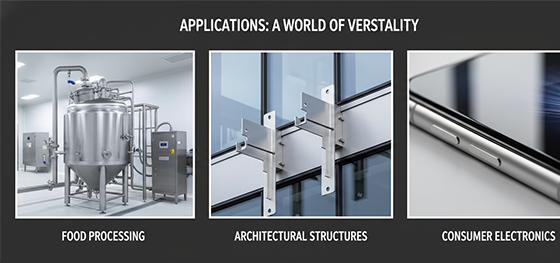
L'équilibre étonnant des propriétés fait du 304 l'un des aciers les plus utilisés Matériaux d'usinage CNC dans le monde.
Dans l'industrie agroalimentaire, sa résistance à la corrosion et sa surface hygiénique et facile à nettoyer en font la norme pour les réservoirs, les tuyaux et les équipements de transformation.
En architecture, il est utilisé pour tout, des rampes aux panneaux décoratifs et aux supports structurels, où il offre à la fois résistance et apparence propre et durable.
Dans les produits de consommation, il est utilisé pour créer une sensation de qualité supérieure. Le cadre d'un smartphone haut de gamme ou le boîtier d'une montre de luxe est souvent usiné à partir d'un bloc solide d'acier inoxydable 304. Il offre un poids satisfaisant, une belle finition et un sentiment de qualité sans compromis.
JUCHENG's Advantage: Inventory and Expertise

Pour un matériau aussi courant, un accès rapide et une expertise approfondie sont des avantages concurrentiels clés.
Chez JUCHENG, nous comprenons l'importance de la rapidité. C'est pourquoi nous maintenons un grand inventaire de barres, de plaques et de tôles en acier inoxydable 304 certifié dans une grande variété d'épaisseurs. Cela signifie que nous n'avons pas à attendre un fournisseur. Nous pouvons souvent commencer à usiner vos pièces le jour même où vous passez votre commande.
Notre équipe d'ingénieurs et d'usineurs a des décennies d'expérience combinée dans la maîtrise des défis de l'acier inoxydable. Nous avons les machines rigides et puissantes. Nous avons les outils de coupe avancés. Et nous avons la connaissance des processus pour produire vos pièces en acier inoxydable 304 avec la précision, la finition de surface et la rapidité que votre projet exige.

