


La traduction de motifs artistiques complexes et de profils fonctionnels intriqués en matériel physique nécessite un contrôle optique avancé. L'utilisation de conceptions de tôles découpées au laser permet aux développeurs de contourner l'outillage dur coûteux tout en exécutant des coupes géométriques hautement complexes avec une répétabilité extrême. Cette voie de fabrication numérique repose sur un faisceau thermique concentré pour vaporiser le matériau le long de trajectoires d'outil précises, traduisant directement des graphiques vectoriels 2D en panneaux métalliques hautement répétables avec un minimum de déchets de matériau.
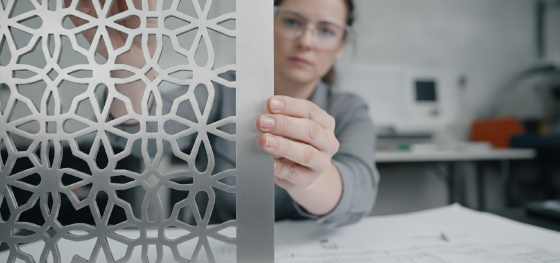
Cependant, concevoir des motifs laser détaillés sans évaluer les réactions thermiques métallurgiques est un risque majeur sur la ligne de développement. Lorsque les groupes de fentes sont placés trop près les uns des autres, l'énergie thermique intense peut déformer la tôle plate, provoquant un flambage sévère et des fractures de contrainte localisées. Équilibrer de manière proactive vos ratios de surface ouverte par rapport aux propriétés du matériau brut est le meilleur moyen de garantir la planéité de votre pièce.
Examinons comment la découpe thermique excelle dans les applications architecturales et mécaniques, passons en revue les règles CAO essentielles pour préparer des fichiers vectoriels propres, et explorons comment le choix du gaz d'assistance dicte la qualité du bord de coupe.
contenu :
Le potentiel artistique et industriel de la découpe laser CNC
Graphiques vectoriels au métal : préparation de vos fichiers CAO
Qualité des bords et tolérance dans les conceptions complexes
Découpe laser à fibre haute vitesse chez JUCHENG
FAQ : Questions critiques sur les conceptions de tôles découpées au laser
Le potentiel artistique et industriel de la découpe laser CNC

Qu'est-ce qui rend le profilage laser CNC très polyvalent pour les pièces matérielles et architecturales modernes ?
Il offre une liberté géométrique illimitée pour couper tout, des supports mécaniques de haute précision aux écrans architecturaux perforés hautement décoratifs, sans nécessiter de matrices de poinçonnage personnalisées.
La découpe laser comble le fossé entre l'ingénierie structurelle à haute résistance et le style industriel cosmétique. Pour les composants structurels, elle découpe des cercles de boulons propres et des pistes de guidage de cartes avec une haute précision. Dans les applications architecturales, elle est utilisée pour fabriquer des panneaux de confidentialité grand format, des portails personnalisés et des revêtements muraux décoratifs.
Parce que le faisceau à fibre optique est entièrement piloté par logiciel, passer d'une conception prototype à une production à grande échelle ne nécessite aucun changement d'outillage physique. Cela permet aux ingénieurs d'affiner leurs géométries à la volée, d'optimiser les agencements pour minimiser les déchets de matériau tout en livrant des contours nets exempts de contraintes de cisaillement mécanique.
Graphiques vectoriels au métal : préparation de vos fichiers CAO

Quelles étapes de modélisation CAO sont nécessaires pour préparer une conception à un profilage laser propre ?
Designers must export clean, continuous vector paths in DXF or DWG formats, ensuring all overlapping geometry lines and micro-gaps are fully closed.
Translating vector graphics directly into physical components is a massive milestone in modern conception de tôle, bridging the gap between digital modeling and the laser controller. Exporting clean vector graphics from your 3D CAD modeling software ensures the laser cutter reads the path correctly. Double-cutting overlapping lines or running a laser head over fragmented curves can cause severe edge burning and dimensional errors.
When preparing laser cut sheet metal designs for custom grilles or brackets, scaling your CAD features relative to the laser spot size is also vital. The laser beam possesses a physical thickness known as the kerf width. Designers must adjust their hole clearances and flange offsets to compensate for this minor material removal, ensuring that nested slots interlock tightly during final assembly.
Qualité des bords et tolérance dans les conceptions complexes
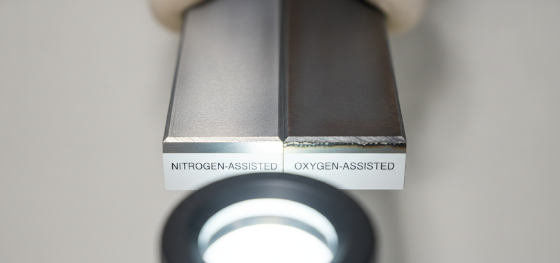
How do different assist gases dictate the cleanliness of laser-cut steel edges?
Nitrogen assist gas prevents oxygen exposure to deliver a bright, weld-ready edge, while oxygen assist gas reacts with carbon steel to cut thick gauges quickly but leaves a dark oxide scale.
The selection of cutting gas significantly impacts the physical properties of the finished cut. Utilizing high-pressure nitrogen assist gas is preferred for stainless steel and aluminum. Nitrogen cools the cut zone and completely blows away the molten metal, preventing oxidation and delivering a bright, clean edge that is ready for immediate welding without secondary grinding.
For thick carbon steel plates, oxygen assist gas is deployed to initiate an active chemical reaction that generates extra heat, allowing the laser to slice through thick gauges quickly. However, this reaction leaves a dark, brittle layer of iron oxide along the edge. If not removed, this oxide layer can cause subsequent powder coatings to peel off, exposing the bare metal to rapid atmospheric rust.
Découpe laser à fibre haute vitesse chez JUCHENG

What sets JUCHENG's CNC laser cutting apart from traditional sheet metal shops?
We operate high-power, multi-kilowatt fiber lasers integrated with active optical stabilization, allowing us to maintain tight dimensional tolerances on highly intricate geometries.
Our workshop floor is engineered to eliminate production bottlenecks during rapid prototyping and low-to-medium volume manufacturing. By connecting our advanced cutting systems directly to our digital engineering network, we interpret complex CAD data instantly, translating your vector paths into clean physical profiles. Every design undergoes an initial, automated manufacturability check where our engineers evaluate kerf widths and heat-affected zone (HAZ) expansion, helping you optimize material nesting before we cycle the laser heads.
We back our operations with strict quality certifications, including ISO 9001 and IATF 16949, ensuring that industrial and automotive brackets meet rigorous regulatory standards. With our flexible no MOQ policy and rapid delivery turnaround, JUCHENG provides a reliable, high-yield manufacturing partner to help you transition custom flat patterns into continuous production-grade hardware.
FAQ : Questions critiques sur les conceptions de tôles découpées au laser
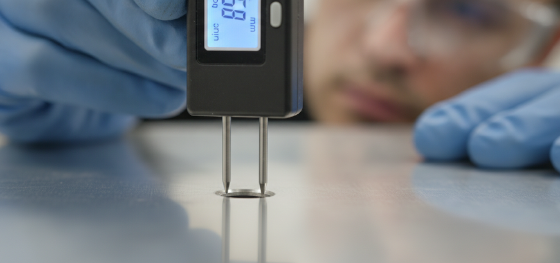
What is the minimum hole size achievable in laser cut sheet metal designs?
As a general manufacturing rule, the minimum hole diameter should not be less than the material thickness. Forcing a high-temperature laser beam to cut a hole smaller than the sheet thickness concentrates intense thermal energy in a tiny area, causing the metal to melt and warp, resulting in irregular, non-circular holes.
Can highly reflective metals like brass and copper be laser cut safely?
Yes, but they require advanced fiber lasers. High-purity le cuivre et laiton reflect standard CO2 laser wavelengths like a mirror, bouncing the energy back into the cutting head and burning out the focus optics. Fiber lasers operate at a much shorter wavelength that reflective metals absorb easily, delivering clean, dross-free cuts without optical feedback risks.
How do you prevent outer edge micro-cracking when bending laser-cut parts?
The intense heat of laser cutting can create a brittle, hardened layer along the cut edge, especially on hard carbon steels. If a bend is executed directly along this cut edge, the brittle material will undergo localized micro-cracking. We prevent this by adjusting laser cutting parameters to minimize the heat-affected zone, or utilizing secondary tumbling to smooth the cut edges before forming.
What causes dross (slag) on the bottom edge of a laser cut panel?
Dross occurs when the cutting head moves too fast or when the assist gas pressure is too low, preventing the molten metal from being blown completely out of the kerf. This remaining metal solidifies on the underside of the sheet, requiring manual grinding to remove. We eliminate dross by continuously optimizing our gas pressure levels and laser cutting speeds to ensure clean, burr-free cuts.

