


Protéger les piles de calcul délicates et les points de montage à couple élevé d'une plateforme autonome nécessite de s'éloigner de la logique d'assemblage par boulonnage traditionnelle. Dans le monde du moulage par injection réactionnelle de polyuréthane, le boîtier n'est plus seulement une coque ; c'est un milieu protecteur actif. Si un capteur est simplement vissé dans un boîtier en plastique, il reste vulnérable à l'humidité, aux vibrations et aux contraintes de dilatation thermique. Atteindre un profil matériel véritablement robuste exige une maîtrise du moulage par insertion et encapsulation en RIM pour lier physiquement l'électronique et les métaux structurels en une seule unité monolithique. Ce processus élimine les fixations mécaniques, réduit le nombre de pièces et offre la protection environnementale ultime pour les composants les plus coûteux d'un robot prototype ou d'un scanner médical.
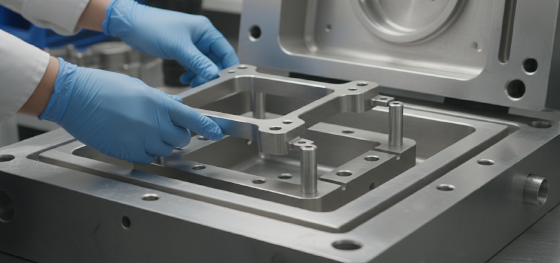
L'intégrité mécanique dans la robotique moderne est souvent compromise à l'interface entre le plastique et le métal. Les pièces moulées par injection standard souffrent de jeux d'air autour des inserts filetés, qui agissent comme des autoroutes de fuite pour la poussière et l'eau. Jucheng Precision résout ces problèmes d'étanchéité critiques en utilisant la réaction liquide-solide pour créer un verrou moléculaire sans couture. Jucheng Precision fournit des composants qui intègrent l'étanchéité hermétique avec un renforcement structurel, garantissant que la technologie survit à la transition du banc de laboratoire au chaos implacable du terrain.
Fonctionnant selon les normes de qualité strictes de ISO 13485, ISO 14001, et IATF 16949, Jucheng Precision agit en tant que partenaire d'innovation pour les fabricants mondiaux de matériel OEM. Jucheng Precision transforme des concepts bruts en assemblages encapsulés validés en seulement 15 jours ouvrables, en exploitant une capacité de 150+ machines CNC et 25 unités Haas/Mazak 5 axes pour construire l'outillage spécialisé nécessaire au surmoulage complexe. Ce guide explore les principes de basse pression pour l'électronique fragile, l'élimination de la prévention des fuites dans le chemin métal-polymère, et l' amortissement des micro-vibrations pour les empilements de capteurs nécessaires à la fabrication du moulage par insertion et de l'encapsulation dans le matériel RIM qui sécurise l'avenir d'une flotte autonome.
contenu :
Avantage de la basse pression : Comment protéger les capteurs de l'écrasement ?
Données techniques : Comparaison de la résistance d'encapsulation et de la qualité d'étanchéité
Logique structurelle : Élimination des chemins de fuite autour des inserts métalliques
Protection contre les chocs : Maîtrise de l'amortissement des vibrations pour les nerfs de l'IA
JUCHENG Hub : Gestion de l'intégration multi-matériaux à Shenzhen
FAQ : Réponses concrètes pour la protection électronique et la sécurité des inserts
Avantage de la basse pression : Comment protéger les capteurs de l'écrasement ?
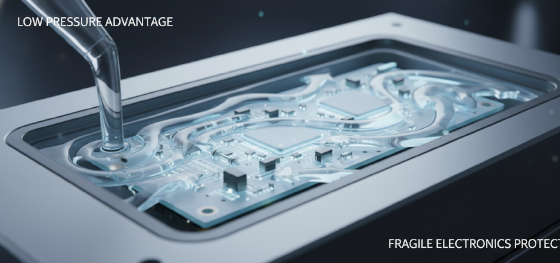
Le principal obstacle au surmoulage de l'électronique est l'effet de marteau hydraulique du moulage par injection traditionnel. Lorsque le plastique fondu entre dans un moule à 15 000 psi, il peut facilement écraser les condensateurs montés en surface ou ciseler les joints de soudure délicats d'un circuit imprimé. Dans le moulage par insert et l'encapsulation en RIM, la pression interne de la cavité reste inférieure à 100 psi. Cet environnement à faible contrainte permet à Jucheng Precision de faire couler du polyuréthane liquide directement sur les cartes électroniques sensibles sans endommager les circuits. En utilisant la physique basse pression pour les composants électroniques fragiles, un bloc solide et résistant aux chocs est créé, protégeant le cerveau d'un robot mieux que n'importe quel boîtier boulonné ne pourrait le faire.
Comment empêcher la résine de pénétrer dans les connecteurs sensibles ?
Jucheng Precision utilise des barrages d'arrêt en silicone usinés sur mesure dans le moule pour protéger les ports et les fiches tout en permettant au reste de la carte d'être entièrement encapsulé.
L'adaptation de la dilatation thermique est le deuxième pilier de la protection électronique. Si la résine se dilate à un rythme différent de celui du circuit imprimé, les cycles thermiques du fonctionnement quotidien finiront par arracher les joints de soudure. Les experts en matériaux de Jucheng Precision formulent des polyols de côté B avec des charges minérales pour ajuster le coefficient de dilatation thermique linéaire (CLTE). Cela garantit que le cocon de polyuréthane se déplace en harmonie avec la carte en verre-époxy, empêchant les contraintes internes qui ruinent les prototypes d'unités robotiques lors des tests de terrain de longue durée. L'installation de Shenzhen fournit la supervision technique pour garantir que le matériel est moléculairement compatible avec son enveloppe.
La conductivité acoustique et thermique peut également être ajustée pendant le cycle RIM. Pour les composants électroniques qui génèrent de la chaleur, Jucheng Precision intègre des pads thermiques en aluminium dans l'assemblage encapsulé. La résine liquide à faible viscosité s'écoule parfaitement autour de ces pads, créant un chemin thermique direct des puces à la surface externe. Cela élimine le besoin de ventilateurs internes, sujets à des pannes dans les environnements agricoles ou industriels poussiéreux. En fournissant des modules encapsulés à refroidissement passif, Jucheng Precision permet à une équipe d'ingénierie de se concentrer sur le logiciel tandis que l'usine gère la thermodynamique de la survie.
Données techniques : Comparaison de la résistance d'encapsulation et de la qualité d'étanchéité
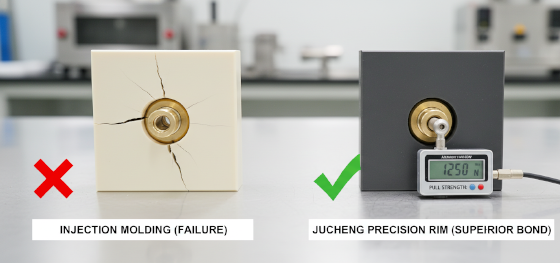
Le succès du durcissement du matériel dépend de la force de la liaison entre des matériaux dissemblables. Si la résine n'adhère pas à l'insert métallique ou plastique, l'assemblage finira par fuir. Jucheng Precision fournit des données complètes de résistance au pelage et de test de pression pour aider les équipes à valider leurs conceptions. Le tableau suivant compare les indicateurs de performance essentiels du moulage par insert et de l'encapsulation en RIM par rapport à l'étanchéité mécanique traditionnelle pour le marché industriel actuel.
| Métrique | Joint d'étanchéité mécanique | Liaison encapsulée RIM | Avantage technique |
|---|---|---|---|
| Indice de protection | IP65 - IP67 (Variable) | IP69K (Hermétique) | Survives Power Washing |
| Shock Resistance | Moderate (Mount dependent) | Maximum (Cradled) | Zero Jitter for Optics |
| Insert Pull-Out (lbs) | 800 - 1,200 | 2,500 - 4,000 | Unyielding Torque Strength |
| Assembly Time | High (Manual Bolting) | Zero (As-Molded) | Reduces Production Costs |
The insert pull-out strength is the most critical data point for building heavy-duty robotic skeletons. Jucheng Precision utilize Insert molding and encapsulation in RIM to anchor large steel mounting plates directly into the plastic shell. Because the resin flows into the microscopic undercuts and knurling of the metal, it creates a joint that is significantly stronger than a post-mold ultrasonic or heat-staked insert. This structural integrity is essential for industrial robot parts that must handle the reversing torque of a 50kg payload arm without the mounting bolts backing out over time.
Logique structurelle : Élimination des chemins de fuite autour des inserts métalliques
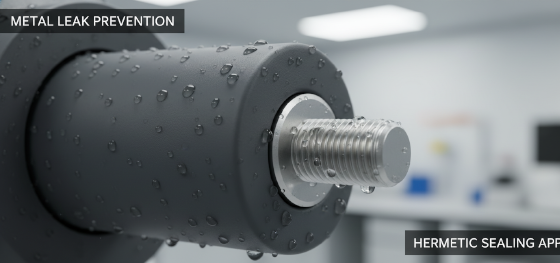
Threaded inserts are the Achilles Heel of waterproof enclosures. In traditional manufacturing, moisture finds its way into the device by traveling along the threads of the mounting bolts. Jucheng Precision solves this through metal-polymer leak path prevention. By encapsulating the entire blind-end of the threaded insert within the RIM part, the physical path to the interior is eliminated. The liquid polyurethane creates a high-pressure seal against the metal surface during the curing phase, providing Hermetic Sealing that survives even the pressure differentials of high-altitude flight or deep-sea submersion.
How to ensure metal inserts do not move during injection?
Jucheng Precision utilize specialized registration nests in the aluminum mold that lock the inserts into place with +/- 0.05mm accuracy.
Chemical bonding agents are applied to the metal surfaces before they enter the mold. While the mechanical interlock is strong, Jucheng Precision utilizes specialized primers that create a covalent bond between the metal oxide and the polyurethane resin. This chemical bridge ensures that the seal remains intact even if the part is subjected to extreme thermal cycles that cause the metal and plastic to expand at different rates. This level of attention to the invisible interface is why Jucheng Precision remains the preferred partner for global medical OEMs who cannot afford a single microscopic leak in their diagnostic hardware.
Weight management is also improved by this integration. By molding the structural metal frame directly into the shell, Jucheng Precision eliminates the need for redundant internal skeletons. This monocoque design approach reduces the total mass of a robot while increasing its torsional rigidity. Every gram saved in the chassis is a gram added to the battery capacity, extending the mission time of an autonomous fleet. Jucheng Precision’s analyse DFM gratuite en 24 heures service identifies these consolidation opportunities, helping build a sleeker, more reliable machine on a leaner budget.
Protection contre les chocs : Maîtrise de l'amortissement des vibrations pour les nerfs de l'IA
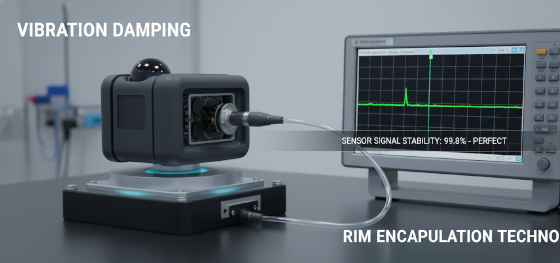
High-resolution sensors like LiDAR and multi-spectral cameras are incredibly sensitive to high-frequency mechanical noise. If the sensor mount vibrates, the resulting data jitter can blind the robot's AI. In Insert molding and encapsulation in RIM, the sensor is not just mounted; it is cradled. Jucheng Precision utilize elastomeric polyurethane formulations that act as a permanent micro-vibration damping for sensor stacks cocoon. The material absorbs the harmonic energy of the drivetrain, decoupling the delicate optics from the vibrating chassis. This results in a much cleaner data stream and extends the service life of the expensive sensors.
Does encapsulation block sensor signals?
No. Jucheng Precision utilize optical windows made of clear PC or Acrylic that are encapsulated into the shell, ensuring a transparent path for the laser or vision signal.
Impact protection is the second benefit of the foamed core. By utilizing structural foam RIM, Jucheng Precision can produce encapsulated assemblies with a dense solid skin and a microcellular core. This bionic bone architecture acts like a helmet for electronics. If an autonomous vehicle strikes an obstacle, the core deforms slightly to dissipate the kinetic energy, protecting the internal boards from the G-shock that would shatter a traditional thin-walled plastic case. This environmental resilience is essential for robots operating in shared human workspaces like fulfillment centers and hospital corridors.
ESD (Electrostatic Discharge) protection is integrated during the material blending phase. To protect sensitive microchips during the Insert molding and encapsulation in RIM cycle, Jucheng Precision adds anti-static agents to the Side B polyol. This ensures that the cocoon does not build up a static charge during field travel, preventing the random electronic resets that plague low-tier hardware iterations. By delivering electrically-safe structural parts, Jucheng Precision helps clients pass the most rigorous regulatory safety audits on the first attempt, providing the unyielding foundation an autonomous innovation requires.
JUCHENG Hub : Gestion de l'intégration multi-matériaux à Shenzhen
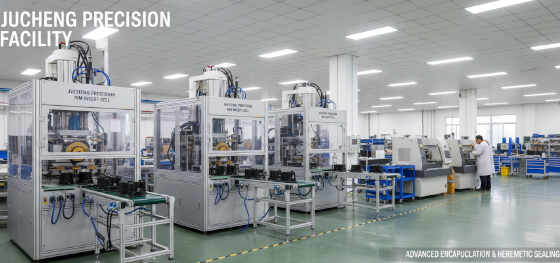
Dominating the large-format hardware market requires a partner that doesn't just mold plastic, but integrates complex systems. Jucheng Precision operates with a 24/7 manufacturing mindset in our Shenzhen precision manufacturing hub, delivering high-tolerance moulage par insertion et encapsulation en RIM results with industry-leading speed. Jucheng Precision provides a bridge to production that allows a transition from a single hand-fitted Alpha unit to a commercial deployment of 5,000 Beta robots with consistent metallurgical and chemical quality. Jucheng Precision has No MOQ, allowing clients to source 1 to 10 units for high-stakes sensor trials without the crushing cost of mass-production tools.
Integrating structural design with Jucheng Precision’s expertise ensures that hardware survives the first-field contact and moves into mass adoption. Jucheng Precision offers a free DFM analysis in 24 hours, identifying potential air-pockets or thermal-bottlenecks in a design before they become field failures. Whether building an autonomous medical assistant or a heavy-duty industrial mobile base, Jucheng Precision provides the rigid, precise, and integrated foundations that keep innovation moving through the high-speed cycles and the years of hard labor.
The facility is equipped with dedicated high-pressure RIM assembly cells and dedicated ISO 13485 and ISO 14001 quality labs, allowing Jucheng Precision to manage the entire hardware lifecycle in one location. Jucheng Precision manages the complexity of multi-material bonding and automotive-grade finishing so the engineering team can focus on the motion control and the AI. By combining speed with industrial-grade material verification and global quality standards, Jucheng Precision remains the preferred partner for the world's most aggressive Polyurethane Molding Services challenges. Contact the Shenzhen hub today to start a project.
FAQ : Réponses concrètes pour la protection électronique et la sécurité des inserts
Can a standard PCB be encapsulated without a custom housing?
Yes. RIM allows for potting logic where the resin becomes the permanent structural housing for the board itself.
What is the maximum torque an encapsulated insert can handle?
Encapsulated M8 steel inserts in Jucheng Precision rigid PU typically handle over 40 Nm of torque without loosening or spinning.
Does the RIM process damage electronic components?
No. The low-pressure and moderate-temperature cure (below 60°C) is safer for electronics than any other molding process.
How is the hermetic seal verified after molding?
Jucheng Precision perform vacuum leak testing and submerged pressure testing to ensure zero-porosity seals for critical modules.
What is the lead time for an encapsulated Beta prototype?
Aluminum rapid tooling and the first set of encapsulated parts are typically delivered in 15 to 20 business days.
Sensor failure and loose anchors are absolute project killers for clinical and industrial robotics. Partnering with Jucheng Precision ensures that functional iterations are built with the unyielding polyurethane reaction injection molding and specialized Insert molding and encapsulation in RIM techniques the industry demands. Reach out to the Shenzhen manufacturing hub today for a complete DFM review and build the unyielding foundation an autonomous fleet requires.

