


Peu de sons sont aussi décourageants dans un atelier d'usinage de précision que le " claquement " cristallin et aigu d'une pièce transparente qui casse pendant la phase finale de production. Vous avez peut-être passé des heures à perfectionner l'état de surface d'un boîtier complexe, pour qu'un seul trou de montage ruine toute la pièce au cours des dix dernières secondes du cycle. C'est la réalité du travail avec le polyméthacrylate de méthyle (PMMA). C'est un matériau qui exige un respect absolu, en particulier lorsque le projet implique le perçage de l'acrylique sans le fissurer. Parce que l'acrylique est un polymère sensible aux entailles, tout défaut mineur créé pendant le processus de perçage agit comme un concentrateur de contraintes, entraînant une défaillance immédiate ou un réseau de fissures différé connu sous le nom de micro-fissuration.

Chez Jucheng Precision, nous considérons L'usinage CNC de l'acrylique comme un art de la pression contrôlée et de la gestion thermique. Nous ne " poussons " pas simplement un foret à travers le plastique ; nous concevons la rencontre entre l'outil et la pièce pour neutraliser la fragilité inhérente du matériau. L'acrylique ne se comporte pas comme l'aluminium ou l'acier ; il n'a pas la ductilité nécessaire pour se déformer gracieusement sous un bord émoussé. Il préfère se briser. Ce guide est basé sur plus d'une décennie de production plastique à grand volume, détaillant les stratégies professionnelles que nous utilisons pour garantir un taux de rendement de 100% même sur les collecteurs transparents et les dispositifs médicaux les plus délicats.
Un perçage réussi fait la différence entre une pièce qui ressemble à de la ferraille industrielle et une pièce qui conserve sa clarté optique et son intégrité structurelle pendant des années. La fissuration se produit généralement à deux étapes spécifiques : l'entrée initiale du foret et la percée finale à la sortie. Comprendre la physique de ces moments est essentiel pour tout ingénieur cherchant à dépasser les résultats de hobbyiste pour passer à une fabrication de qualité professionnelle. Explorons la mécanique de la défaillance et les solutions spécialisées que JUCHENG emploie pour éliminer complètement ces risques.
contenu :
La physique de la fissuration : coin et chaleur
Maîtrise de l'outillage : le secret de l'angle de coupe nul
Contrôle du processus : avances, vitesses et cycles de picotage
Support et refroidissement : prévenir l'éclatement à la sortie
Détente des contraintes : recuit après perçage pour la longévité
L'avantage JUCHENG dans les plastiques de précision
La physique de la fissuration : coin et chaleur
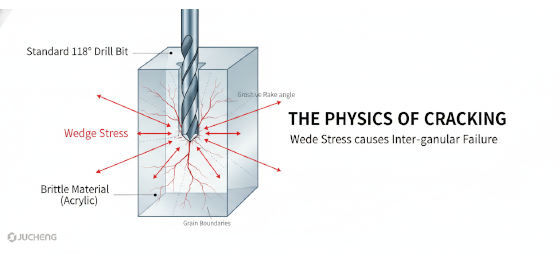
Pour résoudre le problème du le perçage de l'acrylique sans le fissurer, nous devons d'abord analyser le foret standard. La plupart des forets hélicoïdaux conçus pour le métal ont un angle de pointe de 118 degrés ou 135 degrés et une arête de coupe vive et positive. Bien que cela soit parfait pour trancher l'acier résistant, cela agit comme un coin destructeur dans l'acrylique. Lorsque le foret pénètre dans le matériau, les arêtes vives " attrapent " le plastique. Parce que l'acrylique ne peut pas s'étirer, la pression de cette action de saisie crée des micro-fissures qui rayonnent vers l'extérieur à partir du centre du trou. Si le matériau est mince, ces fissures peuvent instantanément parcourir toute la largeur de la pièce.
La chaleur est le deuxième ennemi invisible. L'acrylique a une température de transition vitreuse relativement basse. Lorsque le foret tourne, la friction sur la face de coupe génère une énergie thermique intense. Parce que le plastique est un mauvais conducteur de chaleur, cette énergie ne se dissipe pas dans les copeaux ; elle reste concentrée au niveau du trou. Si la température dépasse la limite du matériau, l'acrylique commence à fondre et à fusionner avec les goujures du foret. Une fois les goujures obstruées, le foret ne coupe plus—c'est un objet chaud et émoussé qui est forcé à travers un solide fragile. Cette dilatation thermique localisée exerce une contrainte interne immense sur la pièce, entraînant des fissures quelques minutes ou même quelques heures après la fin de l'usinage. JUCHENG gère ces forces grâce à une combinaison d'outillage sur mesure et de stratégies de refroidissement agressives.
Maîtrise de l'outillage : le secret de l'angle de coupe nul

The single most important factor in professional plastic drilling is the geometry of the cutting edge. At Jucheng Precision, we never use standard "out of the box" bits for our high-end acrylic projects. We utilize specialized bits with a "Zero Rake" grind. A standard metal bit has a positive rake that pulls the tool into the material. In contrast, our plastic-specific tools are ground so that the cutting edge is perpendicular to the rotation. This ensures that the drill scrapes the acrylic away in thin, powdery curls rather than biting and pulling. This scraping action keeps the vertical force consistent and prevents the bit from "diving" as it enters or exits.
We also modify the point angle to be much steeper, typically between 60 and 90 degrees. A steeper point allows the drill to center itself more effectively on the surface and ensures a gradual entry into the material. This minimizes the initial shock that often triggers surface cracks. For deep holes, we use high-helix flutes that are polished to a mirror finish. This reduces friction as the chips travel up the drill body, preventing the thermal buildup that causes the acrylic to weld itself to the tool. By controlling the tool's interaction at the micron level, we transform a violent cutting process into a gentle, controlled erosion of material.
Contrôle du processus : avances, vitesses et cycles de picotage
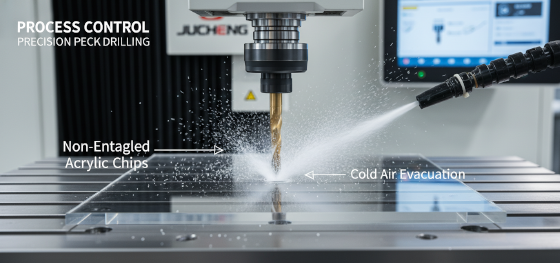
Correct parameters are vital for success. In metal machining, we often push for speed to reduce cycle times. In acrylic, speed is a dangerous variable. If the RPM is too high, you generate friction heat too fast for the cooling system to handle. If the feed rate is too slow, the tool "dwells" in one spot, rubbing against the plastic and causing it to melt. The golden rule we follow at Jucheng is to maintain a high feed per revolution to ensure the tool is always cutting fresh, cool material. Each tooth of the drill should take a definitive bite of plastic to carry the heat away in the chip.
Our CNC programmers utilize a technique called "Peck Drilling" (G83 cycle). Instead of a continuous plunge, the drill enters the hole for a short distance and then retracts completely out of the hole to clear the chips. This allows the tool to be hit with a blast of cool air before it dives back in. For a 1-inch thick manifold block, we might perform thirty or forty "pecks." This prevents the flutes from clogging and ensures that the temperature remains well below the melting point of the PMMA. This methodical approach is the only way to achieve consistent results in high-volume L'usinage CNC de l'acrylique projects where quality cannot be compromised for speed.
Support et refroidissement : prévenir l'éclatement à la sortie

The most common failure point in le perçage de l'acrylique sans le fissurer is the "blowout" at the bottom of the hole. As the drill approaches the end of the part, the material wall becomes incredibly thin. Without support, the downward pressure of the spindle will simply burst through that last layer, leaving a jagged, shattered exit. Jucheng solves this using a rigid "Sacrificial Backer Board." We clamp the acrylic workpiece tightly against a flat piece of high-density material. This provides a continuous physical support system, tricking the material into thinking it is much thicker than it actually is. The result is a clean, razor-sharp exit hole with zero chipping.
Coolant selection is another critical area where many shops fail. Standard oil-based metalworking fluids can chemically attack acrylic, leading to immediate surface crazing. We avoid these entirely. Instead, we use high-pressure cold air guns or specialized water-soluble coolants that are verified for plastic compatibility. The air blast serves a dual purpose: it removes the thermal energy from the tool tip and physically clears the static-charged acrylic dust away from the hole. Keeping the cutting zone clear of debris prevents the drill from re-cutting old chips, which is a major source of friction and subsequent cracking.
Détente des contraintes : recuit après perçage pour la longévité

Even with perfect drilling techniques, the act of machining introduces internal stresses into the polymer matrix. Over time, these stresses can lead to spontaneous cracking, especially if the part is exposed to cleaning alcohols or varying temperatures. At Jucheng Precision, we offer post-machining annealing as a high-value engineering service. We place the finished acrylic parts in a controlled thermal oven, slowly raising the temperature and then cooling it at a specific rate over several hours.
This thermal cycle allows the long polymer chains to relax and realign, effectively "healing" the internal stresses created by the drill bit. This is a mandatory step for medical manifold blocks and aerospace enclosures where the part must remain optically perfect for decades. By integrating annealing into our workflow, we ensure that the "clear" part we ship today doesn't develop "spiderwebs" six months from now. It is this attention to the long-term lifecycle of the material that separates a high-end manufacturer from a basic job shop.
L'avantage JUCHENG dans les plastiques de précision

Mastering the nuances of le perçage de l'acrylique sans le fissurer is just one part of our broader capability in precision plastic fabrication. Jucheng Precision operates a state-of-the-art facility equipped with high-speed 5-axis CNC centers specifically calibrated for low-vibration plastic work. We understand that transparency is often the most critical requirement of your design, and we treat every part with the silken-glove care it deserves. Our quality control team utilizes high-magnification inspection to verify that every hole is free of micro-cracks before it leaves our floor.
We don't just follow your blueprints; we partner with you during the DFM phase to suggest hole placements and radii that maximize the strength of the acrylic. Whether you are developing a prototype for a new diagnostic device or scaling up production of complex lighting lenses, our expertise ensures that your vision is realized with perfect clarity. Don't leave your transparent designs to chance. Trust the engineers who understand the delicate soul of acrylic. Contact Jucheng Precision today to discuss your project and receive a quote that reflects our commitment to excellence.

