


L'intégration de l'efficacité thermique et des performances électriques élevées dans les châssis matériels personnalisés représente une étape majeure dans les énergies renouvelables et le conditionnement des batteries. Opter pour la fabrication de tôles en cuivre offre la pureté de cuivre supérieure et la faible résistance de surface nécessaires pour construire des connexions électriques sûres et à courant élevé. Ce métal rouge unique présente une conductivité électrique exceptionnelle, des limites de transfert thermique excellentes et une ductilité métallurgique supérieure, ce qui en fait la norme incontestée pour les blocs de distribution d'énergie, les connexions de batteries de véhicules électriques et les ailettes de transfert de chaleur complexes.
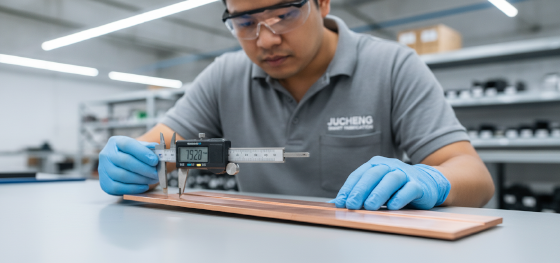
L'utilisation d'alliages à faible conductivité pour les connecteurs de batterie peut entraîner de graves goulets d'étranglement thermiques, provoquant une accumulation localisée de chaleur qui peut compromettre votre électronique. Bien que l'acier standard offre un support structurel, il manque de la capacité de flux d'électrons brute nécessaire pour les systèmes haute tension. Passer vos plaques de transport de courant à du cuivre de haute pureté garantit une efficacité énergétique maximale avec une résistance thermique minimale.
Équilibrer l'état physique mou et collant du matériau par rapport aux outils de découpe standard est ce qui distingue les joints électriques propres et à faible résistance des composants en cuivre déchirés et hors tolérance. Examinons comment les propriétés du cuivre optimisent les systèmes de haute puissance, analysons les lasers à fibre de pointe nécessaires pour découper les tôles métalliques hautement réfléchissantes, et passons en revue comment protéger les pièces finies de l'oxydation atmosphérique.
contenu :
Applications clés : barres omnibus électriques et dissipateurs thermiques
Le défi de la découpe laser du cuivre réfléchissant
Poçonnage et pliage de précision pour pièces en cuivre
Fabrication de cuivre et de laiton chez JUCHENG
FAQ : questions critiques sur la fabrication de tôles en cuivre
Applications clés : barres omnibus électriques et dissipateurs thermiques
Qu'est-ce qui fait de la tôle de cuivre le choix standard pour les connexions de batteries ?
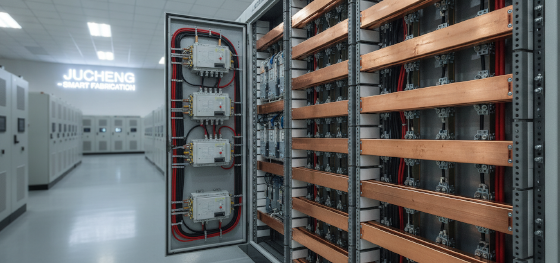
Le cuivre possède une conductivité électrique allant jusqu'à 101% IACS, permettant aux barres omnibus électriques lourdes de transmettre des courants massifs avec une perte d'énergie minimale.
Les batteries de véhicules électriques modernes, les appareillages haute tension et les réseaux électriques dépendent fortement des barres omnibus en cuivre robustes pour acheminer les courants en toute sécurité entre les cellules. Avec une conductivité électrique atteignant jusqu'à 101% IACS (International Annealed Copper Standard), le cuivre sans oxygène C11000 et C10100 sont les alliages de choix, offrant une faible résistance de surface pour maximiser la transmission de puissance du système.
For advanced cooling systems, copper sheet metal is fabricated into intricate, high-surface-area heat sinks. The material's superior thermal conductivity (roughly double that of aluminum) allows heat to dissipate rapidly away from microprocessors, protecting sensitive electronic components from thermal degradation and ensuring stable performance.
Le défi de la découpe laser du cuivre réfléchissant
Why is laser cutting on high-purity copper so difficult for standard CNC shops?
Pure copper possesses high optical reflectivity, meaning it reflects standard CO2 laser beams back into the cutting head, causing severe optical damage.
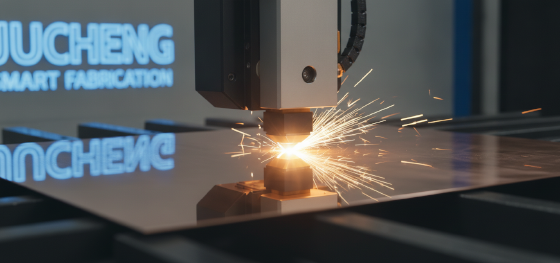
Standard CO2 lasers operate at a long wavelength that copper reflects like a mirror. When a CO2 laser beam hits a polished copper sheet, the beam bounces back, initiating a phenomenon known as back-reflection that can instantly burn out expensive focus lenses and fiber cables.
To overcome these optical challenges, high-precision facilities utilize advanced fiber laser cutting systems. Fiber lasers operate at a much shorter wavelength that copper absorbs far more readily. Coupled with high-pressure nitrogen assist gas, our fiber lasers slice through thick copper plates cleanly, delivering bright, oxide-free edges with zero back-reflection risk to the cutting equipment.
Poçonnage et pliage de précision pour pièces en cuivre
What mechanical precautions are required when punching and bending soft copper sheets?
Copper is highly ductile and prone to surface scratching, requiring customized punch-die clearances and specialized protective films during press operations.
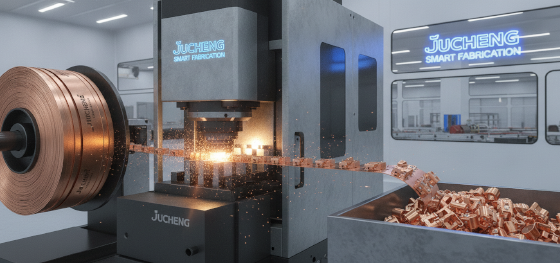
While pure copper is highly ductile and easy to cold-work, executing copper sheet metal fabrication under continuous high-speed press runs requires specialized mechanical expertise. Because the metal is soft and gummy, it can stick to standard tool steel punches, leading to slug pulling and dimensional variations on blanked parts. We resolve this by running customized punch clearances and highly polished dies.
Forming copper also requires careful angular calibration. Due to its high ductility, copper exhibits very low springback compared to stainless steel. However, our operators must utilize protective polyurethane die covers during press brake bending to prevent steel dies from leaving deep, ugly tool marks on the soft copper surface, ensuring a flawless cosmetic profile.
Fabrication de cuivre et de laiton chez JUCHENG
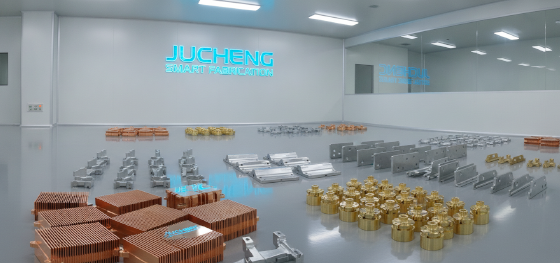
How does JUCHENG manage high-precision copper fabrication for advanced power systems?
We operate high-power fiber laser cutters, high-tonnage press brakes, and automated plating lines managed by certified operators, utilizing custom tooling to ensure tight tolerances.
Selecting this highly conductive matériau de tôle ensures that your power distribution grids and electronic brackets achieve optimal power transmission with minimal thermal resistance. JUCHENG integrates advanced fiber cutting, punching, and forming systems into our full-service production lines. This allows us to transition your 3D models into fully finished, durable copper busbars with extreme dimensional accuracy.
We process a wide range of raw gauges in both C11000 and C10100 grades. Our technical department provides a 24-hour free DFM analysis to check your CAD models for hole clearances and bend radii before production. Supported by our no MOQ policy and rapid delivery guarantee, we manage your project from initial flat pattern cutting to final, fully integrated surface plating and packaging.
FAQ : questions critiques sur la fabrication de tôles en cuivre
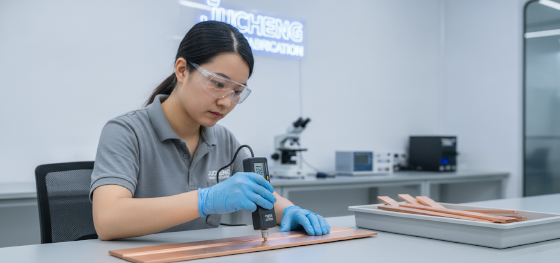
Why must copper busbars be plated with tin or nickel before installation?
Raw copper instantly oxidizes when exposed to oxygen and humidity, forming a dark copper oxide layer that dramatically increases electrical resistance. Electroplating the copper with a protective layer of tin plating or nickel prevents oxidation, ensuring that the electrical contacts maintain high conductivity and low resistance over years of service.
Can C11000 copper be hardened through heat treatment?
No, C11000 is pure electrolytic tough pitch copper and cannot be hardened by thermal heat treatment. It can only be hardened mechanically through cold-working processes such as rolling, stamping, or bending. If your design requires high mechanical hardness, we recommend utilizing copper-beryllium alloys which respond beautifully to aging heat treatments.
What causes tearing on the outer bend radius of thick copper bars?
Tearing occurs when the inner bending radius is set too sharp for the material thickness, stretching the outer fibers past their tensile limits. Although copper is highly ductile, thick busbars require a generous minimum bend radius (typically equal to or greater than the plate thickness) to prevent localized splitting during press brake operations.
How does JUCHENG prevent tool marks during copper sheet metal fabrication?
We protect the soft, delicate surfaces of raw copper sheets by executing CNC bending with specialized urethane die inserts or applying high-density protective vinyl masking films. This prevents direct metal-on-metal friction between the steel tooling and the copper, delivering clean, mark-free electrical contacts ready for immediate electroplating.

