


Precision in CAD is a mathematical certainty, but precision on the factory floor is a thermodynamic struggle. When an engineer specifies a tolerance on a digital model, they are assuming a world without friction, heat, or gravity. However, the choice between a machine CNC vs imprimante 3D is exactly where these physical laws begin to exert their will. A 3D printer builds a part through a series of micro-welds or chemical transitions, each introducing a tiny variable of shrinkage. A CNC machine, by contrast, removes material with a rigid, documented force. This is the technical battlefield of CNC vs 3D Printing Tolerances. It is a decision that determines whether your parts will assemble with a satisfying "click" or whether you will spend weeks in a remedial rework loop.
JUCHENG operates as a unified technical hub, and we’ve noticed a consistent "Micron Trap": designers often expect 3D printers to hold the same H7 tolerances as a precision mill. The reality is that additive manufacturing is a "Near-Net-Shape" technology. It excels at complex volume but struggles with the absolute sovereignty of the coordinate. We utilize over 25 high-precision 5-axis centers specifically to close the accuracy gap that additive methods leave behind. This guide moves past the standard datasheets to explore the actual mechanics of thermal drift, the logic of linear scales, and why JUCHENG’s integrated hybrid approach is the only way to achieve sub-ten-micron fits in high-performance hardware.
Reliability in high-stakes engineering is born from the control of deviation. You aren't just buying a shape; you are buying the verified relationship between features. Whether you are building a complex medical valve or a high-speed aerospace spline, the logic of the tolerance is your primary manufacturing governor. Let us break down the physical laws of dimensional integrity and see how technical foresight can lock the soul of your next design into reality.
Thermal Hostility: Why 3D Printing Drifts in the Tank
The Sovereignty of the Spindle: Machining Without Deviation
Dimensional Benchmarks: The Additive vs. Subtractive Chart
The Press-Fit Crisis: Why H7 Bores Demand the Mill
JUCHENG’s Hybrid Standard: Printing for Mass, Milling for Fit
Thermal Hostility: Why 3D Printing Drifts in the Tank
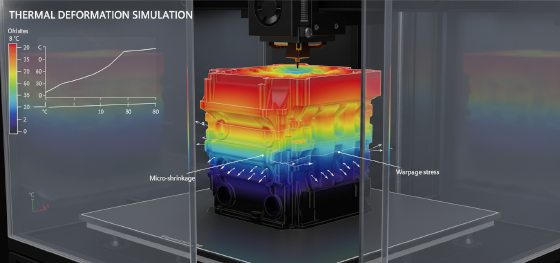
The primary differentiator in the CNC vs 3D Printing Tolerances Le standoff est la gestion des changements de phase. Chaque technologie d'impression 3D repose sur l'ajout de chaleur ou d'énergie UV pour transformer un liquide ou une poudre en solide. Lorsque le matériau refroidit ou durcit, il rétrécit. Ce retrait n'est pas toujours uniforme ; il est influencé par la masse de la section transversale de la pièce et la température ambiante de la chambre de construction. Dans une grande pièce FDM ou SLS, les coins ont tendance à se replier vers l'intérieur, créant un "gauchissement" qui peut déplacer une caractéristique hors tolérance jusqu'à 0,3 mm. Même dans les systèmes SLA (Résine) de haute précision, l'action de "décoller" la pièce de la cuve peut provoquer des distorsions microscopiques.
Cette "Hostilité Thermique" fait de la fabrication additive un jeu de compensation plutôt que de contrôle absolu. Le logiciel de tranchage tente de prédire ce retrait et de dimensionner la pièce en conséquence, mais ce sont des estimations mathématiques, pas des certitudes physiques. Pour une pièce esthétique, un écart de 0,2 mm est invisible. Mais pour un collecteur médical où les canaux internes doivent s'aligner parfaitement avec un capteur usiné, cette dérive est un échec. JUCHENG atténue cela en utilisant des systèmes 3D de qualité industrielle avec des chambres chauffées activement et des rampes de refroidissement stabilisées, mais nous sommes honnêtes avec nos clients : si votre pièce est définie par de longues portées non supportées et nécessite une précision de +/- 0,05 mm, la physique de l'impression 3D lutte contre vous dès la première couche. Nous traitons l'additif comme un outil pour la complexité, pas pour la maîtrise absolue du micron.
The Sovereignty of the Spindle: Machining Without Deviation
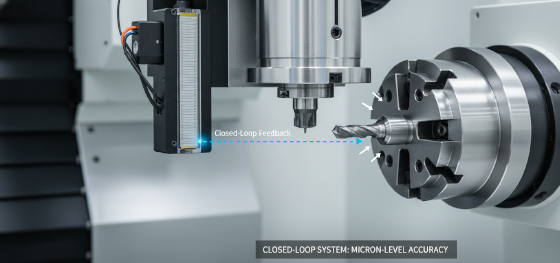
L'usinage CNC fonctionne sur le principe de l'imposition mécanique. Nous n'attendons pas que le métal réagisse ; nous le forçons à prendre forme. La précision du machine CNC vs imprimante 3D choix est enracinée dans la rigidité du système de mouvement. Une fraiseuse CNC utilise des composants massifs en fonte et des vis à billes rectifiées de précision pour verrouiller la position de l'outil. Plus important encore, les machines haut de gamme chez JUCHENG utilisent une rétroaction "en boucle fermée". Des règles linéaires à haute résolution mesurent la position physique de la table et fournissent des corrections en temps réel aux servomoteurs, compensant la dilatation thermique des propres composants de la machine.
Cette Souveraineté de la Broche nous permet d'atteindre +/- 0,01 mm (0,0004 pouces) avec une répétabilité stupéfiante. Contrairement à l'impression 3D, où le matériau est "formé" sur place, la CNC enlève de la matière d'un billette stabilisée et corroyée qui a déjà été traitée thermiquement et détensionnée. Cela élimine le "gauchissement" qui se produit lors de la création de nouveaux solides à partir de liquide ou de poudre. Si vous usinez de l'acier inoxydable 17-4 PH ou du Nylon 6, la fraiseuse maintient la vérité géométrique du fichier CAO car la rigidité de l'outil surmonte la résistance interne du matériau. Nous traitons chaque opération CNC comme un événement chirurgical, fournissant la certitude dimensionnelle nécessaire pour les assemblages aérospatiaux et de défense les plus exigeants au monde. Dans la course aux tolérances, la fraiseuse est le champion incontesté des charges lourdes.
Dimensional Benchmarks: The Additive vs. Subtractive Chart
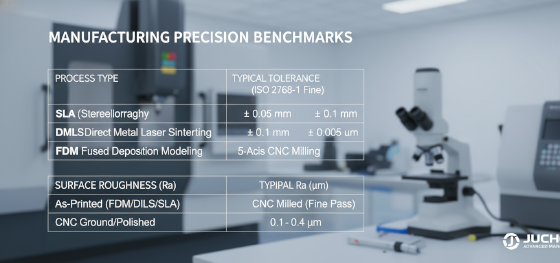
Les données sont le seul remède contre l'ambiguïté de fabrication. Pour simplifier votre stratégie de fabrication, Jucheng Precision a développé un benchmark réaliste de CNC vs 3D Printing Tolerances. Ces valeurs représentent la "Performance Industrielle Standard" des pièces produites et inspectées dans notre laboratoire climatisé à 20°C.
| Technologie | Tolérance Standard | Limite de Précision | Finition de Surface Typique |
|---|---|---|---|
| Fraisage CNC 5 axes | +/- 0,05 mm | +/- 0,005 mm | Ra 0,8 - 1,6 |
| Industrial SLA (Resin) | +/- 0.15 mm | +/- 0.10 mm | Ra 1.6 - 3.2 |
| DMLS (Metal 3D) | +/- 0.20 mm | +/- 0.10 mm | Ra 6.3 - 12.5 |
| MJF / SLS (Powder) | +/- 0.30 mm | +/- 0.20 mm | Ra 3.2 - 6.3 |
The Press-Fit Crisis: Why H7 Bores Demand the Mill
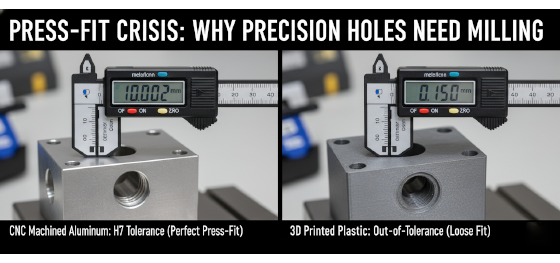
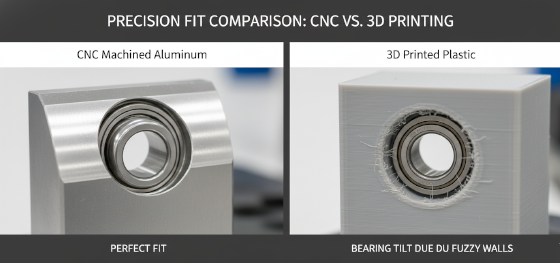
The "Fit" of an assembly is where CNC vs 3D Printing Tolerances move from a theoretical discussion to a functional crisis. If your part features a bearing seat, a locating pin hole, or a high-pressure seal groove, you are likely operating in the world of H7 or g6 fits. These ISO standards allow for a margin of error measured in single-digit microns. 3D printing is physically incapable of hitting these tolerances consistently. The layer lines and stair-stepping effects create "peaks" on the internal surface of a hole that prevent a bearing from seating flat. If you try to force a fit on an "as-printed" hole, you will likely crack the part or cause a misalignment that leads to early failure.
At JUCHENG, we manage the "Press-Fit Crisis" by auditing every assembly interface during the DFM review. We don't just "hit go" on the printer for your complex manifolds. We identify the zones where additive manufacturing will fail to meet the functional requirement and we propose a hybrid solution. This ensures that the primary weight-saving and complex geometry is handled by the 3D printer, while the critical "interfacing" features are handled by our CNC department. We understand that a part that looks good but doesn't fit is a wasted investment. By separating the "structural mass" from the "precision interface," we deliver a component that works flawlessly in your final assembly, regardless of the complexity of the design.
JUCHENG’s Hybrid Standard: Printing for Mass, Milling for Fit
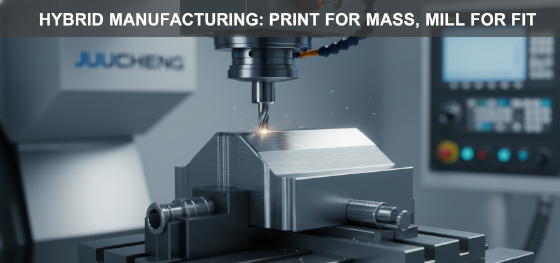
The final hallmark of a professional manufacturing partner is the move away from "Either/Or" thinking. The future of CNC vs 3D Printing Tolerances is not a choice between two machines, but the synchronization of both. Jucheng Precision has mastered the "Hybrid Workflow." We print your complex metal or plastic parts with extra material (machining stock) on all critical faces. We then move the part to our 5-axis CNC floor, where we mill the features back to absolute zero-deviation.
This integrated approach provides our clients with the geometric freedom of 3D printing and the surgical accuracy of CNC machining. We use our high-resolution CMMs to verify this hybrid bond, providing you with 100% inspection reports that prove every H7 bore and every datum face meets your print. When you receive a component from JUCHENG, you aren't just getting additive or subtractive work; you are getting a verified engineered solution that has been audited for survival. Whether you are building an innovative medical heart pump or a high-performance satellite manifold, our dual-technology protocols clarify and elevate your most ambitious projects. Contact Jucheng Precision today for a technical DFM review and see how our tolerance mastery can stabilize your next manufacturing breakthrough.

