


Missing a single planting window in the AgTech industry is not just a delay; it is a year-long catastrophic failure for market entry. In robots agricoles de précision, the hardware must be field-ready before the soil is turned. If the chassis cracks or a sensor mount vibrates loose during the critical three-week trial period, there is no second chance until the following season. This unrelenting pressure makes Agriculture robot prototyping the most time-sensitive phase of the entire product development lifecycle in [2026].
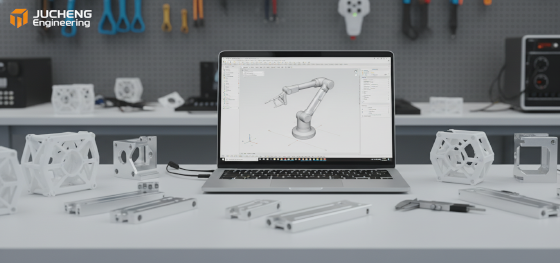
Prototyping for the farm is fundamentally different from prototyping for the consumer market. A farm robot must handle dirt, rain, and impacts immediately—3D-printed aesthetic models are useless here. Engineers require "functional prototypes" that utilize production-grade materials like 6061-T6 aluminum and high-impact polymers from day one. Jucheng Precision addresses this need by providing an integrated multi-process facility that turns CAD files into mud-ready hardware in a matter of days.
Operating out of the Shenzhen precision manufacturing hub, JUCHENG serves as the high-velocity engine for global AgTech startups. We combine the speed of industrial 3D printing with the raw strength of 5-axis CNC machining to deliver prototypes that can actually do the work. This guide explores the seasonal dynamics, multi-process strategies, and rapid tooling technologies required to ensure your autonomous fleet is ready for the field trial season.
The Seasonal Deadline: Why Speed is AgTech’s Survival Metric
Comparative Data: Prototyping Speed and Material Integrity
Multi-Process Iteration: Integrating CNC and 3D Printing
Rapid Tooling: Bridging the Gap to Pilot Production
JUCHENG: The 24/7 Iteration Hub in Shenzhen
FAQ: Hardware Iteration for Autonomous Farming
The Seasonal Deadline: Why Speed is AgTech’s Survival Metric
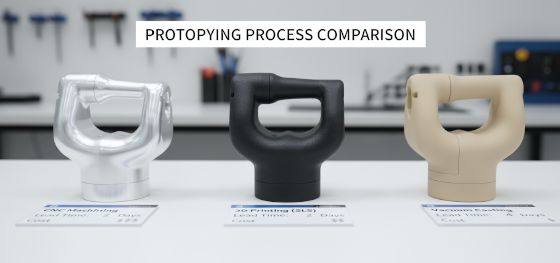
Agricultural development cycles are dictated by the sun and the soil, not by a project manager’s Gantt chart. In Agriculture robot prototyping, la " fenêtre d'opportunité " correspond aux quelques semaines où les cultures sont au stade spécifique requis pour les tests. Qu'il s'agisse d'un robot récolteur de fruits nécessitant une maturité spécifique ou d'un robot de désherbage nécessitant une certaine hauteur de mauvaises herbes, un retard de dix jours peut invalider une année entière de R&D. JUCHENG comprend cette urgence saisonnière et fait fonctionner notre installation 24h/24 et 7j/7 pour garantir que le matériel arrive avant que la première graine ne soit plantée.
Les tests itératifs sur le terrain révèlent des défauts qu'aucune simulation ne peut prédire. Les variations de densité du sol, les pics d'humidité inattendus et le " facteur poussière " ne se manifestent que lorsque le robot physique touche la boue. Plus vite une équipe d'ingénierie peut mettre une version 1.0 sur le terrain, plus vite elle peut recevoir les " données d'échec " nécessaires pour la version 2.0. En offrant des délais aussi rapides que 3 à 5 jours ouvrables pour des assemblages complexes, JUCHENG permet aux équipes de réaliser trois ou quatre cycles itératifs en une seule saison de croissance.
Une défaillance fonctionnelle lors d'un essai représente une dépense logistique énorme. Envoyer une équipe d'ingénieurs dans une ferme isolée pour qu'un support de moteur casse le premier jour est un désastre financier. JUCHENG élimine ce risque en traitant chaque prototype avec la rigueur d'une production en série. Nous utilisons des métaux réels et des résines de qualité industrielle pour garantir que le prototype fonctionne exactement comme la machine finale. Cette approche de prototypage " haute fidélité " garantit que les données recueillies sur le terrain sont valides et que les fondations mécaniques sont solides pour la phase suivante de mise à l'échelle.
La fiabilité de la chaîne d'approvisionnement en [2026] est la dernière composante de l'équation de la vitesse. Attendre des semaines pour une pièce CNC personnalisée d'un atelier standard est inenvisageable. La philosophie " Pont vers la production " de JUCHENG signifie que nous stockons une vaste gamme de matériaux adaptés à l'agriculture, de l'ASA stable aux UV à l'acier inoxydable 316L, ce qui nous permet de passer du devis à l'usinage en quelques heures. Cette rapidité brute permet à nos clients de pivoter leurs conceptions en cours de saison et de capturer les données de récolte critiques dont ils ont besoin pour les démonstrations aux investisseurs et la validation commerciale.
Comparative Data: Prototyping Speed and Material Integrity
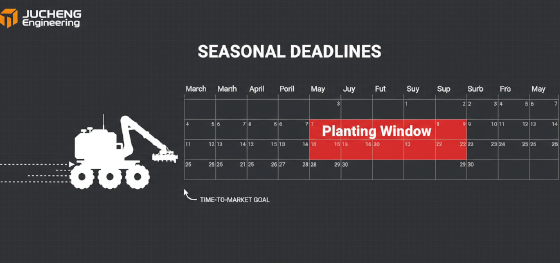
Choisir le bon procédé pour chaque composant d'un prototype de robot est essentiel pour équilibrer le coût et la performance. Un garde-boue en plastique n'a pas besoin de la précision d'un support de boîte de vitesses. Jucheng Precision fournit des consultations multi-procédés pour vous aider à choisir la voie la plus efficace pour vos Agriculture robot prototyping besoins. Le tableau suivant compare les procédés courants utilisés pour construire des prototypes AgTech fonctionnels.
| Procédé | Délai de livraison | Résistance du matériau | Cas d'utilisation typique |
|---|---|---|---|
| Usinage CNC | 3 à 7 jours | Maximum (Métal/Plastique) | Transmissions, Supports |
| Impression 3D SLS | 2 à 4 jours | Élevée (Nylon) | Agencement interne, Capots |
| Moulage sous vide | 10 - 15 Days | Moderate (PU Resins) | External Panels, Seats |
| Tôle | 5 - 8 Days | High (Steel/Alu) | Chassis, Brackets |
CNC machining remains the gold standard for any component subject to torque, vibration, or friction. Because we use real extruded billets, the mechanical properties are 100% predictable. For robots agricoles de précision, this predictability is vital during the early "stress-testing" phase. If a CNC part fails, you know it was a design error; if a 3D-printed part fails, you don't know if it was the design or the weak layer adhesion of the printing process. JUCHENG prioritizes CNC for all load-bearing prototype components to eliminate this ambiguity.
Multi-Process Iteration: Integrating CNC and 3D Printing
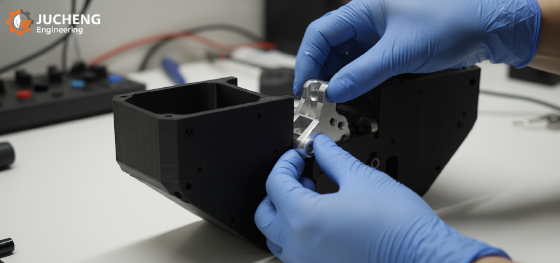
The most efficient prototypes are "hybrids" that use the best process for every sub-assembly. In Agriculture robot prototyping, JUCHENG often combines SLS (Selective Laser Sintering) nylon for complex, non-load-bearing internal ducts with CNC-machined aluminum for the primary motor mounts and drive pivots. This hybrid approach optimizes both the cost and the delivery speed. By using SLS for organic shapes that would be expensive to CNC, we save our clients thousands in unnecessary NRE while keeping the strength where it matters most.
DMLS (Direct Metal Laser Sintering) is utilized for high-complexity effector heads that require internal cooling or fluid channels. For robotic fruit harvesters, the grippers often require intricate bionic geometries that are impossible to machine. JUCHENG 3D prints these in 316L stainless steel or AlSi10Mg aluminum, providing a level of design freedom that accelerates the testing of new harvesting bionics. This "additive-first" approach for end-effectors allows for rapid design-and-pick cycles, where a new gripper can be designed, printed, and tested on the robot in under 72 hours.
Precision fitment between different processes is a hallmark of JUCHENG’s Agriculture robot prototyping service. A 3D-printed shell must fit perfectly onto a CNC-machined chassis. Because we manage both processes in one Shenzhen hub, we calibrate our 3D printers and CNC machines to the same global standard, ensuring that "tolerance stack-up" never ruins a field assembly. We perform pre-assembly checks on every multi-process prototype before it leaves our facility, identifying potential interference issues in the CAD vs. physical reality.
Durability testing of these hybrid assemblies is verified in-house. We subject prototype joints to cycle testing and salt-spray exposure to simulate the first few weeks of farm life. By identifying a "rubbing hose" or a "weak bracket" in the lab, we prevent the costly field failures that kill project momentum. JUCHENG’s goal is to deliver a prototype that doesn't just look like a robot, but behaves like a production machine under the unrelenting sun of the [2026] season.
Rapid Tooling: Bridging the Gap to Pilot Production
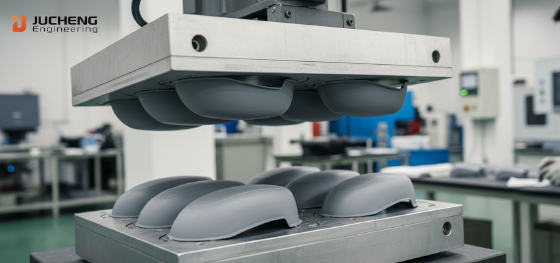
Once the design is validated via CNC and 3D printing, the next step is a "pilot run" of 10 to 50 robots for multi-site field trials. Standard production tooling is too slow and expensive for this stage. JUCHENG utilizes Rapid Tooling—aluminum molds for injection molding or vacuum casting—to deliver production-grade parts in 2 to 3 weeks. For Agriculture robot prototyping, this allows for the production of ruggedized fenders, battery enclosures, and sensor hoods in their final production materials like ASA or DCPD.
Vacuum casting is particularly effective for the "soft-touch" components of a harvester. We create a high-fidelity 3D-printed master and then cast silicone or TPU skins around a CNC-machined bone. This allows for the testing of different "grip hardnesses" during the harvest season without committing to expensive steel molds. By providing 50 sets of these bionic grippers in record time, JUCHENG enables our clients to gather massive datasets across multiple farms simultaneously, proving their technology's commercial viability.
Aluminum molds used in rapid tooling can often survive for 5,000 cycles, providing a cost-effective "Bridge to Production" for the entire first year of sales. Many AgTech companies never move beyond aluminum tooling, as their annual volumes remain within the sweet-spot of this process. JUCHENG manages the mold design, the injection cycle, and the final finishing, ensuring that your first 50 units are indistinguishable from the 5,000th unit. This level of quality is vital for maintaining investor confidence and securing early customer buy-in.
JUCHENG: The 24/7 Iteration Hub in Shenzhen
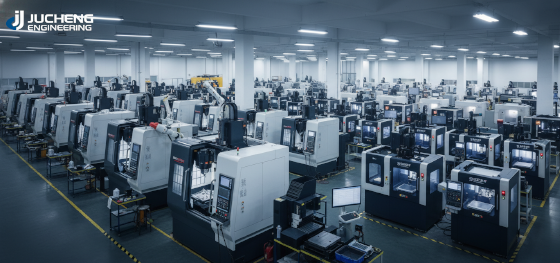
Dominating the [2026] AgTech market requires a partner that can scale as fast as the growing season. Jucheng Precision operates with a 24/7 manufacturing mindset in our Shenzhen precision manufacturing hub, delivering complex robot prototypes and pilot-run assemblies with lead times that standard vendors simply cannot match. We provide a bridge to production that allows you to scale from a single functional prototype to a fleet of commercial harvesters without ever worrying about part quality or seasonal deadlines.
Integrating your design with JUCHENG’s expertise ensures that your robot survives the "First-Field Season" and moves into mass adoption. We offer comprehensive DFM reviews within 24 hours, identifying potential fatigue points or weight-saving opportunities in your prototype design before they become field failures. Whether you are building an autonomous fruit harvester or a heavy-duty soil-tilling bot, Jucheng Precision provides the rapid-iteration hardware that keeps your innovation moving through the mud, the sun, and the years.
Our facility is equipped with 150+ CNC machines and dedicated 3D-printing and molding cells, allowing us to manage the entire prototype lifecycle in one location. We manage the complexity of multi-process manufacturing so your engineering team can focus on the AI, the autonomy, and the farm. By combining Shenzhen's speed with industrial-grade material verification, JUCHENG remains the preferred partner for the world's most aggressive AgTech hardware challenges. Contact us today to start your next project.
FAQ: Hardware Iteration for Autonomous Farming
What is the fastest way to get a functional chassis prototype?
CNC-machined aluminum or laser-cut steel. They offer production strength with no tooling lead time.
Can JUCHENG 3D print production-grade robot parts?
Yes. We use SLS Nylon and DMLS Metal 3D printing for complex, functional hardware.
Is rapid tooling cheaper than CNC for 50 parts?
Generally yes. Aluminum molds become cost-effective when part quantities exceed 20 to 30 units.
How do you ensure a 3D-printed part won't break in the field?
We utilize SLS Nylon with glass-filled additives for increased stiffness and impact resistance.
What are typical lead times for a complete robot prototype?
A complete mechanical assembly is typically delivered in 10 to 15 business days.
Prototypes that fail in the mud are the ultimate hardware killers in AgTech. Partnering with Jucheng Precision ensures that your functional iterations are built with the CNC-machined aluminum and rapid-tooling techniques the industry demands. Reach out to our Shenzhen manufacturing hub today for a complete DFM review and build the field-ready foundation your autonomous fleet requires.

