


L'engagement financier est le cœur du cycle de fabrication. Lorsqu'un ingénieur fait passer un design d'une maquette numérique à un lancement commercial, la question la plus cruciale ne concerne pas la performance des matériaux, mais le seuil fiscal de la production. Dans le paysage intense de la gestion des coûts d'impression 3D , il y a un moment de divergence totale où l'agilité du laser rencontre l'efficacité implacable du moule métallique. C'est la comparaison définitive des coûts entre l'impression 3D et le moulage par injection. C'est une bataille entre le sanctuaire " sans outillage " de la fabrication additive et la domination " haute pression " du moulage par soustraction. Choisir la mauvaise voie peut laisser une startup ancrée par des dettes de moules de centaines de milliers de dollars ou ruiner une série de production par les prix unitaires insoutenables d'une imprimante 3D.

JUCHENG agit comme un pont stratégique pour les innovateurs mondiaux, et nous avons remarqué une " illusion de quantité " récurrente : la croyance que l'impression 3D est uniquement pour les prototypes et le moulage par injection uniquement pour les millions. La réalité moderne est bien plus nuancée. En intégrant des systèmes MJF à haute capacité avec un outillage rapide professionnel et des lignes de moulage par injection à grande échelle, nous agissons comme un consultant économique impartial. Nous comprenons que la " valeur " est une cible mobile qui se déplace avec le volume de votre bon de commande. Ce guide dépasse les tutoriels de base pour explorer les mathématiques rigoureuses de l'amortissement des coûts fixes, la logique stratégique de la production de transition, et pourquoi l'installation intégrée de JUCHENG est le seul sanctuaire unique capable de faire évoluer votre vision d'une seule unité à un déploiement mondial d'un million de pièces.
La rentabilité dans le matériel se gagne en identifiant le moment exact pour faire pivoter votre technologie. Vous n'achetez pas seulement du plastique ; vous gérez le risque de votre budget R&D. Que vous construisiez un capteur médical innovant ou un appareil grand public à grand volume, la logique du seuil de rentabilité est votre principal régulateur de fabrication. Décomposons les piliers physiques et financiers de la division d'échelle et voyons comment la prévoyance technique peut verrouiller l'intégrité de votre ROI dans la réalité.
Économie structurelle : Logique des coûts fixes vs variables
Mécanique du seuil de rentabilité : Identifier le pivot de quantité
Sanctuaire de l'outillage rapide : Naviguer dans la zone grise des 500 unités
Contraintes géométriques : Concevoir pour le moule vs le vide
Norme intégrée de JUCHENG : Passer de 1 à 1 000 000
Économie structurelle : Logique des coûts fixes vs variables
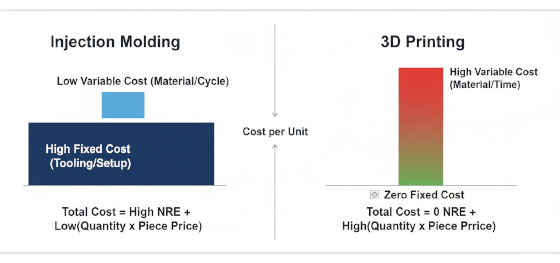
Pour maîtriser le comparaison définitive des coûts entre l'impression 3D et le moulage par injection, one must first deconstruct the anatomy of an invoice. Injection molding is a process defined by front-loaded NRE (Non-Recurring Engineering) costs. You are essentially building a high-precision robot—the mold—to produce your part. This mold requires specialized tool steel, 5-axis CNC machining, and hours of expert assembly. Whether you need one part or one hundred thousand, the cost of that mold remains constant. This is a "Fixed Cost" heavy model. For a small industrial enclosure, a mold might cost $15,000. If you only produce 100 parts, the "Amortized Tooling Cost" is $150 per part, which is financially unviable.
3D printing operates on a "Variable Cost" heavy model. There is no mold to build and no NRE debt to pay. The cost of the first part is nearly identical to the cost of the ten-thousandth part. You pay for the grams of resin and the minutes of machine time consumed. This linear relationship is the primary technical shield for startups; it allows you to start production with near-zero capital risk. However, the piece-price for a 3D printed part is inherently higher than an injection-molded one because you are paying for premium powders and the high machine-hour rate of an industrial printer. At JUCHENG, we help our clients perform a "Capital Triage." We identify the point where the low variable cost of injection molding begins to eat away at the fixed cost of the tool. If your part is simple and high-volume, the variable cost of 3D printing will quickly outrun the total investment of a mold, making additive manufacturing the more expensive long-term choice.
Mécanique du seuil de rentabilité : Identifier le pivot de quantité

The "Breakeven Point" is the most critical coordinate on your manufacturing roadmap. It is the specific quantity where the total cost of 3D printing (Material + Machine Time) intersects with the total cost of injection molding (Tooling + Low Piece Price). Identifying this pivot is the hallmark of a professional gestion des coûts d'impression 3D audit. For small, complex parts made from standard Nylon 12, JUCHENG generally identifies the breakeven point between 300 and 800 units.
If your requirement is for 50 specialized brackets, 3D printing is the definitive winner—you avoid the $5,000 tooling fee and receive parts in days. If your requirement is for 5,000 brackets, injection molding becomes a financial necessity. The piece price for a molded part might be $1.00, while the 3D printed version remains at $20.00. Over 5,000 units, the $95,000 difference in piece price easily justifies the $15,000 mold investment. We utilize proprietary ROI calculators to present our clients with these hard-data intersections. We look at factors like "Design Maturity"—if your design is still evolving, the breakeven point shifts in favor of 3D printing, as the cost of a mold revision is a hidden secondary tax that can ruin a project's budget. We don't just quote parts; we provide the economic visibility needed to commit your capital with confidence.
Sanctuaire de l'outillage rapide : Naviguer dans la zone grise des 500 unités

The gap between "one hundred" and "two thousand" units is often called the "Grey Area" of manufacturing. It is too many parts for expensive 3D printing and too few parts to justify a high-end hardened steel mold. Jucheng Precision solves this through the "Rapid Tooling Sanctuary." Instead of building a 100,000-cycle steel tool, we utilize Aluminum Tooling or Master Unit Die (MUD) systems. This allows us to perform authentic injection molding with production-grade resins at a fraction of the traditional mold cost.
Rapid tooling is the ultimate bridge technology in the comparaison définitive des coûts entre l'impression 3D et le moulage par injection. It allows you to use real-world materials like PEEK or glass-filled Nylon while keeping the entry fee under $5,000. For our clients in the medical device and EV sectors, this is an essential "Market-Entry" strategy. It allows them to fulfill their first production orders with molded parts that pass final regulatory tests, while they wait to validate the market before investing in multi-cavity mass-production tools. By offering a middle-path between the printer and the hard-mold, JUCHENG ensures your scaling process is a smooth transition rather than a jarring financial leap. We treat "Bridge Production" as a technical discipline, ensuring that the dimensions and finishes of your low-volume molded parts match the quality of your eventual millions.
Contraintes géométriques : Concevoir pour le moule vs le vide

A critical variable often ignored in cost comparisons is the "Complexity Surcharge." In additive manufacturing, complexity is effectively free. A part with internal labyrinths, undercuts, and hollowed-out honeycomb structures costs the same as a solid block. In injection molding, complexity is an aggressive cost-driver. Every "Undercut" (a feature that prevents the part from being pulled straight out of the mold) requires a slide, a lifter, or a secondary action in the tool. Each of these mechanical movements adds thousands of dollars to the mold price.
At Jucheng Precision, our DFM (Design for Manufacturing) review identifies these "Geometric Taxes." If your design is highly complex and you only need 1,000 parts, the comparaison définitive des coûts entre l'impression 3D et le moulage par injection might still favor 3D printing simply because the mold required would be too sophisticated to be cost-effective. Conversely, if we can simplify your design—adding draft angles, uniform wall thicknesses, and eliminating undercuts—we can drive the mold price down to a level that makes injection molding the winner much earlier. We help our clients "Design for the Process." If you want the speed and freedom of 3D printing, we show you how to optimize for volume. If you want the economy of molding, we show you how to optimize for the pull of the tool. We bridge the gap between design theory and shop-floor reality, ensuring your geometry is an asset to your budget, not a liability.
Norme intégrée de JUCHENG : Passer de 1 à 1 000 000

The final hallmark of a world-class manufacturing partner is the ability to grow with the client. Most bureaus only offer one technology, forcing your design into a box that suits their machine inventory, not your business lifecycle. Jucheng Precision is a unified manufacturing hub. We don't just "sell 3D printing"—we manage your product's total physical evolution. We use our industrial SLA and MJF systems to provide the "Speed-to-Hand" prototypes you need in week one. As your volume grows to 500 units, we pivot to our rapid-tooling aluminum molds to deliver production-grade materials. When your product reaches the million-unit milestone, our high-volume injection molding department takes the lead.
This "Unified Scaling Protocol" is the cornerstone of JUCHENG’s reliability. We provide full material traceability and documented process validation at every stage. We bridge the gap between "now" and "forever," providing the technical clarity needed to manage your gestion des coûts d'impression 3D today while preparing for the economies of scale tomorrow. Whether you are building a revolutionary heart pump or a high-performance aerospace housing, our dual-technology expertise ensures your vision is delivered with absolute precision and fiscal integrity. Contact Jucheng Precision today for a technical DFM review and let our integrated scaling protocols clarify and armor your next industrial breakthrough. Stop guessing the breakeven point and start engineering your competitive advantage.

