


Biological hostility destroys inadequate hardware before a procedure even begins. In the uncompromising environment of the modern operating theater, reusable surgical instruments are subjected to a brutal cycle of bodily fluids, high-pressure steam, and aggressive chloride-based cleaning agents. When an engineer specifies a material for a robotic fluidic manifold or a laparoscopic grasper, traditional carbon steel or generic 304 stainless will rapidly succumb to "Pitting Corrosion," creating microscopic rust caverns that harbor lethal bacteria. For reusable devices, intended use and validated reprocessing requirements help determine whether to specify usinage médical en acier inoxydable 316L. Cet alliage spécifique—souvent surnommé " acier chirurgical "—est le cheval de bataille incontesté du secteur de la santé, conçu avec des additifs chimiques uniques pour résister à l'assaut de l'autoclave. Jucheng Precision opère comme un sanctuaire métallurgique certifié ISO 13485 dans le pôle de fabrication de précision de Shenzhen, fournissant les capacités CNC d'élite nécessaires pour conquérir ce métal notoirement " collant " et retenant la chaleur. Dans le cadre plus large de la Fabrication de robotique médicale, we bridge the gap between "industrial metal" and "clinical instrument," but the finished device must be assessed for its intended contact and validated for its specified reprocessing conditions and number of reuse cycles.

Establishing a resilient clinical supply chain demands the rejection of standard machining protocols. Amateurs often approach a billet of 316L with the same feeds and speeds used for aluminum, unaware that the material will actively "Work-Harden" ahead of the cutter, snapping carbide end-mills and destroying tight tolerances. Jucheng Precision eliminates these "Mechanical Drifts" by enforcing a strict "Heavy-Chip" machining philosophy across our fleet of advanced Swiss-style turning centers and 5-axis mills. Whether you are developing ultra-thin needle drivers or robust structural hubs for a surgical arm, manufacturing and inspection records can support the device evaluation, but do not establish FDA clearance or approval, or conformity for CE marking. This guide deconstructs the chemistry of Molybdenum defense, the physics of surface roughness (Ra), and why JUCHENG’s "Passivation Protocol" is a finishing option when required by the drawing or application.
Armure chimique : l'avantage du molybdène dans le 316L
Rébellion mécanique : conquérir l'effet d'écrouissage
Hygiène microscopique : pourquoi Ra 0,4 est la référence clinique
Souveraineté de surface : la nécessité de la passivation chimique
Protocole JUCHENG : CNC suisse et traçabilité des lots de chaleur
Foire aux questions : matériel chirurgical en 316L
Armure chimique : l'avantage du molybdène dans le 316L

La survie métallurgique dans un environnement salin est dictée par un ajout chimique de 2%. Le " L " dans 316L signifie " bas carbone " (max 0,03%), ce qui empêche la précipitation de carbures lors de processus à haute chaleur comme le soudage, réduisant le risque de corrosion intergranulaire. Cependant, le véritable super-pouvoir du usinage médical en acier inoxydable 316L is the inclusion of 2% to 3% Molybdenum. Standard 304 stainless steel relies solely on Chromium to form a protective oxide layer. When 304 is exposed to the chlorides present in human blood or hospital disinfectants, those chlorides attack the oxide layer, causing deep, localized "Pitting" rust. Molybdenum acts as a chemical reinforcement to the chromium-oxide shield, making it vastly more resilient to chloride assault. Jucheng Precision engineers mandate 316L for any robotic component that will enter the sterile field or handle bodily fluids. Corrosion resistance does not make a component permanently biologically inert. Evaluate the finished device in its intended use, taking account of surface condition, processing, and the type and duration of patient contact.
Rébellion mécanique : conquérir l'effet d'écrouissage
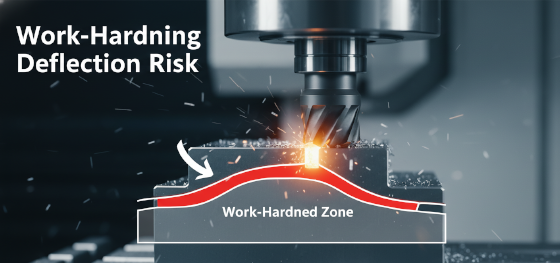
L'accumulation thermique détruit la précision dimensionnelle lors de la coupe des aciers inoxydables austénitiques. Le 316L est connu pour un phénomène appelé "écrouissage". Lorsqu'un outil de coupe CNC frappe le métal, la pression et la chaleur localisées modifient instantanément la structure cristalline de l'acier directement sous la coupe, le rendant nettement plus dur que le matériau environnant. Si l'outil "frotte" ou s'attarde à un endroit, le passage suivant rencontrera une surface deux fois plus dure, déviant la fraise et détruisant la tolérance de la pièce. Jucheng Precision combat cela en utilisant des configurations de machines rigides à couple élevé et des outils en carbure à angle d'attaque positif spécialisés. Nous programmons nos trajectoires d'outil pour maintenir une "charge de copeaux" constante et élevée, garantissant que la fraise mord physiquement *sous* la zone écrouie générée par le passage précédent. Nous associons cela à un liquide de refroidissement à haute pression par la broche pour évacuer agressivement la chaleur. Cette stratégie d'usinage "violente mais contrôlée" garantit que vos arbres chirurgicaux et vos boîtiers d'engrenages robotiques maintiennent une concentricité submicronique sans souffrir de déformations induites par les contraintes après leur sortie de la machine.
Hygiène microscopique : pourquoi Ra 0,4 est la référence clinique

A surface roughness of Ra 0.4 µm (16 µin) may be a drawing requirement, but it is not a universal criterion for tissue-contacting surfaces. Surface condition and part geometry can affect cleanability. A usinage médical en acier inoxydable 316L specification should define the required finish and acceptance criteria for the intended application. Jucheng Precision uses a multi-stage finishing process. After the precision CNC cut, we utilize centrifugal barrel tumbling with specialized ceramic media to knock down the microscopic peaks without altering the tight geometric tolerances of the part. A roughness measurement does not demonstrate microbial test performance or replace validation of the finished device’s cleaning, disinfection or sterilization steps, as applicable.
Souveraineté de surface : la nécessité de la passivation chimique

Machining inherently compromises the natural rust-defense of stainless steel. As the carbide tool cuts the 316L billet, it inevitably deposits microscopic particles of "free iron" onto the surface of the part. If left untreated, this free iron will oxidize rapidly when exposed to moisture, causing the "Surgical Steel" to rust. Jucheng Precision restores the material's chemical integrity through an in-house Passivation Protocol, compliant with ASTM A967 standards. We submerge the finished components in a controlled bath of heated nitric or citric acid. This acid attacks and dissolves the free iron without harming the base metal, while simultaneously accelerating the formation of a thick, impenetrable chromium-oxide passive layer. For complex robotic end-effectors with intricate hinge pins and internal lumens, we often upgrade to "Electropolishing." This electrochemical process acts as a reverse-plating bath, stripping away the outermost skin of the metal, removing micro-burrs, and leaving a mirror-like, ultra-passive finish. Electropolishing can smooth and passivate the surface under suitable process conditions. It does not sterilize the component or guarantee corrosion resistance in service.
Protocole JUCHENG : CNC suisse et traçabilité des lots de chaleur
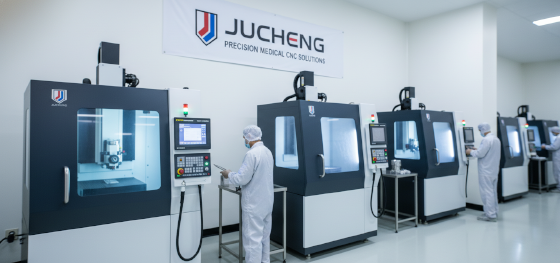
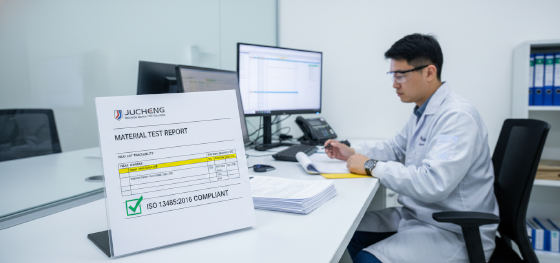
Manufacturing excellence at Jucheng Precision is built on the foundation of the documented pedigree. We recognize that producing long, slender surgical shafts (often 300mm long by 5mm wide) requires specialized equipment. Our facility houses an elite fleet of Swiss-style CNC turning centers. The guide-bushing technology of the Swiss machine supports the 316L rod mere millimeters from the cutting tool, eliminating the deflection that ruins standard lathe operations. Furthermore, our ISO 13485 certified workflow guarantees absolute "Heat Lot Traceability." When you receive a batch of surgical jaws or robotic flanges, it is accompanied by a Material Test Report (MTR) linking those parts to the specific smelting batch of the steel mill. Material traceability can support the device manufacturer’s documentation, but it does not replace finished-device validation or the applicable regulatory assessment. Contact our technical team today for a free DFM review and see how we can turn your digital intent into a rust-proof, clinical reality.
Foire aux questions : matériel chirurgical en 316L
Question : Pourquoi utiliser du 316L plutôt que de l'acier inoxydable 17-4PH pour les robots chirurgicaux ?
Réponse : Le 17-4PH peut être traité thermiquement pour atteindre une dureté beaucoup plus élevée (HRC 40+), ce qui le rend idéal pour les lames de coupe et les mâchoires tranchantes. Cependant, le 316L offre une résistance à la corrosion nettement supérieure contre les produits chimiques hospitaliers, ce qui en fait le choix préféré pour les boîtiers fluidiques, les poignées et les composants structurels.
Question : Quelle est la tolérance la plus serrée que JUCHENG peut maintenir sur un arbre robotique en 316L ?
Réponse : En utilisant nos tours CNC suisses avancés, nous maintenons régulièrement des tolérances de concentricité et de diamètre à +/- 0,005 mm (0,0002 pouce) même sur des pièces avec des rapports longueur/diamètre (L/D) extrêmes.
Question : JUCHENG peut-il fournir un marquage laser sur des instruments chirurgicaux en 316L ?
Réponse : Oui. Nous fournissons une gravure laser permanente à contraste élevé pour les codes d'identification unique des dispositifs (UDI) et les numéros de série. Les pièces sont passivées *après* le marquage laser pour garantir que la zone gravée ne devienne pas un point d'initiation de la rouille.

