
Matériaux de moulage par injection TPE et TPU (élastomères)
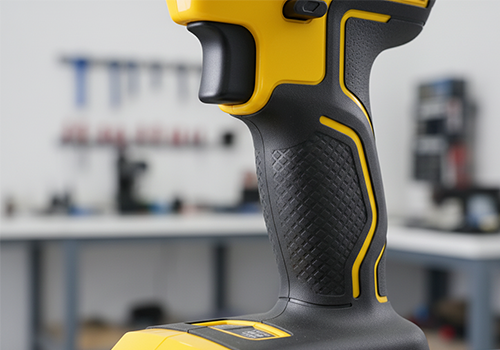
Les élastomères thermoplastiques (TPE) et les polyuréthanes thermoplastiques (TPU) sont des matériaux uniques qui combinent la facilité de transformation des plastiques avec la flexibilité et la durabilité du caoutchouc. Contrairement au caoutchouc thermodurcissable (qui met plusieurs minutes à durcir), ces matériaux peuvent être moulés en quelques secondes, ce qui les rend idéaux pour la production en grande série. Chez JUCHENG, nous sommes experts dans le traitement des résines élastomères. Nous nous spécialisons dans le moulage bi-matière (2K) et le surmoulage par insertion, en liant des couches souples de TPE/TPU sur des substrats rigides pour créer des poignées ergonomiques, des joints étanches et des pare-chocs résistants aux chocs pour les industries de l'outillage électrique, médicale et de l'électronique grand public.
Matériaux de moulage par injection TPE et TPU (élastomères)
Capacités de moulage d'élastomères de JUCHENG
Le moulage de plastiques souples nécessite un contrôle précis de la pression et de la température pour éviter les bavures et garantir l'adhérence. JUCHENG propose :
- Expertise en surmoulage: Nous maîtrisons l'art de la liaison chimique entre les plastiques souples et durs. Nous vous aidons à sélectionner le grade de TPE approprié pour une liaison naturelle avec votre substrat spécifique en ABS, PC ou PP, sans apprêt.
- Personnalisation de la dureté: Nous stockons des élastomères allant du Shore 30A ultra-doux (semblable à un gel) au Shore 90A semi-rigide (talon en caoutchouc dur), permettant un réglage tactile précis.
- Moulage bi-matière: Pour les projets de grande série, nous utilisons des machines à plateau rotatif pour mouler le substrat dur et la peau souple en un seul cycle, garantissant un alignement parfait et une réduction du temps de cycle.
- Texturation de surface: Nous appliquons des textures de moule spécialisées (VDI/gravure) sur les pièces en TPE pour améliorer la prise en main et éliminer la sensation de "collant" souvent associée aux plastiques souples brillants.
Profils de matériaux détaillés
Nous proposons deux familles principales d'élastomères thermoplastiques :
1、TPU (Thermoplastic Polyurethane)
- Description: A tough, durable elastomer known for its outstanding abrasion resistance and mechanical strength. It bridges the gap between rubber and hard engineering plastics.
- Avantages clés: Excellent wear/scratch resistance, high load-bearing capacity, good resistance to oils and greases, high transparency grades available.
- Applications idéales: Industrial casters/wheels, heavy-duty phone cases, footwear outsoles, drive belts, seals exposed to oil.
- Description: A broad family of materials (often Styrenic block copolymers like TPS). It offers a softer, more rubber-like feel than TPU and is easier to process.
- Avantages clés: Superior "Soft-Touch" tactile feel, excellent colorability, lower cost, good elongation. Food-safe and medical grades widely available.
- Applications idéales: Toothbrush grips, power tool handles, buttons, sealing gaskets, baby products, medical syringe plungers.
Overmolding Compatibility Chart
Selecting the right elastomer is critical for chemical bonding. Not all soft plastics stick to all hard plastics:
| Substrate (Hard Plastic) | Recommended Elastomer | Bonding Quality |
| PP (polypropylène) | TPE (Olefin-based) | Excellent (Chemical Bond) |
| PE (polyéthylène) | TPE (Olefin-based) | Bon |
| ABS / PC / PC-ABS | TPU or Specialized TPE-S | Excellent (Chemical Bond) |
| PA (Nylon) | Specialized Modified TPE/TPU | Difficult (Requires mechanical interlock or specialized grades) |
| Metal (Steel/Al) | TPU / TPE | Mechanical Bond Only (Requires holes/undercuts in metal) |
Design Guidelines for TPE/TPU
- Mechanical Interlocks: Even with chemical bonding, we recommend designing holes, grooves, or undercuts in the hard substrate to mechanically lock the soft material in place.
- Épaisseur de paroi: TPE cools slowly. Keep walls uniform. Thin sections of TPE over a hard substrate should be at least 0.8mm - 1.0mm to prevent flow lines or tearing.
- Arrêts: Concevoir des limites d'arrêt nettes là où le matériau souple rencontre le matériau dur pour éviter les bavures (fines fuites) sur la surface esthétique.
- Retrait: Les élastomères ont un retrait élevé et variable (1,01 % - 3,01 %). L'outillage doit être adapté à la nuance spécifique utilisée.
Scénarios d'application
- Biens de consommation: Poignées souples pour brosses à dents, rasoirs et ustensiles de cuisine (TPE sur PP).
- Électronique: Étuis de protection robustes pour tablettes/téléphones (TPU sur PC), joints d'étanchéité.
- Automobile: Tapis intérieurs, revêtements de porte-gobelets, joints de fenêtres, amortisseurs de vibrations HVAC.
- Industriel: Poignées d'outils électriques (amortissement des vibrations), soufflets flexibles, déchargeurs de traction de câbles.
Tableau comparatif complet
Comparaison des propriétés physiques du TPU et du TPE :
| Propriété | TPU (Polyuréthane) | TPE (Styrénique/oléfinique) | Unité |
| Plage de dureté | 60A - 80D (Plus dur) | 0A - 90A (Plus doux) | Shore |
| Résistance à l'abrasion | Excellente | Modérée | - |
| Sensation tactile | Lisse, semblable au plastique | Caoutchouteux, adhérent | - |
| Résistance chimique | Bon (Huiles/Carburants) | Modéré (Acides/Bases) | - |
| Déformation rémanente | Bon | Correct | - |
| Coût | Moyen/Élevé | Faible/Moyen | - |
FAQ : Élastomères
- Q : Le TPE peut-il être peint ?
- Q: What is the difference between Silicone and TPE?

Demandez votre DFM et devis – Téléchargez vos dessins
ㆍRemplissez vos exigences et téléchargez vos fichiers 2D et 3D, nous vous fournirons votre devis de projet et DFM sous 24 heures.ㆍTypes de fichiers : STEP, STP, IGES, IGS, SLDPRT, 3DM, SAT, X_T, DWG, DXF, STL, PDF, ZIP et plus. Taille du fichier : < 128 Mo Taille de la pièce : < 1500*1500*1500 mm
ㆍConfidentialité : Nous respectons votre vie privée. Vous trouverez ici un exemple d' accord de non-divulgation. En soumettant ce formulaire, vous acceptez nos conditions générales et notre politique de confidentialité.
ㆍConfidentialité : Nous respectons votre vie privée. Vous trouverez ici un exemple d' accord de non-divulgation. En soumettant ce formulaire, vous acceptez nos conditions générales et notre politique de confidentialité.
