
1.7131 (16MnCr5) Case Hardening Steel Machining
When a component requires a diamond-hard surface to resist wear but a ductile core to withstand shock loads, DIN 1.7131 (16MnCr5) is the industry standard solution. This Chromium-Manganese alloy is a "Case Hardening Steel," specifically designed to undergo Carburizing. Unlike through-hardening steels (like 4140) which become hard all the way through (and thus brittle), 16MnCr5 allows us to engineer a "hard shell, soft core" structure. At JUCHENG, we utilize this material extensively to manufacture high-performance gears, camshafts, and piston pins for the automotive and heavy machinery sectors, delivering parts that survive conditions where other steels would chip or crack.
1.7131 Alloy Steel
JUCHENG's 16MnCr5 Fabrication Capabilities
Processing carburizing steel is a multi-step engineering process. We offer:
- Precision Gear Cutting: We machine complex gear profiles (spur, helical, bevel) while the material is in its soft, annealed state for maximum accuracy and tool life.
- Carburizing & Quenching: We partner with certified heat treatment facilities to diffuse carbon into the surface, achieving a case hardness of 58-62 HRC while maintaining a tough core.
- Post-Hardening Grinding: Heat treatment causes slight distortion. We utilize precision ID/OD grinding and gear grinding to bring critical dimensions back to micron-level tolerances after the part has been hardened.
- Selective Hardening: By masking certain areas (e.g., threads), we can keep them soft and ductile while hardening only the wear surfaces (e.g., gear teeth).
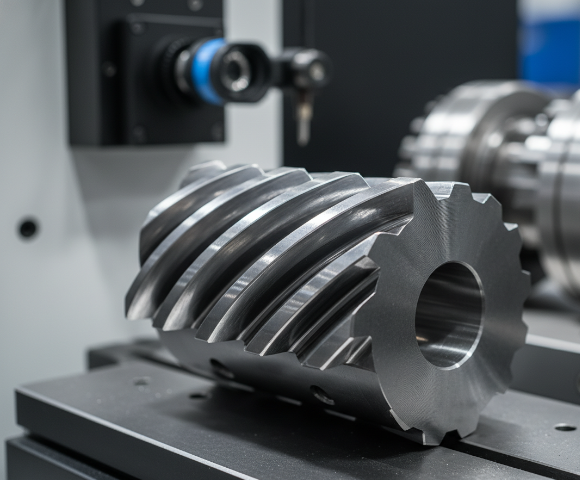
Advantages of CNC Machining 1.7131
| Avantage | Description détaillée | Avantage clé |
| Dual Property Performance | Combines extreme surface hardness with a tough, shock-absorbing core. | Prevents tooth breakage in gears under sudden impact loads. |
| Résistance à l'usure supérieure | The carburized surface resists abrasion and sliding wear. | Extends the lifespan of camshafts, bushings, and sliding rails. |
| Bonne usinabilité | Machines easily in the annealed condition before heat treatment. | Allows for complex geometries to be cut cost-effectively. |
| High Surface Pressure | Can withstand high contact pressure without pitting. | Essential for heavy-duty transmission components. |
| Rentabilité | Cheaper than high-alloy tool steels while offering similar surface hardness. | Economical for mass production of automotive parts. |
Paramètres techniques et normes de matériaux
We process this grade according to European standards:
| Catégorie de qualité | Spécification | Caractéristiques et utilisations idéales |
| DIN 1.7131 | 16MnCr5 | Characteristics: The classic European carburizing steel. Good hardenability and machinability. Surface hardness reaches 60 HRC after treatment. Uses: Transmission gears, ring gears, pinions, camshafts, piston pins. |
| EN 10084 | 16MnCr5 | Characteristics: The modern EN standard. Chemically identical. Often supplied in "Annealed to Ferrite/Pearlite" (+FP) condition for best machining. Uses: Automotive powertrain components, heavy machinery bushings. |
CNC Machining Guidelines for 16MnCr5
- Surépaisseur de rectification: We always leave 0.2mm - 0.3mm of stock on critical features during the initial CNC stage. This allows us to grind away any distortion caused by the carburizing heat cycle.
- Case Depth: You must specify the required "Effective Case Depth" (e.g., 0.8mm - 1.2mm). We control the carburizing time to achieve this specific hard layer thickness.
- Finition de surface: For gears and bearings, we aim for Ra 0.4 or better after grinding to reduce friction.
- Filetage: We recommend masking threads during carburizing to prevent them from becoming brittle and snapping during assembly.
Scénarios d'application
- Automotive Transmission: Gearbox gears, synchronizer rings, shift forks.
- Machines lourdes: Excavator pins, rock drill components, crane wheels.
- Sports mécaniques: Camshafts, valve lifters, racing driveline parts.
- Industriel: Mold guide pillars, bushings, collets.
Tableau des propriétés physiques
Comparison: Surface vs. Core Properties (After Carburizing):
| Propriété | Surface (Case) | Core | Unité |
| Dureté | 58 - 62 HRC | 30 - 45 HRC | Rockwell C |
| Résistance à la traction | - | 800 - 1100 | MPa |
| Limite d'élasticité | - | 600 - 850 | MPa |
| Résistance à l'usure | Excellente | Modérée | - |
| Ductility/Toughness | Faible (Fragile) | Élevé | - |
| Densité | 7.85 | 7.85 | g/cm³ |

Demandez votre DFM et devis – Téléchargez vos dessins
ㆍRemplissez vos exigences et téléchargez vos fichiers 2D et 3D, nous vous fournirons votre devis de projet et DFM sous 24 heures.ㆍTypes de fichiers : STEP, STP, IGES, IGS, SLDPRT, 3DM, SAT, X_T, DWG, DXF, STL, PDF, ZIP et plus. Taille du fichier : < 128 Mo Taille de la pièce : < 1500*1500*1500 mm
ㆍConfidentialité : Nous respectons votre vie privée. Vous trouverez ici un exemple d' accord de non-divulgation. En soumettant ce formulaire, vous acceptez nos conditions générales et notre politique de confidentialité.
ㆍConfidentialité : Nous respectons votre vie privée. Vous trouverez ici un exemple d' accord de non-divulgation. En soumettant ce formulaire, vous acceptez nos conditions générales et notre politique de confidentialité.
